


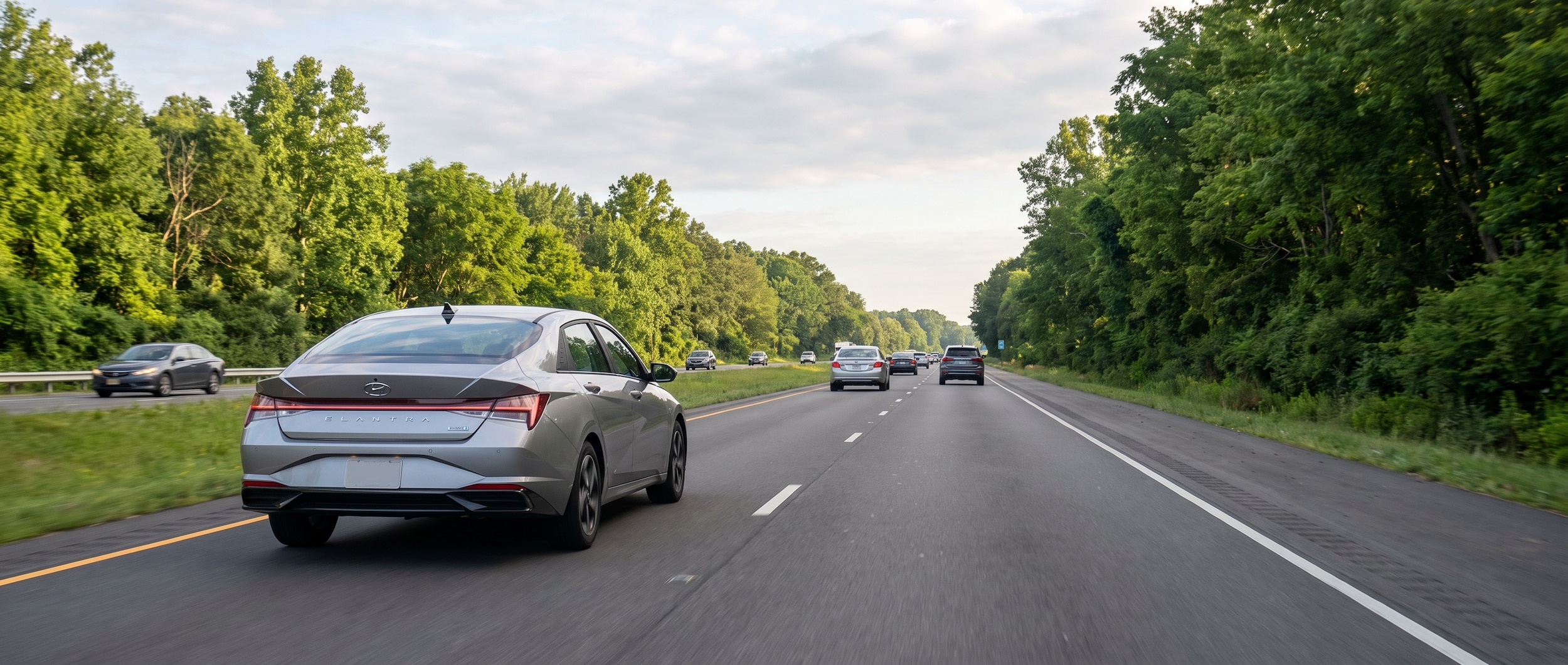
If you're driving into Birmingham from Chelsea every day, the 2026 Hyundai Elantra Hybrid is the pick that makes the most sense for that corridor. The reason matters more than it sounds. The roughly 18-mile run up US-280 is almost entirely stop-and-go once you clear the Shelby County line, and that's precisely where a hybrid earns back its efficiency advantage through regenerative braking. Not all commutes are created equal. A steady 55-mph highway cruise doesn't favor a hybrid the same way a crawl through the Hoover corridor does, and ALDOT has been widening US-280 specifically because this stretch is documented as one of Alabama's busiest non-interstate roadways.
We ranked four Hyundai models by how well they match the real conditions on US-280. Spec-sheet numbers alone don't tell that story.
The Rankings at a Glance
| Rank | Pick | Best For | Standout Spec |
|---|---|---|---|
| 1 | Elantra Hybrid | Pure stop-and-go efficiency | EPA-est. 51 city / 54 combined MPG |
| 2 | Sonata Hybrid | Roomier sedan with strong efficiency | EPA-est. 47 city / 51 combined MPG (Blue) |
| 3 | Tucson Hybrid | SUV utility with flat, consistent efficiency | EPA-est. 38 city / 38 combined MPG |
| 4 | Elantra (gas) | Lowest entry point, still respectable | EPA-est. 31 city / 35 combined MPG |
Rank 1: Elantra Hybrid, Built for Exactly This Kind of Traffic
The EPA rates the 2026 Elantra Hybrid Blue at 51 MPG in the city and 54 MPG combined, and those city numbers reflect your US-280 reality far better than the highway figure does, because the corridor rewards a hybrid right where it's strongest. Regenerative braking is the mechanism behind that. Every time you ease off the gas for a red light or a merge backup on US-280, the hybrid system converts that deceleration into electricity rather than heat. Short commutes with frequent braking are a hybrid's natural habitat.
There's a real tradeoff. The Elantra Hybrid is a compact car with an 11-gallon fuel tank, and there's no all-wheel-drive option, which is worth knowing before Birmingham's occasional winter ice on the Red Mountain Expressway approaches. But for a single driver or a two-person carpool making that 18-mile run daily, the EPA-estimated 630-plus-mile tank range on the Blue trim can stretch refueling to roughly once every two to three weeks. That's a genuine quality-of-life difference.
Fixating on the highway MPG number is easy when you're shopping sedans, but on a congested corridor like US-280 the city figure is what actually predicts your real tank behavior, at least on this corridor. Fifty-one city MPG is a material gap from anything in the mid-30s.
Rank 2: Sonata Hybrid, More Cabin, Still Serious Efficiency
The Sonata Hybrid suits the commuter who wants a genuinely roomy sedan without giving up meaningful efficiency, and it delivers on both counts, with the Blue trim earning an EPA estimate of 47 MPG city and 51 MPG combined. The SEL and Limited trims come in at 44 city and 47 combined. Both stay strong for a midsize sedan with standard driver-assistance tech across the lineup.
The cabin is noticeably larger than the Elantra's. If you're carrying work gear, need rear-seat space for a passenger, or simply want to arrive without feeling folded in half, the Sonata Hybrid does that. The 192-horsepower hybrid powertrain runs through a conventional six-speed automatic rather than a CVT, which feels more natural during the rapid acceleration-and-braking rhythm of US-280 peak hours.
The tradeoff here is simple. The Sonata Hybrid costs more to get into than the Elantra Hybrid, and you'll need to decide whether the added cabin space actually serves your daily use case. If it's just you and a laptop bag, the Elantra Hybrid is the sharper efficiency buy.
Rank 3: Tucson Hybrid, When You Need the SUV Body
The Tucson Hybrid is the answer for the Chelsea commuter who also needs weekend cargo capacity, a higher seating position, or all-wheel-drive availability, and it holds its efficiency where a gas SUV would fade, with the EPA estimating 38 MPG city, 38 highway, and 38 combined for the base front-wheel-drive trim. A flat, uniform number like that is a genuine feature. The Tucson Hybrid's system stays consistent across driving conditions, so the US-280 stop-and-go doesn't punish you the way it would in a conventional gas SUV.
AWD availability matters for Birmingham winters. Freezing rain on the elevated approaches downtown or early-morning ice in Shelby County is a seasonal reality the AWD trims handle more confidently than a front-wheel-drive sedan.
You do pay in efficiency, though, since EPA estimates drop to 35 MPG combined on AWD trims. That number stays solid for a compact SUV, just not the same as the FWD figure.
| Pros | Cons | |
|---|---|---|
| Tucson Hybrid | Consistent 38 MPG city/hwy/combined (FWD); SUV cargo and seating height; AWD available | Heavier than sedans; AWD trims drop to 35 MPG combined |
| Elantra Hybrid | Highest city MPG in the lineup (51 EPA est.); lowest running costs; compact to park downtown | No AWD; smaller cabin; 11-gallon tank |
Before you choose a trim: Every hybrid in this lineup sells multiple trim levels on the same powertrain, and those trims return different EPA figures. The Sonata Hybrid Blue earns 51 MPG combined, while the SEL and Limited earn 47. The Elantra Hybrid Blue earns 54 combined, and the SEL Sport and Limited earn 50. Across 12,000-plus annual miles, that difference adds up at the pump. So check the trim-level figure for the exact configuration you're considering, not just the model name.
Rank 4: Elantra (Gas), The Straightforward Starting Point
The 2026 Elantra in its standard gas configuration isn't a compromise so much as a clear-eyed choice for the commuter who wants a fuel-efficient, well-equipped car without the hybrid step up, and the EPA estimates 31 MPG city and 35 MPG combined for the SE trim. The 147-horsepower 2.0-liter four-cylinder is uncomplicated, and the lighter build makes it easy to navigate parking downtown or in Southside.
There's a real tradeoff, and we'll say it plainly. The stop-and-go driving that recaptures energy for a hybrid just burns gasoline in a conventional powertrain. On a short, congested commute like US-280, that shows up at the pump more noticeably than it would on a long highway run. If your priority is the lowest upfront cost in the Hyundai lineup, the gas Elantra is the straightforward starting point. If you're keeping the car three or more years and driving it five days a week, run the hybrid math before you decide.
By the Hallmark Hyundai Birmingham Team | August 2026
Categories:
Social


