


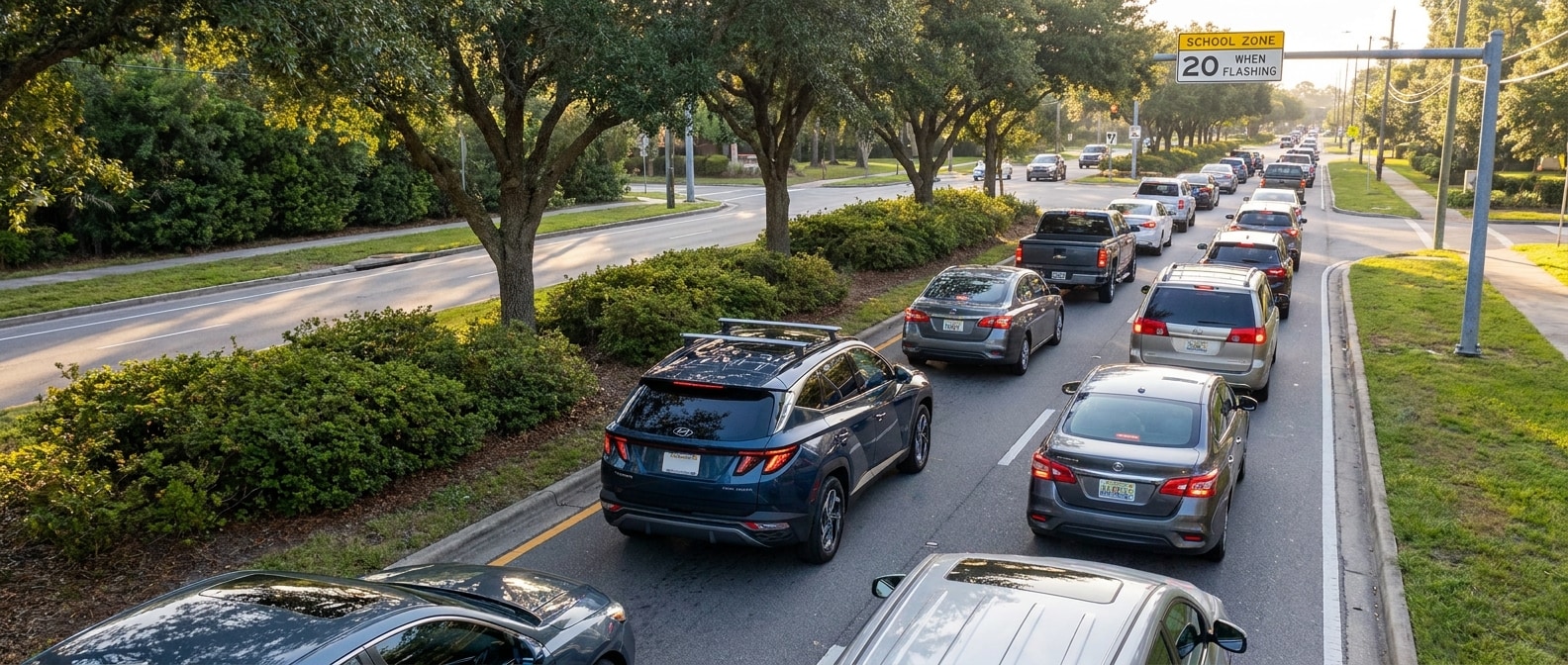
Right about now, Birmingham's roads shift. The summer lull on US-280 disappears by the second week of August, and the morning crawl through Hoover toward the I-20 interchange comes back like clockwork. Car pool lines stack up. Side streets around Vestavia Hills and Mountain Brook fill in ways they just don't in July. For plenty of families and commuters across Jefferson and Shelby County, that rhythm means burning noticeably more fuel every week, whether they're thinking about it or not.
The part worth knowing runs against instinct. The stop-and-go grind that makes the school-year commute so frustrating is precisely the condition where the 2026 Hyundai Tucson Hybrid runs most efficiently. The EPA rates the base Blue SE trim at 38 mpg city, 38 mpg highway, and 38 mpg combined. That flat rating across city and highway isn't a rounding accident. It reflects what the hybrid powertrain actually does with all those forced slow-downs, capturing braking energy and feeding it back into the battery through a system Hyundai calls adjustable regenerative braking. A gas engine just wastes that energy as heat. The Tucson Hybrid banks it.
Every 2026 Tucson Hybrid trim comes with HTRAC all-wheel drive standard and adjustable regenerative braking via steering-wheel paddles, which means Birmingham's school-year stop-and-go actively recharges the battery rather than draining your tank.
Why Does the Tucson Hybrid Fit Birmingham's School-Year Roads?
The Tucson Hybrid fits because Birmingham's August and September commute is built almost entirely from the accelerate-brake-wait cycle a hybrid recovers energy from, though the payoff shows up in city crawl far more than on a clear highway run. Consider what happens on US-280 between Greystone and the Red Mountain Expressway on a Tuesday morning at 7:45 a.m. You're not cruising. You're accelerating to 35 mph, lifting off, braking, waiting, accelerating again. That cycle repeats for miles.
| Birmingham Driving Condition | Tucson Hybrid Feature | Why It Fits |
|---|---|---|
| US-280 stop-and-go school traffic | Regenerative braking (4 adjustable levels) | Captures braking energy and returns it to the battery instead of losing it as heat |
| Red Mountain Expressway descent into downtown | Regen paddle control on downhill grades (maximize recovery) | Drivers can dial up regen intensity to capture energy on the slope |
| Malfunction Junction merge delays (I-20/I-59/I-65) | Smart Cruise Control with Stop and Go | Maintains following distance and manages throttle automatically in slow merge traffic |
| Back-road school-zone surface variation | HTRAC AWD standard on every trim | Distributes torque between front and rear axles without driver input |
| Afternoon carpool line idling | Hybrid electric motor handles low-speed creep | Gas engine can shut off at low speeds, cutting fuel use during the slow crawl |
| Birmingham summer heat through September | 12.3-inch touchscreen with dual-zone climate | Cabin comfort managed without adding significant engine load at low speeds |
A gas-only Tucson AWD earns an EPA-estimated 24 mpg city. That same routine on US-280 costs you real fuel, since nothing's in place to recover anything from the braking. The Tucson Hybrid's powertrain pairs a 1.6-liter turbocharged four-cylinder with a 47.7 kW electric motor for a combined system output of 231 horsepower and 271 lb-ft of torque, all running through a six-speed automatic. So it's more capable than the gas model and more efficient in the exact conditions Birmingham's school calendar creates.
Stop-and-Go Is Where the Hybrid Earns Its Advantage
The hybrid earns its biggest advantage in stop-and-go driving, and Birmingham's school-year commute is packed with exactly that kind of traffic, even though fuel-economy intuition usually points toward the open highway instead. Slow urban cycling constantly feeds the battery. Cruising gives the system far less to work with.
Highway driving at a steady 65 mph gives the gas engine almost nothing to recover, so the regenerative braking system stays mostly quiet. The city and highway EPA ratings still come out equal at 38 mpg on the Blue SE trim because urban cycling banks enough energy to match open-road cruising, and higher trims with added equipment weight land at an EPA-estimated 36 combined.
Browse our current Tucson Hybrid inventory and you can line up the trims side by side. The Blue SE and SEL trims make the strongest efficiency case if fuel economy is your main reason for the Tucson Hybrid. The SEL adds heated front seats, a power driver's seat, and an available hands-free smart liftgate, if that matters to you. Worth knowing before you configure.
The steering-wheel-mounted paddle shifters in every Tucson Hybrid control regenerative braking intensity across four levels. In school-zone traffic, you can run a higher regen setting and let the car slow itself when you lift off the throttle, recovering more energy and cutting how often you reach for the brake pedal. Feels like a small thing until you're doing it 40 times between home and the office, and your weekly fuel trip gets noticeably lighter.
Local detail: The Red Mountain Expressway descent from the Southside neighborhoods toward downtown gives Tucson Hybrid drivers a real regen opportunity on a road plenty of Birmingham commuters drive daily. A higher paddle setting on that downhill stretch lets the car recover energy instead of simply riding the brakes.
Next step: If you're planning around the start of the school year, now's a good time to test the Tucson Hybrid's regen paddles in real Birmingham traffic before the September crunch fully sets in. See our See Current Tucson Hybrid Offers to explore Hyundai's latest incentives.
The Honest Tradeoff You Should Know Before You Decide
The main tradeoff here is weight against efficiency, and we'd rather lay it out now than have you work it out in the parking lot, because all-wheel drive helps you in bad weather while shaving a little off the fuel numbers at the same time. HTRAC all-wheel drive is standard on every 2026 Tucson Hybrid trim, which is genuinely useful on Birmingham's occasionally icy January roads and on rain-slicked surfaces through our long storm season. But AWD adds weight, and heavier vehicles recover slightly less energy than lighter ones. Weight is part of why the higher-trim Tucson Hybrid versions rate 36 combined rather than 38.
None of that is a deal-breaker for most Birmingham buyers. It becomes one, though, if you walk in expecting 38 mpg from a fully loaded Limited and you've built your fuel budget around that number. The 38 mpg EPA estimate is real, but it belongs to the Blue SE trim specifically. The SEL and above earn an EPA-estimated 36 combined. Both beat the gas Tucson's 26 combined by a meaningful margin, and both recapture energy from the school-year crawl in a way the gas model can't.
Families who regularly haul gear, run after-school activities, and need the cargo flexibility of a 38.7 cubic-foot trunk will find the Tucson Hybrid's cabin practical without feeling like a compromise. If three rows are on your list, the Hyundai Palisade Hybrid is worth a separate conversation. For five-passenger, right-sized school-year efficiency, the Tucson Hybrid is where we'd start, at least for most families.
The Tucson Hybrid doesn't plug in. The standard hybrid system recharges entirely through the gas engine and regenerative braking while you drive. No home charger required, no range anxiety, no new habits. All of that matters for families and commuters who want the fuel savings without changing their infrastructure. Consider it the straightforward path into hybrid ownership, and Birmingham's school-year traffic will do a lot of the efficiency work for you without any extra effort on your part.
The Hyundai Santa Fe Hybrid steps up in interior room if you find yourself stretched on cargo, though for most school-year routines in Jefferson and Shelby County, the Tucson Hybrid's dimensions are the right fit. Stop by 1424 5th Ave N and we'll walk you through both on the lot.
Categories:
Social


