


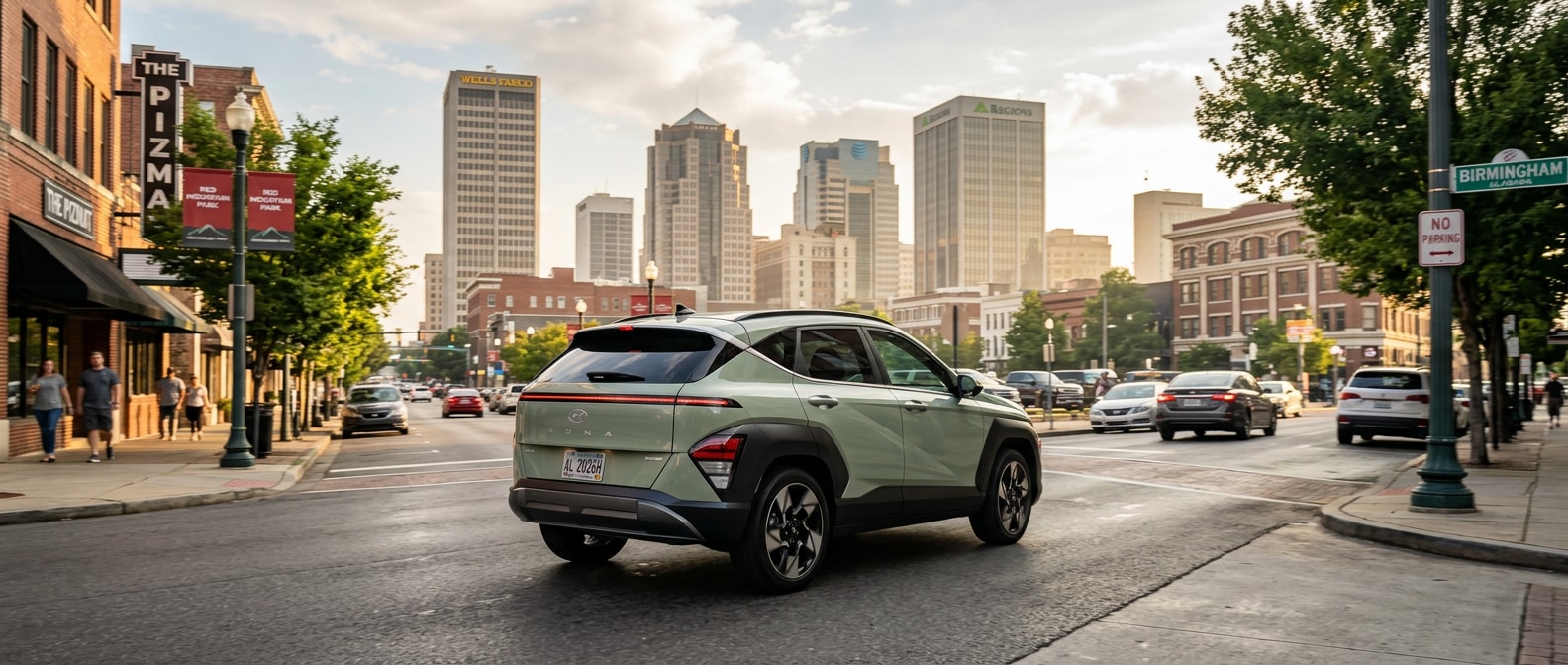
If you're cross-shopping these two right now, here's our team's bottom line. The 2026 Hyundai Kona wins on interior roominess and standard tech, while the Toyota Corolla Cross fights back with stronger long-term resale and an available hybrid that reaches an EPA-estimated 42 combined mpg. Which one fits Birmingham depends almost entirely on how many adults ride in your back seat and how hard you're going to push your fuel budget on I-65.
The short version
- The Kona gives rear passengers 38.2 inches of legroom; the Corolla Cross gives them 32.0 inches. That 6.2-inch gap is the single biggest difference spec sheets tend to bury.
- Both carry roughly the same cargo behind the seats, but the Kona expands a lot more when the rear row folds flat (63.7 cu ft vs roughly 46 cu ft for the Corolla Cross).
- The Corolla Cross base engine is a bit more powerful (169 hp vs 147 hp on the Kona base), and Toyota's available hybrid reaches an EPA-estimated 42 combined mpg. The Kona has no hybrid option.
- The Kona comes standard with a 12.3-inch touchscreen, wireless Apple CarPlay and Android Auto, and adaptive cruise with stop-and-go capability at base trim.
- If adults ride in your back seat regularly, the Kona is the easier call. If long-term resale value or the hybrid option is your priority, the Corolla Cross deserves a serious look.
What's the Real Difference Between These Two?
Both are subcompact crossovers in the same general price neighborhood, and that's the part shoppers usually get right on their own. Where they actually split is the back seat, the cargo math once you fold the second row, and how much standard tech lands at base trim, and those gaps run wider than a shared segment would suggest.
The rear seat is where these two part ways. On paper they look like twins. In the back seat, they feel nothing alike. Hyundai lists the 2026 Kona's rear legroom at 38.2 inches. Toyota puts the Corolla Cross at 32.0 inches. Six inches is the difference between a comfortable highway passenger and someone sitting with knees angled toward the front seatback. If you're driving adults regularly, that gap shows up on every commute, every road trip, and every grocery run with a full car.
Cargo is more nuanced than most comparisons let on. Behind the rear seats, both vehicles sit at approximately 25.5 cubic feet. Fold that rear row flat, though, and the Kona grows to 63.7 cubic feet while the Corolla Cross trails by a wide margin. Hyundai also builds in a dual-level cargo floor with underfloor storage, a practical detail for keeping a roadside kit or a bag of sports gear out of sight without eating into everyday cargo room.
On safety, the IIHS awarded the 2026 Kona its Top Safety Pick+ designation (ratings apply to the 2024-2026 Kona generation). NHTSA gives the 2026 Kona a four-star overall rating. The Corolla Cross comes standard with Toyota Safety Sense 3.0, a capable active-safety suite, though full NHTSA and IIHS results for the 2026 Corolla Cross model year aren't published yet.
| Category | 2026 Hyundai Kona | 2026 Toyota Corolla Cross |
|---|---|---|
| Base engine | 147 hp, 2.0L | 169 hp, 2.0L |
| Performance upgrade | 190 hp, 1.6T (upper trims) | None (gas) |
| EPA combined mpg (FWD base) | 31 mpg | 32 mpg |
| Hybrid option | Not available | 42 mpg combined (EPA est.) |
| Rear legroom | 38.2 in | 32.0 in |
| Cargo (seats up) | 25.5 cu ft | 25.5 cu ft |
| Cargo (seats folded) | 63.7 cu ft | ~46 cu ft |
| Standard screen | 12.3 in | 8.0 in (L trim) |
| Wireless CarPlay/Android Auto | Standard (all trims) | Varies by trim |
| Towing capacity | 1,500 lbs | 1,500 lbs |
| IIHS rating | Top Safety Pick+ | Not yet evaluated (2026) |
| NHTSA overall | 4 stars | Not yet rated (2026) |
The single deciding factor is simple. If adults ride in your back seat regularly, the Kona's 38.2 inches of rear legroom versus the Corolla Cross's 32.0 inches changes the daily experience in a way no amount of screen size or feature packaging can compensate for.
Does Fuel Economy Actually Matter More in Birmingham Stop-and-Go?
Yes, in Birmingham's stop-and-go it matters, though the size of the edge depends on which trim you line up, because the two gas base engines land within a single combined mpg of each other while the Corolla Cross Hybrid opens a real gap. Birmingham's commute isn't just miles. Think of the I-65 interchange stacking up near Hoover, the merge pressure where I-65 and I-20/59 converge downtown, and a cabin that soaks up Alabama August heat while you sit in it. Malfunction Junction is the local name for that downtown convergence. The EPA rates the 2026 Kona's base 2.0L FWD at 29 city and 34 highway, for 31 combined. The Corolla Cross FWD base checks in at 31 city and 33 highway, for 32 combined. On the combined number they're essentially tied. In stop-and-go specifically, the Kona's standard stop-start system shuts the engine down at red lights, which earns its keep on a signal-heavy downtown commute.
Where the Corolla Cross makes a stronger case is its available hybrid. Toyota rates the Corolla Cross Hybrid at an EPA-estimated 42 combined mpg. For anyone running a long daily route on Highway 280 or I-459 toward Hoover, that's a meaningful jump. The Kona doesn't offer a hybrid variant, so if fuel cost over a five-year ownership window is a real factor, this tradeoff is worth naming plainly.
The Kona's upper trims swap in a 1.6-liter turbocharged engine producing 190 hp. On the grades heading toward Vestavia Hills or the quicker merge ramps on I-20, that extra output is noticeable. The Corolla Cross offers no comparable performance step-up in its gas lineup, so the Kona gives you two upgrade paths (more power, or more standard tech at base), while the Corolla Cross gives you one meaningful one, the hybrid.
Browse our available Kona inventory to see current trim and drivetrain availability.
Interior Tech and What You Actually Get at Base Trim
At base trim the standard-equipment gap between these two is concrete, and it tilts toward the Kona on screens and wireless connectivity while the Corolla Cross claws back a point on rear-seat comfort. Our financing team can walk you through trim-level cost differences once you've settled on which direction fits.
So what do you actually get at base? The 2026 Kona gives you a 12.3-inch touchscreen across all trims, plus a 4.2-inch digital instrument display. Wireless Apple CarPlay and wireless Android Auto are standard from the base SE. Four USB ports come standard. The Corolla Cross L starts with an 8.0-inch screen, and wireless connectivity availability varies by trim. All of that matters if you're planning to live with a base trim for a few years.
One detail the Corolla Cross gets right is standard rear-seat HVAC vents. On an Alabama August afternoon with the back seat occupied, that's not a small thing. The Kona offers rear ventilation on equipped trims rather than uniformly at the base level, a genuine point in the Corolla Cross's favor for families who run the AC full blast all summer.
Both cabins are practical and clear about what they are. The Kona reads as tech-forward with its dual-display layout. The Corolla Cross is tidier in a traditional sense, though early reviewers noted the base L trim carries more hard plastic than expected in its cabin.
Team observation: The Kona's base 2.0L includes a standard stop-start system that cuts the engine when you're stationary at a red light and restarts it cleanly when you lift off the brake. It earns real fuel savings on Birmingham's signal-dense city streets. Worth knowing, stop-start is standard on the SE trim and isn't included on the SEL Sport, so if that detail matters to your decision, confirm the trim before you commit.
So Which One Should You Pick?
Which one you should pick comes down to who rides in the back and where your money pressure lands, and there are three buyer profiles worth walking through, one of which is probably yours.
Buy the Kona if you carry adults in the back seat with any regularity. The 38.2-inch rear legroom figure isn't marketing language; it's what your passengers will notice on the first drive to the airport. The standard 12.3-inch screen, wireless CarPlay, and adaptive cruise with stop-and-go also give you a stronger tech baseline at entry trim than the Corolla Cross L delivers. If you think you'll want more engine eventually, the 1.6T upper trims give you that path.
Choose the Corolla Cross if the hybrid's EPA-estimated 42 combined mpg is where your attention is focused, if your back-seat passengers are regularly children rather than adults (the 32-inch rear legroom reads very differently with a car seat than without), or if long-term resale trajectory is a priority. Toyota's hybrid option in this segment is real and it's strong. The Kona doesn't answer it.
One honest caveat on the Kona. The base 2.0L produces 147 hp. On steeper on-ramps or heavy-load merge situations, it's adequate but not spirited. The 1.6T trim resolves that. Or, if you want a step more interior space and a stronger standard engine in a similar Hyundai package, the Tucson is worth a conversation with our team.
Our read is this. For most Birmingham commuters who carry a full car and want the most standard tech without moving up in trim, the Kona is the stronger daily driver. The Corolla Cross Hybrid is a legitimate alternative. Both are good vehicles. It comes down to which tradeoff you're willing to make, and we're glad to help you work through it.
Frequently Asked Questions
Does the Kona have more cargo space than the Toyota Corolla Cross?
Behind the rear seats, both the 2026 Kona and the 2026 Corolla Cross offer approximately 25.5 cubic feet of cargo room. The meaningful difference opens when the rear seats fold. The Kona reaches 63.7 cubic feet of total space, while the Corolla Cross offers much less. The Kona also includes a dual-level cargo floor with underfloor storage, giving you a practical place to stow gear you'd rather keep out of sight without eating into everyday cargo room.
Is the Corolla Cross or the Kona a better fit for Birmingham's summer heat and stop-and-go commute?
For Birmingham's stop-and-go commute, the Kona's standard stop-start system cuts fuel waste at red lights, and the 12.3-inch wireless CarPlay screen makes the daily grind more manageable. The Corolla Cross counters with standard rear-seat HVAC vents (a real comfort upgrade for back-seat passengers on a 95-degree Alabama afternoon) and an available hybrid powertrain rated by Toyota at an EPA-estimated 42 combined mpg. If you're logging heavy city miles every day and fuel cost is the priority, the Corolla Cross Hybrid's efficiency is the one advantage the Kona can't match. FAQ:
Does the Kona have more cargo space than the Toyota Corolla Cross?
Behind the rear seats, both the 2026 Kona and the 2026 Corolla Cross offer approximately 25.5 cubic feet of cargo room. The meaningful difference opens when the rear seats fold. The Kona reaches 63.7 cubic feet of total space, while the Corolla Cross offers much less. The Kona also includes a dual-level cargo floor with underfloor storage, giving you a practical place to stow gear you'd rather keep out of sight without eating into everyday cargo room. It's a genuinely useful detail.
Is the Corolla Cross or the Kona a better fit for Birmingham's summer heat and stop-and-go commute?
For Birmingham's stop-and-go commute, the Kona's standard stop-start system cuts fuel waste at red lights, and the 12.3-inch wireless CarPlay screen makes the daily grind more manageable. The Corolla Cross counters with standard rear-seat HVAC vents (a real comfort upgrade for back-seat passengers on a 95-degree Alabama afternoon) and an available hybrid powertrain rated by Toyota at an EPA-estimated 42 combined mpg. If you're logging heavy city miles every day and fuel cost is the priority, the Corolla Cross Hybrid's efficiency is the one advantage the Kona can't match.
Categories:
Social


