


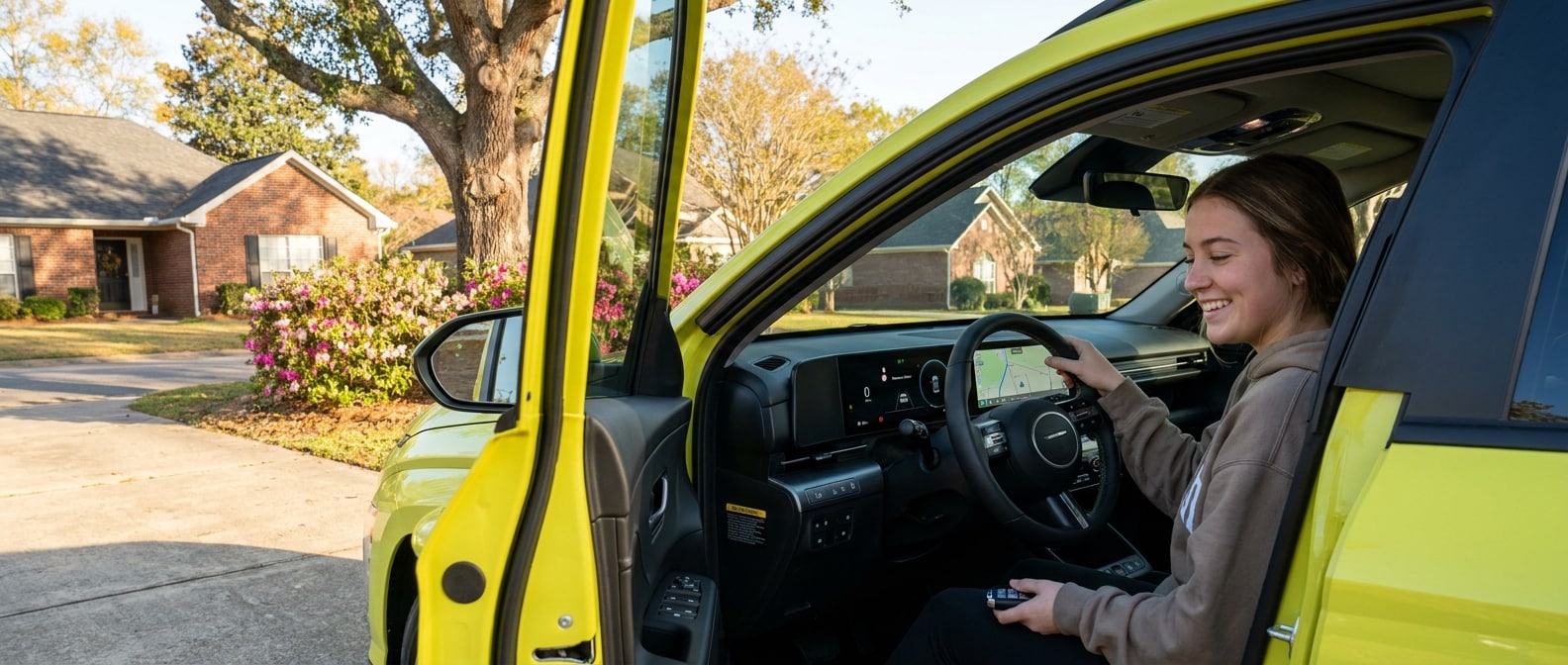
Mountain Brook doesn't run school buses, which is a documented fact about this community, and it means your teenager will need a car far sooner than parents in most other suburbs. You're also handing over keys on actual roads (US-280 through the Cahaba Heights corridor, the winding residential streets around Cherokee Bend Elementary, parking lots at Mountain Brook High) instead of a quiet country lane. The stakes are concrete.
The good news is Hyundai's 2026 lineup includes three models that fit this situation well, and every one of them ships with a standard safety technology suite that, once properly configured, gives a new driver meaningful protection. The procedure below walks you through picking the right model, then activating, personalizing, and verifying each safety setting before your teen takes the car solo for the first time.
The 2026 Hyundai Kona is the model we'd point most Mountain Brook families toward first, for reasons the steps below explain. But the 2026 Hyundai Venue and the 2026 Hyundai Elantra both have strong cases depending on your situation. We'll cover all three.
Every 2026 Hyundai in this guide ships with Hyundai SmartSense as standard equipment on the base trim (forward collision avoidance, lane keeping assist, blind-spot monitoring, and driver attention warning included from the factory, no upgrade required).
What You Need Before You Start
Before you head to the lot, run through the prep list below at the kitchen table, and give yourself real time with it, because getting the trim and the configuration right up front prevents two common mistakes. One is buying a trim that's missing the safety tech your teen needs. The other is skipping the in-car configuration session that makes the tech actually work.
| Prep Item | Why It Matters for a Teen Setup |
|---|---|
| Hyundai owner's manual (PDF or print) | SmartSense sensitivity settings are buried in the infotainment menus; the manual shows you where |
| Your teen's Alabama graduated license stage | Stage 1 (learner's permit) vs Stage 2 (provisional) affects which restrictions you'll mirror in the car's settings |
| A list of your teen's regular routes | US-280 and neighborhood streets have very different demands; you'll calibrate cruise control and alerts accordingly |
| Insurance agent contact | Adding a teen to your policy is handled outside the car, but confirming coverage before the first solo drive is non-negotiable |
| 30-45 minutes of uninterrupted time | Rushing the setup session is how settings get skipped |
The Three 2026 Models Worth Considering
The 2026 Hyundai Venue is Hyundai's smallest SUV. At 159 inches long, it is genuinely easy to maneuver and park, and the EPA rates it at 29 city / 33 highway MPG. There's an honest tradeoff worth knowing. The base SE trim carries forward collision avoidance, lane keeping assist, driver attention warning, and automatic high beams, but blind-spot monitoring doesn't arrive until the SEL trim. If you're buying a Venue for a teen, buy the SEL.
For the compact sedan option, look at the 2026 Hyundai Elantra. Hyundai SmartSense comes standard on every Elantra trim, which includes forward collision-avoidance assist with pedestrian detection, blind-spot collision warning, lane following assist, rear cross-traffic collision avoidance assist, and safe exit warning. The EPA rates the base SE at approximately 33 MPG combined. Sitting lower to the ground, it can feel less commanding to a new driver (something worth noting when you test drive).
Sitting in the middle is the 2026 Hyundai Kona, taller than the Elantra and more maneuverable than a larger SUV. The IIHS awarded it Top Safety Pick+ (the institute's highest designation) for 2026. NHTSA testing produced a four-star overall rating, with five stars in the side crash test. Standard Kona equipment on every trim includes forward collision-avoidance assist with pedestrian, cyclist, and junction-turning detection (that last piece matters on Mountain Brook's intersection-heavy surface streets). The base engine (147 hp, 2.0L four-cylinder) pairs with a CVT, and EPA combined is 31 MPG. There's also a 190-hp turbocharged option if you want stronger highway confidence, though for a teen driver we'd talk that through with you before recommending it.
Configuring the Safety Tech: The Step-by-Step Setup
This is the step that tends to get skipped, and it's the one that matters most, because the car ships with SmartSense active while every sensitivity level, alert threshold, and driver-assistance preference sits at a factory default that was never calibrated to a first-year driver. Don't skip it.
The factory settings work. They just aren't tuned for someone in their first year behind the wheel.
Step 1: Activate and verify Forward Collision-Avoidance Assist (FCA)
Press the Settings icon on the 12.3-inch touchscreen (Kona) or 10.25-inch display (Elantra/Venue). Navigate to Driver Assistance > Forward Collision-Avoidance Assist. Confirm it is switched ON. Set the sensitivity to High. On the Kona, confirm that Pedestrian and Cyclist Detection is also enabled (this is the specific sub-setting the IIHS evaluated when awarding the Kona its "Good" rating in vehicle-to-pedestrian front crash prevention).
Step 2: Enable Lane Keeping Assist and Lane Following Assist
Under Driver Assistance, find Lane Keeping Assist (LKA) and, on trims that have it, Lane Following Assist (LFA). Turn both on. LKA actively corrects drift, while LFA provides subtle steering guidance to keep the car centered. On the Elantra, both are standard on every trim. On the Kona, they're standard across the lineup. The Hyundai Elantra carries these on its base SE trim, which matters if you're budget-conscious.
Step 3: Turn on Driver Attention Warning (DAW)
DAW monitors steering inputs and alerts the driver if patterns suggest fatigue or distraction. For a teen, this is one of the most practically useful features in the suite. Find it under Driver Assistance > Driver Attention Warning. Set alert sensitivity to Normal or High. The system will prompt your teen to take a break if driving patterns shift, a genuinely useful backstop on a longer drive to Tuscaloosa or Huntsville.
Step 4: Confirm Blind-Spot Collision Warning is active (and, on the Kona, Rear Cross-Traffic Collision Avoidance Assist)
US-280 lane changes are demanding for any driver, let alone a new one. Under Driver Assistance, confirm Blind-Spot Collision Warning is ON. On the Kona, also confirm Rear Cross-Traffic Collision Avoidance Assist is active (it will apply the brakes if it detects a moving vehicle while your teen is backing out of a parking space).
Step 5: Set up Safe Exit Warning
On both the Kona and the Elantra, Safe Exit Warning alerts any occupant opening a door if a passing vehicle or cyclist is approaching. Mountain Brook's streets mix cyclists and cars constantly, especially near Jemison Trail access points. Find Safe Exit Warning in Driver Assistance and confirm it's enabled.
Step 6: Set a Speed Alert (Kona and Elantra)
In Vehicle Settings, find Speed Alert. Set a threshold that matches the posted limits your teen will most frequently encounter (35 mph for neighborhood routes, 55 mph for US-280 if you want a buffer). This is separate from the cruise control; it's an audible alert that fires when the car exceeds the limit you set. It doesn't govern speed. It alerts, which is appropriate for a graduated driver.
Step 7: Walk your teen through every alert, together, with the car in park
Don't assume they'll figure it out under pressure. Spend ten minutes in the driveway triggering the alerts on purpose. Approach a wall slowly to demonstrate FCA, and sit next to a curb while someone walks behind to show cross-traffic. The technology is only as effective as the driver who understands what it's telling them.
Tip box: The step most parents get wrong They turn on SmartSense and assume the job is done. The factory sensitivity setting for Forward Collision-Avoidance Assist is Medium on most trims. For a brand-new driver, change it to High. At High sensitivity, the system begins issuing warnings at greater distances, giving your teen more reaction time. It's a 15-second menu change that makes a material difference.
Print-and-Go Checklist: Before the First Solo Drive
Run through the list below before you hand over the keys, and check each item off as you confirm it, so nothing gets missed in the handoff from the driveway to that first solo drive on real Mountain Brook roads.
- [ ] FCA confirmed ON, sensitivity set to High
- [ ] Pedestrian and Cyclist Detection enabled (Kona) or FCA with Ped Detection confirmed (Elantra)
- [ ] Lane Keeping Assist ON
- [ ] Lane Following Assist ON (where equipped)
- [ ] Driver Attention Warning ON, sensitivity Normal or High
- [ ] Blind-Spot Collision Warning ON and confirmed with a lane-change walkthrough
- [ ] Rear Cross-Traffic Collision Avoidance Assist ON
- [ ] Safe Exit Warning ON
- [ ] Speed Alert threshold set for your teen's primary driving routes
- [ ] Teen has walked through every alert with you in the driveway
- [ ] Insurance coverage confirmed active with agent before first solo drive
- [ ] Emergency contact saved in the car's Bluetooth-connected phone
- [ ] Wireless Apple CarPlay or Android Auto connected (keeps the phone put away and navigation on screen)
The Honest Tradeoff You Should Know
We'll be straight with you here, because a small, well-equipped Hyundai is a smart choice for a Mountain Brook teen, though it isn't a consequence-free one, and the reason comes down to power on the highway. The Venue's 1.6L engine produces 121 horsepower. On US-280 at highway speeds, merging requires your teen to plan ahead. The engine has plenty for town driving, but it doesn't have on-ramp urgency. For a community where US-280 access is a daily reality, we'd suggest your teen practice merging on 280 with you in the passenger seat multiple times before the first solo highway trip, no matter which of these three models you choose.
The Kona's optional 190-hp turbo feels meaningfully more confident at highway speeds.
Whether that additional confidence is appropriate for a brand-new driver is a conversation worth having at home first, not one we'll make for you.
A Quick Recap for the Busy Parent
You've got three solid options for your Mountain Brook teen in the 2026 Hyundai lineup, and each earns its place a little differently. The Venue is the most maneuverable, the Elantra gives you the strongest combined fuel efficiency alongside a full standard SmartSense suite, and the Kona brings IIHS Top Safety Pick+ credentials with the most comprehensive standard safety tech in this group. None of them require you to upgrade from the base trim to get meaningful driver-assistance features.
How long does the setup take? About 45 minutes, and it's worth every one of them. Alabama's teen driver safety record is serious (the Alabama Department of Public Health has documented the state's elevated position in teen driver fatalities nationally), and the biggest variable in your teen's first year of driving isn't the car itself. What matters is whether the safety systems in that car are actually turned on and configured correctly.
We're at 1424 5th Ave N in Birmingham. If you'd like to walk through the SmartSense setup on a car you're considering, our team is glad to do that with you and your teen in person.
Frequently Asked Questions
Which 2026 Hyundai model is safest for a teen driver near Mountain Brook?
The 2026 Hyundai Kona earned IIHS Top Safety Pick+ (the institute's highest designation) for 2026, with a "Good" rating in vehicle-to-pedestrian front crash prevention and a five-star NHTSA side crash result. It also ships with the most comprehensive standard SmartSense package in this group, including junction-turning detection that's specifically useful on Mountain Brook's intersection-heavy streets. The Elantra is a close second and carries a full SmartSense suite on every trim.
Does the 2026 Hyundai Venue have blind-spot monitoring as standard?
No. On the 2026 Venue, blind-spot collision warning and rear cross-traffic alert come standard on the SEL trim, not the base SE. If you're buying a Venue for a teen driver, our team's recommendation is to choose the SEL so your teen has those lane-change and backup alerts from day one. The SE does include forward collision avoidance, lane keeping assist, driver attention warning, and high-beam assist.
Why is the setup procedure so important?
The factory default sensitivity settings on SmartSense are set to Medium, not High. For a brand-new driver, raising FCA sensitivity to High gives your teen more reaction time by initiating warnings at greater distances. Also, walking your teen through each alert in the driveway ensures they understand what the system is telling them when it activates on the road. By the Hallmark Hyundai Birmingham Team | August 2026
Categories:
Social


