

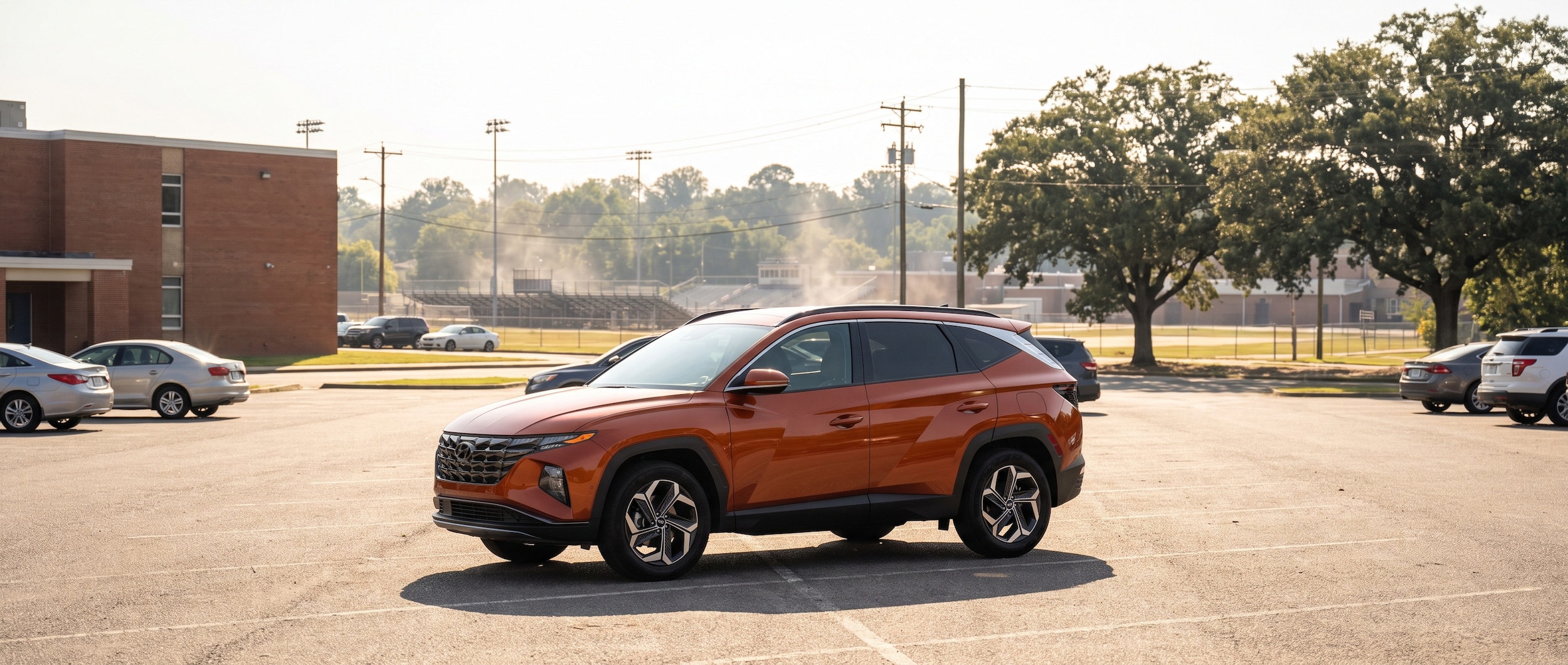
School starts this week for most of Jefferson and Shelby County, and your Hyundai has just pushed through the roughest stretch on Alabama's calendar. August in Birmingham means daily highs near 95 degrees Fahrenheit and heat index readings that the National Weather Service has tagged at up to 109 degrees Fahrenheit this month. That heat makes the commute miserable, and it also quietly chews on your battery, tires, and fluids in ways that often surface as a breakdown in late September, right when carpool schedules are running at full load.
The honest tradeoff is that catching these issues now takes time you probably don't have in the first week of school. Some of the damage a Birmingham summer builds up stays invisible until a system actually fails. Our service team at Hallmark Hyundai Birmingham would rather help you find it before it strands you on the way to drop-off than after.
The Hyundai Tucson and every other model in our lineup are built with southern driving in mind. No vehicle maintains itself, though. Here's the checklist we'd hand you right now, before the school-year miles start stacking up.
What Goes on the Back-to-School Service Checklist?
Run through all eight items before the first full week of school, and you'll want them in this order because they start with what Birmingham's summer heat damages most and move toward what the school year's new mileage patterns will stress hardest. Each one earns its spot for a reason we can point to. Nothing here is filler. Work them top to bottom.
- Battery load test. Have the battery tested with a load tester, not just a voltage check. Heat speeds up the evaporation of battery fluid and degrades internal components, and the damage often stays hidden until a cold morning in October reveals it.
- Coolant level and condition. Check the overflow reservoir when the engine is cold. Discolored, brownish fluid signals degraded coolant that's no longer managing heat the way it should.
- Tire pressure (cold, before driving). Tire pressure rises roughly 1 PSI for every 10 degrees Fahrenheit of temperature increase, per NHTSA guidance. A Birmingham afternoon can push already-borderline tires into overinflated territory while the TPMS light stays dark.
- Tire tread and sidewall inspection. Run your hand along the sidewalls and look for hairline cracking (called weather checking). Black asphalt in direct Alabama sun reaches surface temperatures of 130 to 160 degrees Fahrenheit even when the air reads 90 degrees Fahrenheit. Sidewall rubber breaks down faster at those temperatures.
- Engine air filter. A clogged filter restricts airflow and nudges fuel economy in the wrong direction. If you can't remember the last replacement, have it inspected.
- Cabin air filter. Hyundai recommends inspecting the cabin air filter at every 7,500-mile service interval. Birmingham's pollen season runs deep into August, and a saturated filter recirculates that air right back into the cabin.
- Oil and filter. Most Hyundai models call for full synthetic oil changes every 7,500 miles under normal conditions. Stop-and-go school-year traffic and short carpool trips can qualify as severe use, which moves that interval to 5,000 miles. Your owner's manual defines which conditions apply.
- Wiper blades. Birmingham sees roughly 17 rainy days in August alone. Blades that smear or chatter in a late-afternoon thunderstorm are a genuine safety gap you'll want addressed.
Why These Items Matter Most Right Now
Your battery took a hit all summer and doesn't know it yet
Heat is the number one enemy of battery life, and it never bothers to announce itself with a warning light. High temperatures speed up the chemical reactions inside the battery and cause internal fluid to evaporate faster, wearing down capacity over time. Here's the pattern our service team watches for. The visible symptom (a slow crank, a no-start) shows up weeks or months after the damage happened, usually triggered by the first cooler morning of fall. A battery that's 3 to 5 years old and made it through a Birmingham August is worth testing before school-morning pressure turns a slow start into a real emergency.
A load test measures the battery's actual cold-cranking capacity, giving you a real number instead of a guess about whether it's currently holding a voltage.
The Hyundai Palisade carries heavier electrical loads for its three-row feature set, which puts more demand on the battery than a smaller sedan would. Worth a thought before the full-occupancy carpool season begins.
Schedule Your Back-to-School Service Appointment
Tires and heat: the physics are working against you right now
NHTSA reports that underinflation is the leading cause of tire failure and that tire-related crashes peak between May and October, and both facts trace straight back to heat. Birmingham's daily temperature swing (from the low 70s overnight to the upper 90s by afternoon) causes the air pressure inside your tires to fluctuate with every cycle. Overinflated tires from a hot afternoon shrink the contact patch and affect handling. Underinflated tires build heat from flexing against hot pavement, which weakens the tire's structure from the inside.
Check pressure cold, before the car has moved that day, and compare it to the placard on the driver's door jamb rather than the number molded into the sidewall. That figure is the maximum the tire can hold, not the right pressure for your vehicle.
The Hyundai Elantra comes standard with TPMS on every trim, but NHTSA's TPMS warning triggers at 25% below placard pressure. By that point you're already in the damage zone. A gauge takes 90 seconds and gives you an accurate number.
Cabin air quality: the filter your family is breathing through
Birmingham's pollen season doesn't clear out neatly at the end of summer. A cabin air filter last replaced in spring may have collected months of pollen, road dust, and particulate. Hyundai's normal schedule calls for inspection at every 7,500-mile mark. A clogged filter makes the HVAC system work harder and pushes lower-quality air into the cabin. If kids with allergies are riding to school, that's a practical daily problem worth solving.
The Tucson Hybrid and other models with more sophisticated climate systems rely on clean airflow to hold a steady cabin temperature, which matters for comfort and for long-term system health.
Item / Why-It-Matters Table
| Checklist Item | Why It Matters for Back-to-School |
|---|---|
| Battery load test | Summer heat degrades capacity silently; school mornings reveal it |
| Coolant level and condition | Stop-and-go carpool traffic stresses the cooling system daily |
| Tire pressure (cold check) | Pressure swings with Birmingham's 20-plus degree daily temp range |
| Tire tread and sidewalls | Heat cracking accelerates blowout risk on busy school routes |
| Engine air filter | Restricted airflow hurts fuel economy on short carpool loops |
| Cabin air filter | Late-summer pollen accumulates and recirculates into the cabin |
| Oil and filter | Short trips and school pickup lines often qualify as severe use |
| Wiper blades | Birmingham's August rain average makes clean wipers a safety item |
Print-and-Go Recap Before School Starts
Take this to your service appointment or run through it yourself before Monday. Eight items, in order:
- Battery load test. Especially if the battery is 3 years or older.
- Coolant level. Check cold; look for discoloration.
- Tire pressure. Cold reading, matched to the door jamb placard.
- Tire tread and sidewalls. Look for weather checking and uneven wear.
- Engine air filter. Inspect; replace if it's been more than 15,000 miles or looks dark.
- Cabin air filter. Replace at or before the 7,500-mile inspection interval, sooner if pollen is a concern.
- Oil and filter. Confirm which interval applies (normal or severe) for your model and mileage.
- Wiper blades. Replace if they smear or chatter on a wet windshield.
One note worth flagging. Hyundai ended the Complimentary Maintenance program for 2026 model-year vehicles in March 2025. If you purchased a model year 2020 through 2025 vehicle that included the program, confirm with our service advisors which items remain covered. For 2026 models, service scheduling stands on its own from the start.
Our team can run the full list in a single visit. Bring the checklist, and we'll tell you exactly where your vehicle stands before the Hyundai Santa Fe Hybrid, Palisade, Tucson, or any other model in your driveway puts another thousand school-year miles on the odometer.
Frequently Asked Questions
Does a Hyundai hybrid need a different back-to-school checklist?
Mostly the same items apply, with one addition. Models like the Hyundai Santa Fe Hybrid, Tucson Hybrid, and Palisade Hybrid all have a high-voltage battery system with its own thermal management alongside the conventional 12-volt battery. Both should be checked. The conventional battery still takes heat stress just like any gas-only vehicle, and the hybrid cooling circuit warrants a look if the A/C has been working hard all summer. Everything else on the list above applies identically: oil, tires, filters, coolant, and wipers. Your service advisor can confirm whether your hybrid model has any additional mileage-based items based on where it currently sits on the schedule.
How do I know whether my driving counts as normal or severe for the Hyundai maintenance schedule?
Hyundai defines severe-use conditions as frequent short trips under five miles, extended idling, stop-and-go traffic, or driving in extreme heat. School-year carpooling in Birmingham qualifies on at least two of those counts for most families. Short neighborhood drop-off loops and idle time in school pickup lines both fit the severe-use definition. That moves your recommended oil change interval from 7,500 miles to 5,000 miles. Check the owner's manual for the full criteria, and ask our service team which schedule fits your actual driving pattern.


