


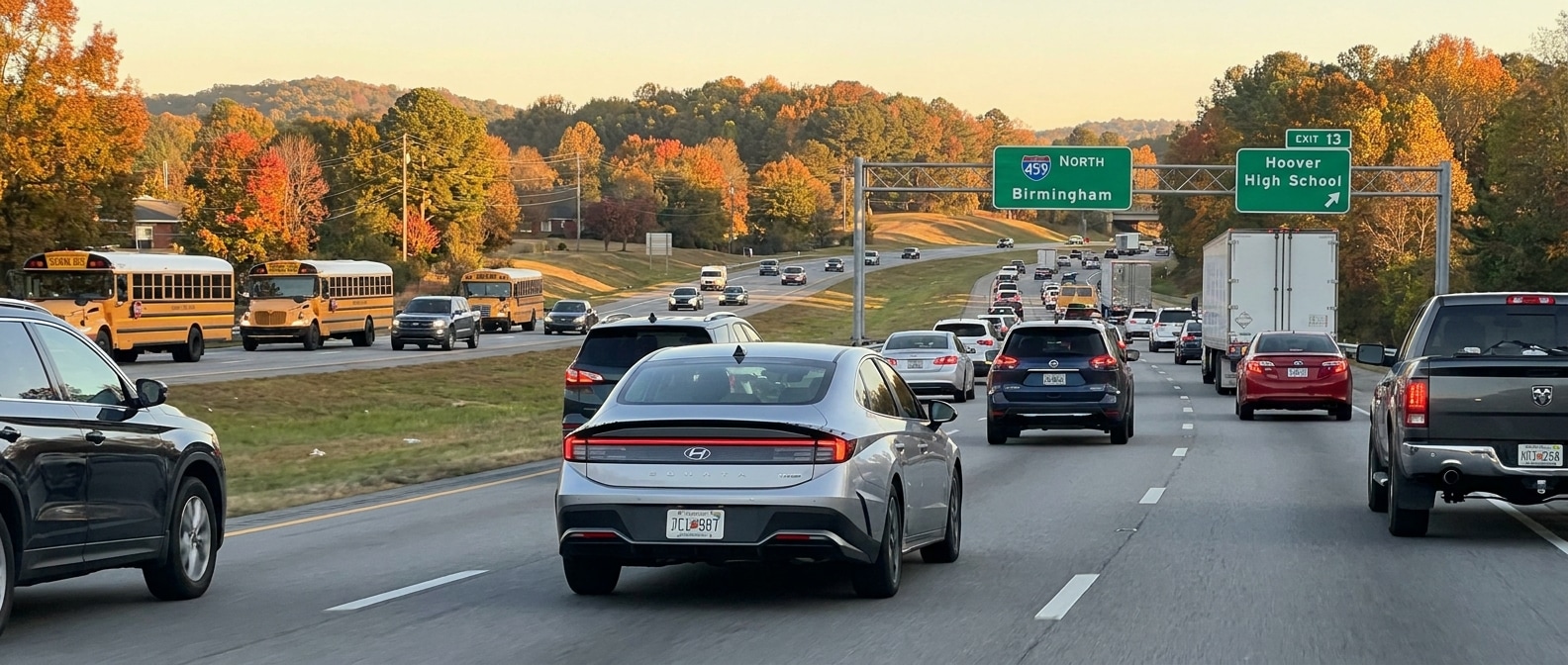
School's back, and that means the I-65 corridor through Vestavia Hills and Homewood is congested again by 7:15 a.m., the I-20/I-59 merge is its usual chaotic self, and your fuel bill is about to start compounding across five days a week for the next nine months. The 2026 Hyundai Sonata Hybrid gives you three trim choices. They're Blue, SEL, and Limited. All three share the same powertrain, but the right one for your commute depends on three things (your route's mix of stop-and-go versus open highway, the features you'll actually use for an hour in the car every day, and whether peak efficiency or daily comfort is the tiebreaker).
We've walked buyers through this exact decision, and here's what stands out from the counter.
The short version
- Pure efficiency commuter (mostly open-highway miles): Blue Hybrid (EPA-estimated 51 mpg combined, the lowest entry point into the hybrid lineup).
- Mixed stop-and-go plus highway, want comfort daily: SEL Hybrid (47 mpg combined EPA estimate, adds heated seats, wireless charging, panoramic sunroof).
- Long daily haul, want everything: Limited Hybrid (47 mpg combined EPA estimate, ventilated seats, built-in navigation, Bose audio).
- All three trim levels are front-wheel drive only and never require plugging in. The hybrid recharges itself through regenerative braking as you drive.
- The trim-to-trim MPG difference comes down to wheel size, not a different engine.
Browse the 2026 Sonata Hybrid in our current inventory
What Actually Drives the Trim Decision for a School-Year Commute?
Four things really drive this pick, and you'll feel each one pull a different direction depending on your route, from your mix of stop-and-go versus open highway to your daily time behind the wheel, your weekly mileage, and how many passengers ride along. The smart choice for a Hoover highway runner isn't the smart choice for a cross-town carpool.
| Variable | Why It Matters for Your Commute | Which Trim It Favors |
|---|---|---|
| Route type (stop-and-go vs. open highway) | Regenerative braking recovers more energy in traffic, so city miles close the gap between Blue and SEL/Limited | Blue Hybrid if mostly open highway; all three if mixed |
| Daily time in the car | More time = comfort features (heated/ventilated seats, wireless charging) carry more value | SEL or Limited |
| Weekly mileage | Higher mileage makes the 4 mpg gap between Blue (51) and SEL (47) more meaningful over a school year | Blue Hybrid for high-mileage pure-highway drivers |
| Passenger count | Second-row air vents on the SEL and Limited matter if kids or carpoolers are riding regularly | SEL or Limited |
The table covers the headline, but it doesn't show the mechanical reason behind the numbers, and that's where a lot of comparison articles stop short.
The Wheel-Size Detail No One Explains
All three trims run the identical powertrain, so the trim you pick changes what you'll touch every day, your comfort and your wheels, while leaving what's under the hood untouched. Under every hood sits a 2.0-liter four-cylinder paired with an electric motor for a combined 192 horsepower, running through a six-speed automatic transmission. The EPA rates the Blue at 47 city / 56 highway / 51 combined. The SEL and Limited both land at 44 city / 51 highway / 47 combined.
Why does four miles per gallon separate the Blue from the SEL when the engine's identical? Look down at the wheels. The Blue rolls on 16-inch alloys wrapped in narrower 205/65R16 low-rolling-resistance tires, while the SEL and Limited step up to 17-inch wheels. Bigger is heavier. Larger diameter means more rotational mass and slightly higher rolling resistance, which is the primary reason the EPA numbers diverge. The engine, motor, battery, and transmission are the same across all three.
So here's how to think about it. If you want to squeeze every bit of efficiency out of the car, the Blue isn't a stripped-down compromise, it's engineered specifically to hit 51 mpg combined. If you'd rather have 17-inch wheels and the comfort features that ride along with them, you're giving up about four combined mpg to get them, a real tradeoff and not a flaw.
We'll say this plainly. For a Birmingham commuter who runs a mostly open-highway stretch on I-65 from Hoover or Alabaster into the city, the Blue's 56 mpg highway estimate is hard to ignore. Stop-and-go congestion near the I-20/I-59 junction works in the hybrid's favor, because every time you brake the system recaptures energy through regenerative braking. The worse the traffic, the more the hybrid's city numbers pull ahead of a conventional gas engine.
Commuter note: The 2026 Sonata Hybrid is a self-charging hybrid. It never needs a charging cable or home outlet. The 270-volt lithium-ion battery recharges automatically through regenerative braking and surplus engine power every time you drive.
The EPA rates the 2026 Sonata Hybrid Blue at 47 city / 56 highway / 51 mpg combined -- four combined mpg more than the SEL and Limited -- and the difference traces to wheel size, not a different engine or battery.
Which Trim's Features Actually Earn Their Place on a Daily Commute
Features are where the choice finally turns personal, and the encouraging part is that you're not starting from a stripped-down car no matter which badge you pick, because even the entry Blue arrives loaded enough to make a long daily commute comfortable. The Blue already comes with a 12.3-inch touchscreen, wireless Apple CarPlay and Android Auto, dual-zone automatic climate control, paddle shifters for manual regenerative braking control, and the full standard safety suite (adaptive cruise, forward collision avoidance, lane keep assist, blind-spot monitors, rear cross-traffic alert, driver attention monitor). None of that is bare-bones.
The SEL adds the touches that change the experience of sitting in a car for 45 minutes each way.
- Heated front seats (relevant from October through March in Birmingham)
- Wireless device charging pad
- Panoramic sunroof
- Second-row air vents (if anyone's in the back regularly, they'll notice)
- 17-inch alloy wheels
The Limited goes further with ventilated front seats (relevant from April through September in Birmingham, which covers most of the school year), built-in navigation with a 12.3-inch display, Bose 12-speaker audio, and a surround-view camera system.
When someone's deciding between SEL and Limited, our team leans one way. Ventilated seats are underrated for an August and September Alabama commute. If you're starting the school year right now and sitting in Birmingham heat every morning, the airflow matters. The Limited's built-in navigation is genuinely useful if you lean on the head unit rather than your phone, but if you're already comfortable with wireless CarPlay, the SEL's navigation workaround feels seamless. See Sonata Hybrid trims currently in our inventory.
Match the Trim to How You Actually Drive
Range is where the Blue quietly pulls its own kind of lead, and for a tight school-morning schedule that can mean noticeably fewer stops at the pump across a busy week of driving into downtown and back. It adds up fast over a nine-month year. The Sonata Hybrid's 13.2-gallon tank gives the Blue Hybrid a total estimated range of up to 673 miles between fill-ups at the EPA combined figure, so you'll pass plenty of gas stations you don't need.
For reference, a 40-mile round-trip Birmingham commute over a five-day week is 200 miles. The Blue's estimated range covers more than three weeks of that before a fill-up at highway-dominant driving. A tank-to-miles ratio like that matters if stopping for gas on a rushed school-morning schedule is a genuine inconvenience, at least in our book.
The SEL and Limited's 47 mpg combined still represents a strong efficiency position. Run the same 200-mile school week and the EPA estimate keeps you well ahead of any conventional gas engine in this segment.
We'll flag one thing here. The Sonata Hybrid's efficiency advantage shows up strongest when your route includes genuine stop-and-go miles. The I-65 crawl through Homewood and Vestavia Hills, or the backup at the I-20/I-59 interchange, is where regenerative braking converts what costs a gas engine into recovered energy. A commute that's almost entirely free-flowing interstate at 70 mph will still return strong numbers, though the gap between a conventional gas sedan and the hybrid narrows in that case. Across Birmingham's typical school-year rush (research from the Vance Law Firm and TomTom data puts this at about 40 hours of delayed driving per year for the average metro commuter), the hybrid's city efficiency still carries a meaningful advantage for most routes into downtown.
The other thing worth saying is simple. All three hybrid trims are front-wheel drive only. If the cold-weather months on your commute worry you, Birmingham's typical winter (occasional ice on elevated sections of I-65, frost on bridge decks) is manageable on front-wheel drive with modern traction control. It's not the snow belt.
Schedule service or ask our team a commute-specific question
By the Hallmark Hyundai Birmingham Team | August 2026
Frequently Asked Questions
Does the Sonata Hybrid need to be plugged in to charge?
No, the 2026 Hyundai Sonata Hybrid is a conventional self-charging hybrid. Its 270-volt lithium-ion battery recharges automatically through regenerative braking every time you slow down, and through surplus engine power at highway speeds. There's no charging cable, no home outlet required, and no range anxiety tied to a wall plug.
Will I actually see the EPA fuel economy figures on my Birmingham commute?
The EPA estimates for the 2026 Sonata Hybrid (51 mpg combined for the Blue and 47 mpg combined for the SEL and Limited) are reasonable targets for a mixed Birmingham commute. Stop-and-go traffic on I-65 through Vestavia Hills and Homewood or near the I-20/I-59 interchange helps the hybrid, because the regenerative braking system recaptures energy that would otherwise be lost as heat. Real-world figures depend on your specific route, speed, and climate control use. Routes with more open-highway miles at higher speeds will typically come in close to the highway estimate, while heavily urban stop-and-go routes may approach or exceed the city figure in the hybrid's favor.
Categories:
Social


