


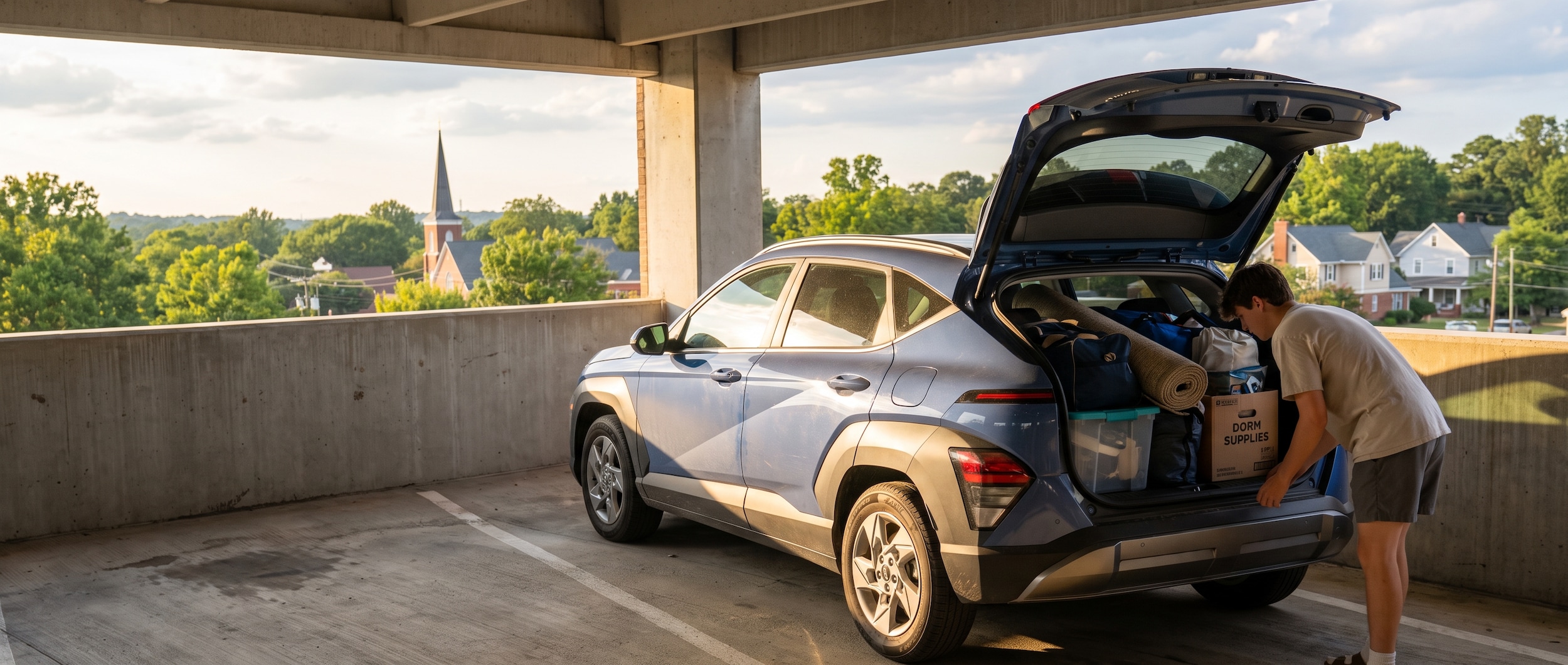
For most Samford students, the Hyundai Kona is the better car. But if you're the specific student who never leaves campus with more than a backpack, the Venue is the smarter buy.
The short version
- Both the 2026 Kona and 2026 Venue return an EPA-estimated 31 mpg combined in base FWD trim, so fuel economy is not the deciding factor.
- The Kona carries 25.5 cubic feet of cargo behind the rear seats. The Venue carries 18.7. That gap is visible the second you open the liftgate.
- Only the Kona offers AWD. The Venue is front-wheel drive only, full stop.
- The Venue is shorter and tighter to park. If a Samford parking deck is your daily reality, that matters.
- Pick the Kona if you drive home for breaks, carpool friends, or haul gear. Pick the Venue if you rarely leave campus with a full load and want the lowest entry point into a new Hyundai.
What's the Real Difference Between the Kona and the Venue?
Both are Hyundai subcompact SUVs sharing a 31 mpg combined EPA estimate, wireless Apple CarPlay, and standard Hyundai SmartSense safety tech, so on paper they read almost like twins, but the moment you load one and drive it, the size gap between them stops being a spec-sheet number. They aren't identical in real life.
At 171.3 inches, the Kona runs about a foot longer than the 159.1-inch Venue. That 12.2-inch difference shows up in every dimension a student cares about. Rear legroom favors the Kona, 38.2 inches back there versus the Venue's 34.3. Cargo depth with the seats up runs 25.5 cubic feet in the Kona against 18.7 in the Venue, and the max haul space with the seats flat splits wider still, 63.7 cubic feet versus 31.9.
The Venue's folded-flat cargo number is genuinely half the Kona's. You feel it the second you open either liftgate.
| Spec | 2026 Kona (SE FWD) | 2026 Venue (SE) |
|---|---|---|
| EPA: City / Hwy / Combined | 29 / 34 / 31 mpg | 29 / 33 / 31 mpg |
| Cargo (seats up) | 25.5 cu ft | 18.7 cu ft |
| Cargo (seats folded) | 63.7 cu ft | 31.9 cu ft |
| Rear Legroom | 38.2 in | 34.3 in |
| Base Engine | 2.0L 147 hp | 1.6L 121 hp |
| AWD Available | Yes (HTRAC, all trims) | No |
| Infotainment Screen | 12.3-inch touchscreen | 8.0-inch touchscreen |
| IIHS Rating | Top Safety Pick+ (2026) | Not yet rated 2026 |
| Length | 171.3 in | 159.1 in |
The single deciding factor for Samford students: if you move home for any holiday break, the Venue's 31.9 cubic feet of folded cargo space may not clear a dorm room's worth of bins, a desk lamp, and a bedding bag in one trip. The Kona's 63.7 handles it.
Does the Size Difference Matter at Samford's Parking Decks?
Yes and no, and the split is worth knowing before you decide, because Samford's parking system is more structured than a first glance suggests, with no free open parking anywhere on campus, so the Venue's shorter body helps in a tight deck, though the decks themselves are standard-width and forgiving enough that the Kona's extra length rarely turns into a real headache. Students park in color-zone permit areas (blue for commuters, green for residents in Beeson Woods, purple for central campus residents), and the decks are structured rather than surface lots. The Venue's shorter 159.1-inch length slips into tighter deck spots more easily than a longer car would.
There's an honest tradeoff worth naming, though. The parking decks at Samford are standard-width structures, not the squeeze-play single-lane situations you find in downtown Birmingham. In our experience with customers who commute along Lakeshore Drive to Homewood, the Kona's extra foot of length doesn't produce a real problem. Both cars are classified as subcompact SUVs. Neither one is a truck.
Where size starts to matter is threading a packed deck during move-in week or the first week of the fall semester, when every level fills up. In that scenario the Venue's tighter turning diameter is a real advantage. Browse our current Kona and Venue inventory to see which trims are available right now if you're trying to time your purchase before August classes start.
Getting Home to Tuscaloosa, Huntsville, or Mobile for Fall Break
For any student heading home for breaks, this section tends to settle the decision toward the Kona, since Alabama sprawls and Samford sits in Homewood with family often three hours out in any direction, though a student who stays local for most breaks won't feel the same pull. Alabama is a sprawling state. You're making that full-car drive four or five times a year.
The Venue's maximum cargo capacity with seats folded is 31.9 cubic feet. One carry-on suitcase fills roughly half of that. Add a second bag, a laundry basket, and a backpack, and you're making choices about what gets left behind. The Kona's 63.7 cubic feet with seats folded is more than double that figure, and the dual-level cargo floor (a feature Hyundai builds into the Kona) gives you a hidden lower storage area for charging cables, emergency kits, and the gear you want out of sight.
The Kona's turbo option is worth noting here too. The SEL Premium and Limited trims step up to a 1.6-liter turbocharged engine rated at 190 horsepower, a noticeably more confident merge onto I-65 south toward Montgomery than the Venue's 121-horsepower 1.6-liter. If most of your driving is Lakeshore Drive and the UAB district, 121 hp is plenty. If you're a frequent highway driver, the Kona's turbo trim earns its place.
Per IIHS, the 2026 Hyundai Kona has earned the Top Safety Pick+ designation, the organization's highest award, recognizing strong performance in crash tests and headlight evaluations.
See Current Kona and Venue Offers
Practical Student Life: Carpooling, IKEA Runs, and Tuesday Night Parking
Neither car is a real five-adult road-trip hauler, so let's be honest about that, but for the everyday stuff (a friend in back, a Target run, the occasional furniture box) the Kona's extra room changes what you can say yes to, while the Venue covers the lighter days just fine. The Kona's 38.2 inches of rear legroom means a 6-foot friend in the back seat isn't folded in half, which the Venue's 34.3 inches can't promise as confidently.
So which one handles the Tuesday-night errand better? The Kona, once a flat-pack box enters the picture. The Venue manages a modest grocery haul without any trouble, but a flat-pack furniture box has you measuring first and hoping, while the Kona's 60/40 split-folding rear seats and 63.7 cubic feet of max space swallow a flat-pack run without the measuring-tape anxiety. Our financing team can walk you through payment options built around a student budget if that's the conversation you need before you decide.
One thing neither car gives you is AWD on the Venue side. Alabama doesn't get harsh winters, and ice events in Birmingham are infrequent, but they happen. When Samford cancels in-person classes because Lakeshore Drive is glazed in late January, front-wheel drive with good all-season tires handles it, most winters anyway. AWD on the Kona is a real upgrade for students who make winter drives to the Tennessee Valley or north Alabama foothills where ice roads are more common. For a Homewood commute, AWD is optional rather than essential.
So Which Should You Pick?
It comes down to one simple question about how you actually live in Homewood, whether you're mainly a campus dweller who walks most places or truly a driver who loads up and heads out, and your answer there points cleanly at one car or the other.
Pick the Venue if: You live on or right next to campus, rarely need more than a backpack's worth of cargo on a given day, want the lowest entry point into a new Hyundai, and the thought of spending more for extra space you won't use feels like the wrong move. It's a genuinely capable car, and for the right buyer it's no compromise at all.
Pick the Kona if: You drive home for every break, you've got a roommate who needs a ride to the airport, you want the optional 190-horsepower turbo engine for highway confidence, or you want the peace of mind that AWD can offer on a wet Lakeshore Drive approach in February. The IIHS Top Safety Pick+ rating adds something real to that case, especially for parents helping with the decision.
We'll put it plainly. The Venue is the smarter choice only for a fairly specific Samford student. If you use your car as a second room, a road-trip vehicle, and a hauler, the Kona earns every inch of its larger footprint. Value your current car before you come in so you know exactly where you're starting from.
Frequently Asked Questions
Is the Hyundai Kona too big for Samford University's parking decks?
No. The 2026 Hyundai Kona is 171.3 inches long, which puts it firmly in the subcompact SUV category. Samford's parking decks are designed for standard passenger vehicles, and the Kona fits comfortably in a normal-width space. The Venue is about a foot shorter, so it's slightly easier to maneuver in tight situations, but neither car poses a real problem in a standard campus parking deck. The bigger concern for most students is permit zone compliance, not vehicle size.
Does the Hyundai Venue have AWD for Alabama winter driving?
No. The 2026 Hyundai Venue is front-wheel drive only across both trim levels, with no AWD option available. For most Birmingham and Homewood driving, front-wheel drive with capable all-season tires handles typical Alabama winters without issue. If you frequently drive north toward Huntsville or into Tennessee during the winter months, or if AWD matters to you for any reason, the 2026 Hyundai Kona is the only option in Hyundai's small SUV lineup that offers it, available on every trim via Hyundai's HTRAC system.
Categories:
Social


