


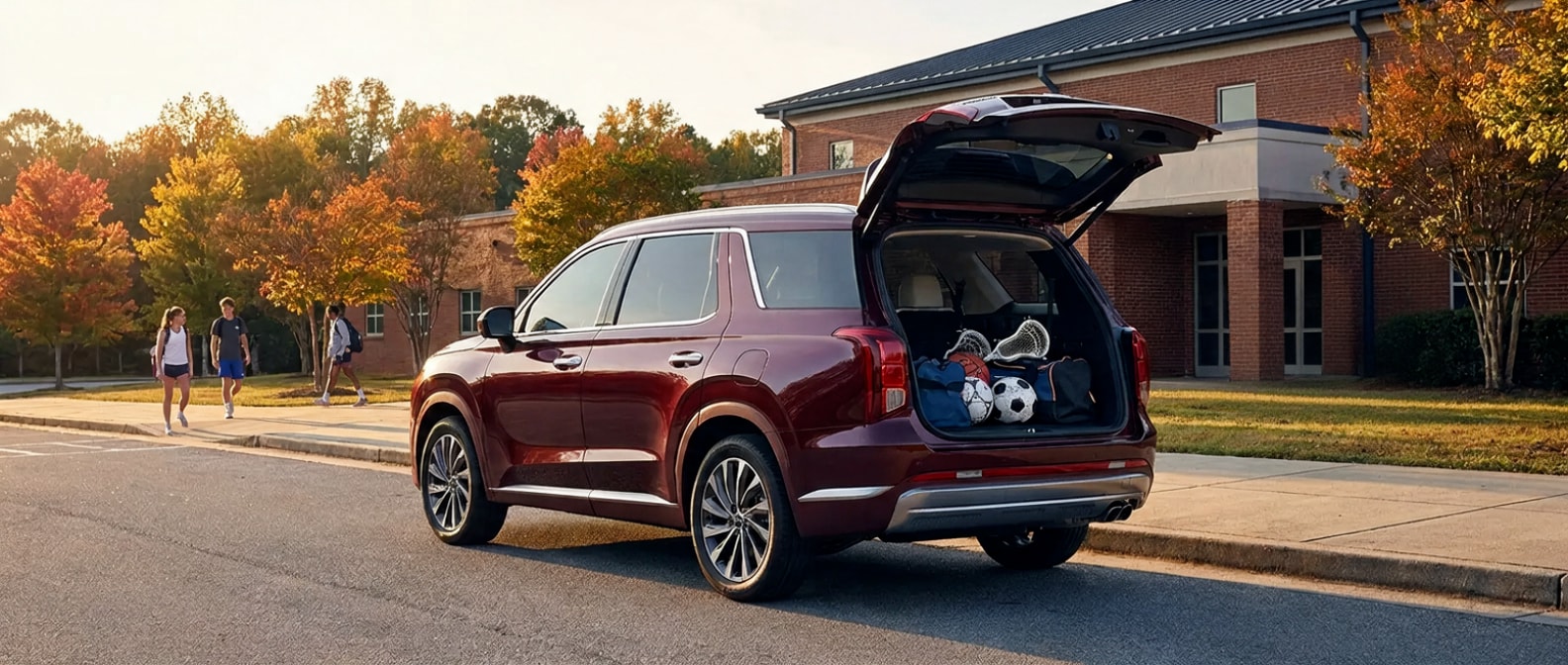
September lands on Birmingham families all at once. Football on Friday nights, soccer on Saturday mornings, two different schools, one parent stuck on US-280 in stop-and-go through Vestavia, and a Sunday pickup at Protective Stadium after a UAB Blazers tailgate. A fair question before you shop gets specific fast. Skip 'which Hyundai is best for families?' The two that count are how many seats you'll actually need and how much gear rides with them.
So what should really drive the pick? Truth be told, the EPA fuel economy gap between the Tucson Hybrid and the Palisade Hybrid is narrow, and seat count plus cargo geometry weigh heavier here than the mpg difference you'll see on the sticker.
The short version
- Two-row, compact efficiency: The 2026 Hyundai Tucson Hybrid hits an EPA-estimated 38 mpg combined (base trim) and fits four kids and a full equipment bag (the right size for a one-sport, smaller-family fall).
- Three rows when you need them, hybrid economy always: The 2026 Hyundai Santa Fe Hybrid delivers EPA-estimated 36 mpg combined (FWD) with an optional third row that works for children, not for adults on a long haul.
- Full three-row capacity, biggest cargo floor: The 2026 Hyundai Palisade Hybrid earns an EPA-estimated 34 mpg combined (FWD Blue/SEL Premium) with genuine seven- or eight-passenger seating and 19.1 cubic feet of cargo with all three rows up.
- The local reality: Stop-and-go carpool runs on US-280 actually favor hybrid regenerative braking, so all three earn better real-world numbers in Birmingham traffic than on a steady highway.
- Our honest take: If you're running five or more kids regularly, skip the Santa Fe Hybrid's third row and go straight to the Palisade Hybrid. If your family is four and occasional, the Tucson Hybrid covers it cleanly.
Browse the 2026 Tucson Hybrid in our current inventory
How Do These Three Hyundai Models Actually Compare?
All three cover a busy Birmingham fall, but they don't line up the same way, splitting instead by seat count and cargo shape, so the table below maps them across the dimensions that matter for a packed schedule. Every cargo and seating figure comes straight from Hyundai's published 2026 specifications, and the fuel economy numbers are EPA estimates.
| Feature | 2026 Tucson Hybrid | 2026 Santa Fe Hybrid | 2026 Palisade Hybrid |
|---|---|---|---|
| Rows / max seating | 2 rows / 5 seats | 3 rows / 7 seats | 3 rows / 7 or 8 seats |
| EPA mpg combined (FWD) | Up to 38 mpg | 36 mpg | 34 mpg |
| Cargo (all rows up) | 39.0 cu ft | 14.6 cu ft | 19.1 cu ft |
| Cargo (3rd row folded) | N/A (2-row) | 40.5 cu ft | 46.3 cu ft |
| Cargo (all seats down) | 74.3 cu ft | ~79 cu ft | 86.7 cu ft |
| 3rd-row legroom | N/A | Tight for adults | 32.1 in (real space) |
| Best for | Smaller families, max efficiency | 5+2 occasional use | Full-crew, regular 3-row use |
Two numbers jump out of this table. First, the Tucson Hybrid holds more cargo with everyone seated than the Santa Fe Hybrid manages with its third row up, since a raised third row eats into the Santa Fe's load floor. Second, the Palisade Hybrid's 32.1 inches of third-row legroom (Hyundai's published figure for the 2026 model) reads as genuine space for growing kids. No one's folded up back there.
How Much Does the Seat-Count Decision Actually Cost You at the Pump?
The seat jump costs you a little at the pump, though not much, since the EPA-estimated gap between the Tucson Hybrid's best combined figure (38 mpg) and the Palisade Hybrid's FWD figure (34 mpg) works out to four miles per gallon. Across an active family's weekly driving, that difference shows up on the fuel bill, though you'll barely notice it.
See 2026 Santa Fe Hybrid inventory at Hallmark Hyundai Birmingham
All three stay this close in real-world Birmingham driving for one reason. Each of these Hyundai hybrid systems recovers energy under braking, and that's where the numbers hold together. Stop-and-go traffic on US-280 through Hoover, or the crawl toward Protective Stadium on a UAB game night, is exactly the driving where regenerative braking earns its keep. A conventional gas SUV bleeds that braking energy off as heat, while these hybrids bank it.
Worth saying plainly, if you're running short, interrupted trips across the metro, each of these models should beat its EPA highway estimate and lean toward its EPA city figure. The same stop-and-go pattern that punishes a conventional engine works in a hybrid's favor.
Look at the city ratings and you'll see the pattern hold. The Tucson Hybrid's city rating is 38 mpg (EPA estimate, base Blue SE trim). The Santa Fe Hybrid posts 37 mpg city (EPA estimate, FWD), and the Palisade Hybrid lands at 33 mpg city (EPA estimate, FWD Blue/SEL Premium). Same stop-and-go that drags a gas engine down lifts these three up.
The EPA fuel economy gap between the Tucson Hybrid (38 mpg combined) and the Palisade Hybrid (34 mpg combined, FWD) is four miles per gallon. Real, but narrow enough that seat count and cargo geometry should drive the size decision, not mpg alone.
A Note From Our Team on Third-Row Reality
Hallmark Team Insight: Line the Santa Fe Hybrid and the Palisade Hybrid up side by side and the third-row geometry settles the question. Seat more than two kids back there on a regular basis and the Palisade Hybrid's architecture is the one that holds up. The Santa Fe Hybrid's third row works well for children and for the occasional adult on a short trip, and Hyundai publishes 32.1 inches of third-row legroom for the 2026 Palisade (versus the Santa Fe Hybrid's tighter rear bench). If you're building a carpool that seats six or more on a regular Friday night drive to a high school game, that 32.1-inch figure is the one that matters.
Which Hyundai Fits Your Fall Schedule?
Your actual week settles this more than any spec sheet, so match the model to how many people and how much gear you haul on a normal Friday rather than a holiday peak, and the three sort themselves out fast. Here's how we'd line them up.
Choose the 2026 Tucson Hybrid if your family runs two to four people and one sport's worth of gear. With 39.0 cubic feet of cargo space behind the second row (all seats occupied) and the EPA's estimated 38 mpg combined on the base trim, you'll clear a full soccer kit, two kids, and a commute on a single tank without drama, most weeks anyway. The footprint stays compact enough for Birmingham's tighter parking near older school facilities and downtown. You won't feel short-changed.
Choose the 2026 Santa Fe Hybrid if five passengers is your occasional peak and seven is a rare exception. The third row seats children comfortably for game-day carpools and folds flat when you want the full 40.5 cubic feet of cargo behind the second row for a gear-heavy weekend. The EPA estimates 36 mpg combined (FWD) for the Santa Fe Hybrid, and the 231 horsepower from its turbocharged 1.6-liter hybrid system handles a full load without feeling strained. The catch is real. If you're seating six or seven on the regular, that third row starts working against you.
Choose the 2026 Palisade Hybrid if seven or eight seats are a regular working reality, and if you're filling them as a matter of routine and not just over the holidays. Hyundai lists 86.7 cubic feet of total cargo capacity with all rows folded, and the 19.1 cubic feet behind the third row is a legitimate everyday number for a gear bag and a few backpacks. The EPA estimates 34 mpg combined (FWD Blue/SEL Premium trim), and the 329-horsepower hybrid powertrain (2.5-liter turbocharged four-cylinder plus two electric motors, per Hyundai) gives the Palisade Hybrid noticeably more punch than the non-hybrid V6 version's 287 hp.
View 2026 Palisade Hybrid inventory
Frequently Asked Questions
Is the Santa Fe Hybrid's third row actually usable for a Birmingham carpool?
For children and shorter adults on trips under an hour, yes. Hyundai's Santa Fe Hybrid third row includes its own climate controls and USB-C ports on upper trims, which matters for a 45-minute drive across the metro. The limitation shows up when you regularly need to seat adults or teenagers with longer legs. For predictable use of that third row by kids in the 6-to-12 range, it works well. If your carpool includes high schoolers who need real legroom on a consistent basis, the Palisade Hybrid's 32.1-inch third-row legroom figure (Hyundai's published spec for 2026) is the more honest fit.
Do these Hyundai hybrids actually get better mileage in city driving than on the highway?
The Tucson Hybrid does. The EPA rates it at 38 mpg city and 37 mpg highway on upper trims, which is one of the few cases where city and highway estimates are nearly equal for a non-plug-in hybrid. The reason is regenerative braking: the system captures energy during deceleration and reuses it at lower speeds, which is exactly what happens in Birmingham school-run traffic and on congested stretches like US-280 through Hoover. The Santa Fe Hybrid (37 city / 36 highway, FWD EPA estimate) and the Palisade Hybrid (33 city / 35 highway, FWD Blue/SEL Premium EPA estimate) follow a similar pattern, with the Palisade being the one model where highway efficiency slightly edges city.
Categories:
Social


