


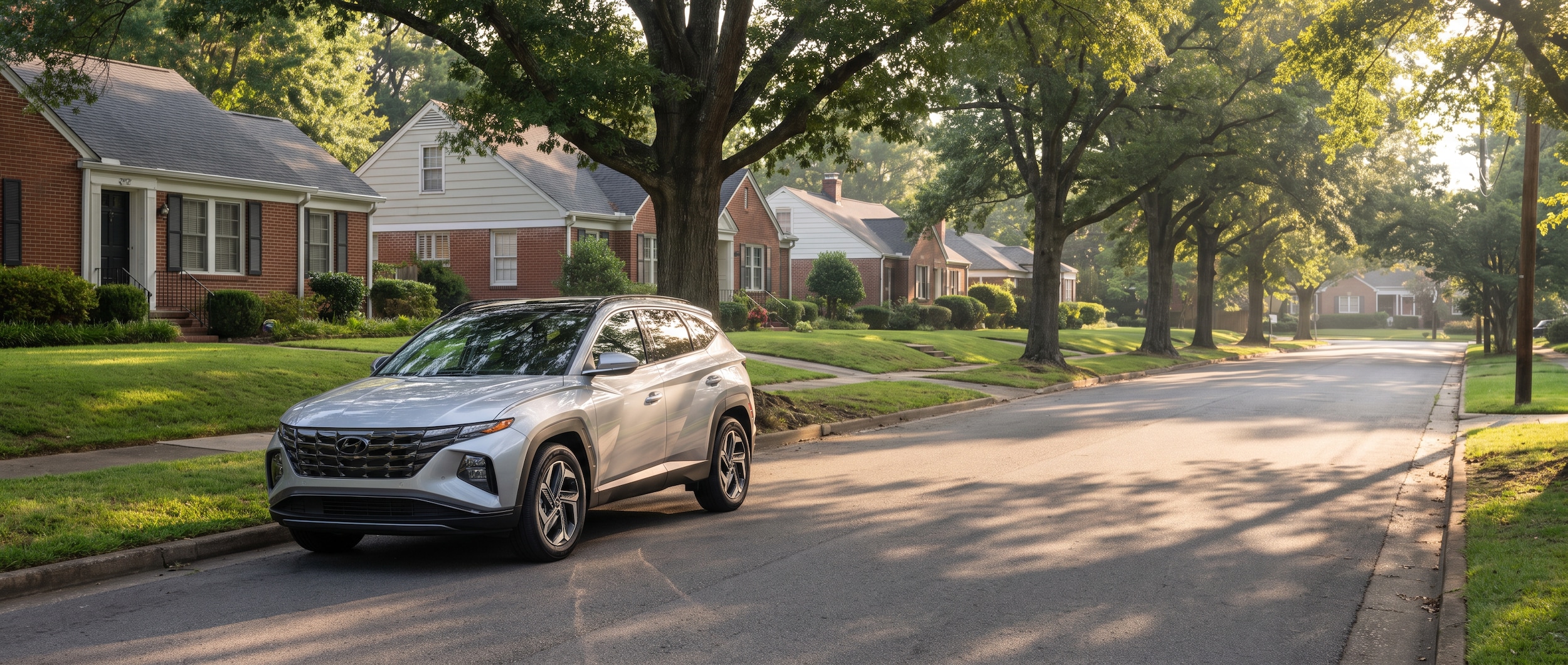
Vestavia Hills parents know the routine. You're creeping down US-31 toward Pizitz or the high school on Lime Rock Road, brake lights stretching ahead, and you're doing this twice a day. The 2026 Hyundai Tucson comes in three distinct powertrain configurations, and the right one depends almost entirely on how many miles that school loop adds up to.
We'll give you the short version up front. For most Vestavia Hills families doing short daily carpool runs in stop-and-go traffic, the Tucson Hybrid earns its keep fastest. But that's not the whole story.
The short version
- Tucson Gas (187 hp, EPA-estimated 28 mpg combined FWD): the practical pick if your school run is part of a longer mixed commute into Birmingham.
- Tucson Hybrid (231 hp, EPA-estimated 36 mpg combined, AWD standard): the sweet spot for Vestavia's stop-and-go US-31 carpool loop where hybrid efficiency shines most.
- Tucson PHEV (268 hp, EPA-estimated 32 miles of electric-only range): worth a look if you can charge overnight and want morning school runs that barely touch the gas engine.
- All three carry an IIHS TSP+ rating and NHTSA 5-star overall, with Hyundai SmartSense including Forward Collision Assist with Pedestrian Detection standard on every trim.
- The Rear Occupant Alert is standard equipment on every 2026 Tucson. For school-run parents, that's not a footnote.
Browse 2026 Tucson inventory at Hallmark Hyundai Birmingham
How Do the Three Tucsons Actually Stack Up?
The three Tucsons separate on powertrain math and your daily mileage, not on features, since the equipment runs nearly identical across all of them. So the choice comes down to how your school loop pencils out against the gas, hybrid, and plug-in numbers. Compare them side by side below.
| Tucson Gas (FWD) | Tucson Hybrid (AWD) | Tucson PHEV (AWD) | |
|---|---|---|---|
| Horsepower | 187 hp | 231 hp | 268 hp |
| EPA City MPG | 25 | 36 | 35 (on gas) |
| EPA Combined MPG | 28 | 36 | 35 (on gas) |
| Electric Range | None | N/A | EPA-est. 32 miles |
| AWD | Optional | Standard | Standard |
| Cargo (seats up) | 41.2 cu ft | 38.7 cu ft | 38.7 cu ft |
| IIHS Rating | TSP+ | TSP+ | Not rated separately |
| NHTSA Overall | 5 stars | 5 stars | Not rated separately |
| Best For | Mixed commute drivers | Daily school-run families | Overnight chargers, short loops |
A few things jump out. The gas model carries slightly more cargo with the rear seats up (41.2 cubic feet versus 38.7) because the hybrid and PHEV battery pack sits under the floor. If the Costco run matters as much as the carpool, that's worth knowing.
The Hybrid's edge on a school loop shows up in the EPA numbers, where the city estimate (36 mpg) and the combined estimate (36 mpg) land virtually identical. Hybrids love stop-and-go. The system recaptures braking energy and leans on the electric motor at low speeds, where the gas engine's least efficient. The school-run math on US-31 plays straight to that strength.
Which Powertrain Makes the Most Sense for Vestavia's Stop-and-Go Routes?
For Vestavia's stop-and-go routes, the Hybrid makes the most sense, though the gas model still fits a family whose loop feeds a longer highway commute. Vestavia Hills City Schools operates eight campuses, and the district's own communications confirm limited bus service, so most families handle the pickup themselves. That means a concentrated burst of idling and low-speed maneuvering twice a day, precisely the profile where the Hybrid's electric assist works hardest.
The Hybrid and PHEV both run on a turbocharged 1.6-liter four-cylinder paired with an electric motor, producing 231 horsepower (268 for the PHEV). That extra pull over the gas model's 187 horses is genuinely noticeable when you need to merge from a side street onto US-31 during the carpool rush.
The Hybrid carries one plain limitation. The EPA rates it at 36 mpg combined, solid but not the segment leader. Some hybrid rivals post better pure fuel economy numbers. What the Tucson Hybrid gives up in headline MPG it wins back in cargo room, available Hyundai Digital Key 2, and the AWD that's standard on every hybrid trim.
The 2026 Tucson Hybrid delivers an EPA-estimated 36 mpg combined with HTRAC AWD standard on every trim, 44 miles per gallon more than the gas model in city driving conditions where a Vestavia Hills school loop actually runs.
For the PHEV, the calculus is simpler but conditional. The EPA rates it at 32 miles of electric-only range. A Vestavia Hills parent whose morning school loop runs under 15 miles round-trip could complete it on battery power on most days if they charge overnight. When the battery depletes, the PHEV runs as a regular hybrid, returning an EPA-estimated 35 mpg combined on the gas engine. The PHEV asks you to build a new habit (plugging in) in exchange for potentially running your morning route on electricity.
A Few Things Every Tucson Buyer on a School Route Should Know
A few Tucson details stand out when parents shop it for a daily carpool, and they cut across all three powertrains rather than favoring one. We'd flag the safety tech and the merge-speed gap first, then the summer-comfort items that Alabama heat makes real. Run down the list before you test drive.
- Rear Occupant Alert is standard equipment. Hyundai built it into every 2026 Tucson. After you park and open the driver's door, the system activates door logic reminders. It's one of those features that feels minor until it isn't.
- Forward Collision Assist with Pedestrian Detection comes standard. In a school zone with kids stepping off curbs, that specific detection capability matters. IIHS credited improved pedestrian crash avoidance systems when it awarded the Tucson its 2026 TSP+ designation.
- The gas model hits 60 mph in about 10.2 seconds. The Hybrid does it in approximately 7.6 seconds. If merging onto a busy road with a carload of kids is part of your morning, the Hybrid's acceleration advantage is real, not just a spec sheet number.
- All three share the same 12.3-inch touchscreen with wireless Apple CarPlay and Android Auto standard, so whoever's navigating around Lime Rock Road during the afternoon rush isn't fumbling with a cable.
- Alabama summers load the cabin fast. The acoustic-laminated windshield on upper Tucson trims helps hold the cool air; combined with the standard ventilated seats on SEL Premium and Limited, that's meaningful comfort during August pickup lines.
Which Tucson Fits Your Actual Situation?
The three-way choice resolves fast once you look plainly at how you drive day to day, since each Tucson wins a different mileage pattern rather than a different feature set. Match the gas model to highway-heavy days, the Hybrid to the suburban carpool, and the PHEV to short loops you can charge for overnight. The specifics follow.
Choose the Tucson Gas if your school run connects to a longer highway commute into Birmingham (and highway miles will dilute the hybrid's city advantage), or if you need the extra cargo floor space and prefer to keep the powertrain as straightforward as possible.
Choose the Tucson Hybrid if the school run is the centerpiece of your daily mileage, your route's mostly low-speed suburban streets and US-31 stops, and you want AWD included without paying to upgrade. We see this configuration fit the suburban carpool pattern best, and the stop-and-go profile on Montgomery Highway is exactly when a hybrid earns its efficiency back.
Choose the Tucson PHEV if you have a home charger (or plan to install one), your school loop's short enough to run on battery most mornings, and you want the strongest powertrain in the lineup. The PHEV's 268 horsepower and standard AWD give it the most confident real-world performance. Just know the price reflects that.
Every configuration carries the same core SmartSense suite, the same 2026 IIHS TSP+ and NHTSA 5-star credentials, and the same cabin that fits a six-foot passenger comfortably behind a six-foot driver. You're choosing the powertrain that fits your mileage pattern. Everything else comes along for the ride.
Come see us at Hallmark Hyundai Birmingham at 1424 5th Ave N and we'll walk you through the Hybrid and PHEV back-to-back. The difference is something you feel in the first merge onto US-31, not something we need to explain in a brochure.
Frequently Asked Questions
Is the Hyundai Tucson Hybrid worth it for short school runs in Vestavia Hills?
Yes, and the route profile is the reason. The 2026 Tucson Hybrid is EPA-estimated at 36 mpg combined, with city and highway estimates that land nearly identical (36 city, 37 highway). Those numbers point to where the efficiency lives, which is low-speed, stop-and-go driving where the hybrid system recaptures braking energy. A twice-daily carpool run on US-31 and Vestavia surface streets is exactly that profile. The gas-only Tucson is rated at 25 mpg city, 33 mpg highway, and 28 mpg combined for FWD. So on a pure school-loop cycle, the Hybrid's city advantage is meaningful. The HTRAC all-wheel drive also comes standard on every Hybrid trim, which matters when January brings ice to those hillside streets.
Does the 2026 Hyundai Tucson have safety features that specifically help in school zones?
Every 2026 Tucson comes standard with Hyundai SmartSense, which includes Forward Collision Assist with Pedestrian Detection, Lane Departure Warning, Lane Keep Assist, and Rear Occupant Alert using door logic. Hyundai's own press release on the 2026 IIHS awards notes that IIHS specifically toughened its criteria around pedestrian crash avoidance for the 2026 model year, and the Tucson earned the TSP+ designation under those higher standards. NHTSA awarded the 2026 Tucson and Tucson Hybrid a 5-star overall safety rating. In practical terms, Forward Collision Assist with Pedestrian Detection is active when a child steps off a curb, and Rear Occupant Alert engages as a reminder when you park and open the driver's door. Both are genuinely relevant on a school run.
Categories:
Social


