


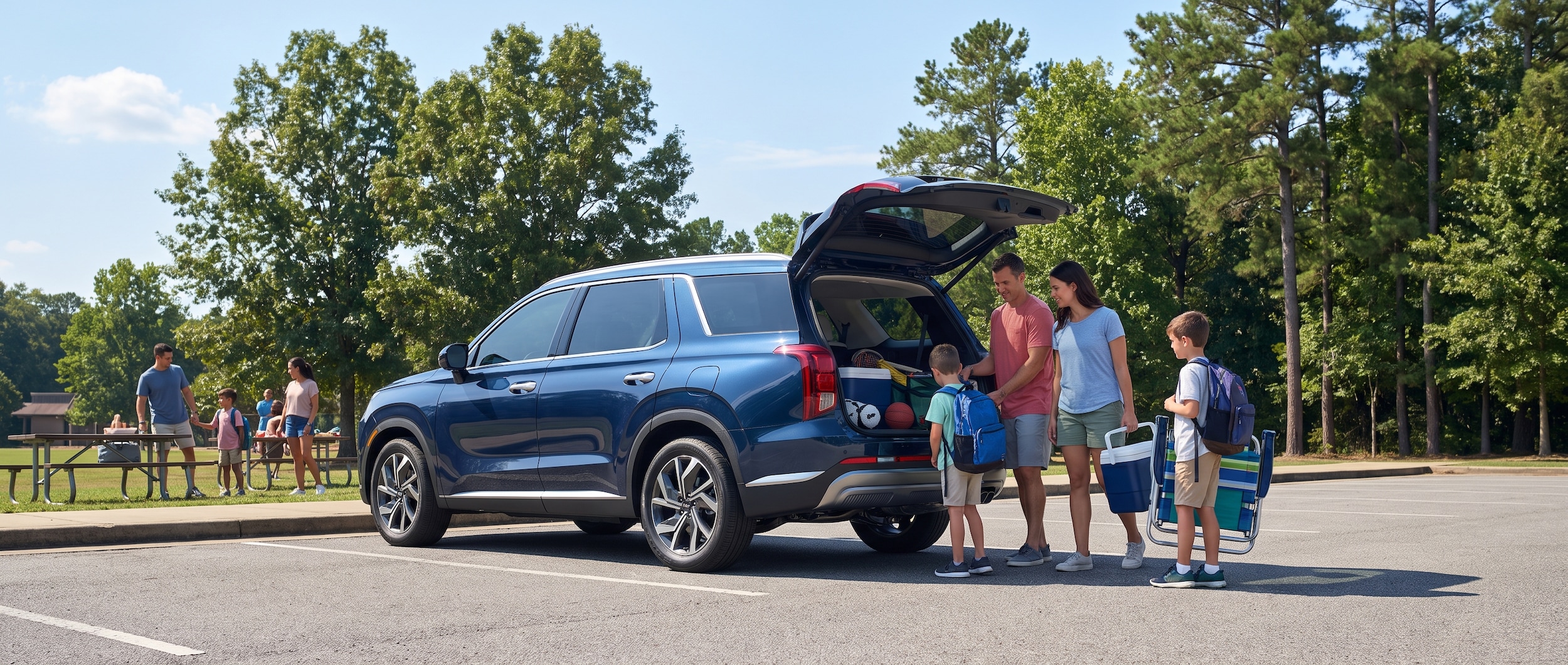
For most Birmingham families comparing these two, the answer comes down to one honest trade-off: the 2026 Hyundai Palisade prioritizes passenger comfort and available hybrid efficiency, while the 2026 Chevrolet Traverse leads on raw cargo volume and standard screen size. Which one fits your household depends on how you actually fill those three rows.
The short version
- The 2026 Palisade seats 7 or 8 with more second-row legroom (43.0 inches); the Traverse seats 7 or 8 with more cargo room behind every row.
- Chevrolet lists the Traverse at up to 97.6 cu ft of max cargo; Hyundai lists the Palisade at 86.7 cu ft -- a consistent gap across all seat configurations.
- The EPA rates the standard Palisade FWD at 21 mpg combined and the Traverse FWD at 22 mpg combined -- nearly identical. The Palisade Hybrid FWD earns an EPA-estimated 34 mpg combined, a figure the Traverse has no answer to.
- Both tow up to 5,000 lbs when properly equipped. Both cover the full active-safety suite standard.
- Families who regularly fill all three rows lean Palisade. Families who frequently fold seats for cargo -- or prioritize the biggest standard infotainment screen -- lean Traverse.
What's the Real Difference Between These Two SUVs?
The 2026 Palisade and 2026 Traverse are genuine competitors, but they were engineered around different assumptions about how families use a three-row SUV. Here is where the numbers make that concrete.
The 2026 Hyundai Palisade runs a 3.5-liter V6 producing 287 horsepower and 260 lb-ft of torque, paired with an eight-speed automatic transmission. Hyundai lists the FWD model at an EPA-estimated 19 city / 25 highway / 21 combined mpg, and AWD at 18 city / 24 highway / 20 combined mpg. The Traverse uses a 2.5-liter turbocharged four-cylinder producing 328 horsepower and 326 lb-ft of torque; the EPA rates FWD at 20 city / 26 highway / 22 combined mpg, and AWD at 20 city / 24 highway / 21 combined mpg.
| Spec | 2026 Hyundai Palisade (FWD) | 2026 Chevy Traverse (FWD) |
|---|---|---|
| Engine | 3.5L V6, 287 hp / 260 lb-ft | 2.5L Turbo I4, 328 hp / 326 lb-ft |
| EPA MPG (city/hwy/combined) | 19 / 25 / 21 | 20 / 26 / 22 |
| Cargo behind 3rd row | 19.1 cu ft | 22.9 cu ft |
| Cargo behind 2nd row | 46.3 cu ft | 56.6 cu ft |
| Max cargo (seats folded) | 86.7 cu ft | 97.6 cu ft |
| 2nd-row legroom | 43.0 in | 41.46 in |
| Max seating | 7 or 8 | 7 or 8 |
| Max towing | 5,000 lbs | 5,000 lbs |
| Standard touchscreen | 12.3 in | 17.7 in |
| Standard airbags | 10 | 8 |
The Traverse holds roughly 11 more cubic feet of max cargo when all seats are folded. The Palisade gives you about 1.5 more inches of second-row legroom -- modest on paper, felt on a long drive.
The single deciding factor: how you fill those seats. Families who run full three-row loads regularly favor the Palisade's passenger comfort and available hybrid efficiency; families who frequently fold rear rows for cargo favor the Traverse's roomier trunk.
Does the Fuel Economy Gap Matter for Birmingham Commuters?
On standard gas models, the gap between these two is one mpg combined -- real money at scale, but not a daily decision-maker. What shifts the comparison for many Birmingham households is the Palisade Hybrid.
The 2026 Palisade Hybrid pairs a 2.5-liter turbocharged hybrid system with two electric motors, producing a combined 329 horsepower and 399 lb-ft of torque. Hyundai lists the SEL and SEL Premium FWD at an EPA-estimated 33 city / 35 highway / 34 combined mpg. The AWD Palisade Hybrid earns an EPA-estimated 29 mpg combined. The Traverse has no hybrid option currently available.
Per Hyundai's published specifications, the 2026 Palisade Hybrid FWD (SEL/SEL Premium) delivers EPA-estimated 33 city / 35 highway / 34 combined mpg.
Those city numbers translate directly to Birmingham's driving patterns. The stop-and-go traffic on I-20/59 through downtown and the I-65 corridor into Hoover -- two of the metro's busiest arterials -- is exactly where hybrid regenerative braking recaptures energy and keeps fuel consumption down. A standard gas SUV burns through every slowdown; the Palisade Hybrid recycles it. That is a distinction you will notice on the monthly fuel receipt, not just in a brochure.
Explore financing options at Hallmark Hyundai Birmingham to see how the Hybrid's efficiency factors into total ownership cost over time.
Third-Row Practicality: Adults or Kids?
This is the question comparison sites rarely answer directly: both SUVs come close to each other on third-row legroom -- Hyundai specifies 32.1 inches for the Palisade, while Chevrolet's specs show 32.13 inches for the Traverse. In daily use, both are best suited to children or occasional adult passengers, not a full-time adult commuter situation.
The Palisade differentiates on the second row. Hyundai lists 43.0 inches of second-row legroom versus 41.46 inches in the Traverse. On a summer drive from Birmingham to Gulf Shores -- a run many Jefferson and Shelby County families do every July -- that 1.5 extra inches gives adults in row two real room to stretch. The Palisade also offers available heated third-row seats and, on upper trims, a power-folding third row that raises and lowers at the press of a button. When October Birmingham evenings turn cool mid-drive, that seat heater detail stops being trivial.
The Traverse answers on the cargo side. Chevrolet lists 22.9 cubic feet behind the third row -- nearly four cubic feet more than the Palisade's 19.1. Loading a full-size double stroller behind a filled third row is noticeably more comfortable in the Traverse. The Traverse's available SmartSlide second-row seat also steps forward automatically when the third row needs entry, which saves a few seconds of gymnastics every time a small child needs help getting in.
Chevrolet lists up to 98 cubic feet of max cargo for the 2026 Traverse -- among the highest figures in the three-row midsize segment.
See What Your Current SUV Is Worth
Safety and Technology: Two Different Philosophies
Both SUVs cover the core active-safety suite standard. Hyundai equips every 2026 Palisade with SmartSense -- forward collision avoidance, lane keeping assist, blind-spot monitoring, and rear cross-traffic alert -- along with 10 standard airbags, a Passenger Talk in-cabin intercom, and three-zone automatic climate control so rows two and three are not subject to the front-seat driver's temperature preference.
The Traverse bundles Chevrolet Safety Assist across every trim -- forward collision alert, automatic emergency braking, lane keep assist, following distance indicator -- with 8 standard airbags. Its standout tech feature is available Super Cruise, Chevrolet's hands-free highway driving system compatible with more than 585,000 mapped road miles. For families doing regular I-65 or I-59 runs, that is a substantive comfort-of-commute upgrade, though it is a higher-trim addition rather than standard. The Traverse also comes standard with a 17.7-inch touchscreen and Google built-in -- the largest standard infotainment display in the segment and the one that lets you control navigation and audio by voice without a phone.
One note for Palisade shoppers: as of mid-2026, Hyundai has issued a stop-sale and recall affecting 2026 Palisade Limited and Calligraphy trims related to second- and third-row power seats. The base SE, SEL, SEL Convenience, SEL Premium, and XRT PRO trims are not included in the stop-sale. Hallmark Hyundai Birmingham can confirm which trims are currently available for sale and delivery.
So Which Should You Choose?
Here is the honest verdict by buyer profile.
You lean Palisade if: you regularly carry a full complement of passengers, including adults in the second row. The Palisade's additional second-row legroom and more passenger-focused interior make it a better daily ride when all seats stay up. Its standard 10 airbags and Passenger Talk intercom are also practical differentiators for active family use.
You lean Palisade Hybrid specifically if: your household runs significant city miles through Birmingham's stop-and-go corridors and you want that efficiency gap -- 34 mpg combined versus 22 -- to work for you over years, not months. The Hybrid also adds 329 horsepower and 399 lb-ft of torque, so you are not trading performance for efficiency.
You lean Traverse if: you frequently fold rear seats to haul bikes, camping gear, sports equipment, or anything else that benefits from 97.6 cubic feet of flat-loading space. The Traverse also wins on the standard infotainment experience -- the 17.7-inch touchscreen with Google built-in is a genuine step up from day one of ownership.
You lean Traverse for towing: both SUVs are rated at 5,000 lbs when properly equipped, but the Traverse's 326 lb-ft of torque -- produced low in the rev range -- gives it a more responsive feel when pulling a small camper or utility trailer from a standing start.
Browse current Palisade inventory at Hallmark Hyundai Birmingham and compare what is in stock today. You can also review Palisade Hybrid trims and specs before making the call.
Frequently Asked Questions
Does the 2026 Hyundai Palisade or the Chevrolet Traverse have more cargo space?
The 2026 Chevrolet Traverse holds more cargo in every configuration. Chevrolet lists 22.9 cubic feet behind the third row, 56.6 cubic feet behind the second row, and 97.6 cubic feet maximum when both rear rows are folded flat. Hyundai lists the 2026 Palisade at 19.1 cubic feet behind the third row, 46.3 cubic feet behind the second row, and 86.7 cubic feet at maximum. If cargo volume is your primary metric, the Traverse holds a consistent advantage across every seat configuration.
Is the 2026 Hyundai Palisade Hybrid significantly more fuel-efficient than the standard Palisade and the Traverse?
Yes, and the gap is substantial. The EPA rates the standard Palisade FWD at 21 mpg combined and the Traverse FWD at 22 mpg combined -- the two are functionally equivalent. The 2026 Palisade Hybrid FWD, however, earns an EPA-estimated 34 mpg combined (33 city / 35 highway) in SEL and SEL Premium trims. In AWD, the Palisade Hybrid is rated at 29 mpg combined. The Traverse currently has no hybrid version available. For Birmingham families with significant city and stop-and-go driving, the Palisade Hybrid's efficiency advantage is real and compounds across years of ownership.
What is the difference in second-row comfort between the two?
The 2026 Palisade offers 43.0 inches of second-row legroom, while the Traverse provides 41.46 inches. That 1.5-inch advantage in the Palisade is noticeable on long drives, especially for adult passengers. The Palisade also offers available heated third-row seats and a power-folding third row on upper trims, adding to passenger comfort for families in Birmingham's cooler months.
Categories:
Social


