


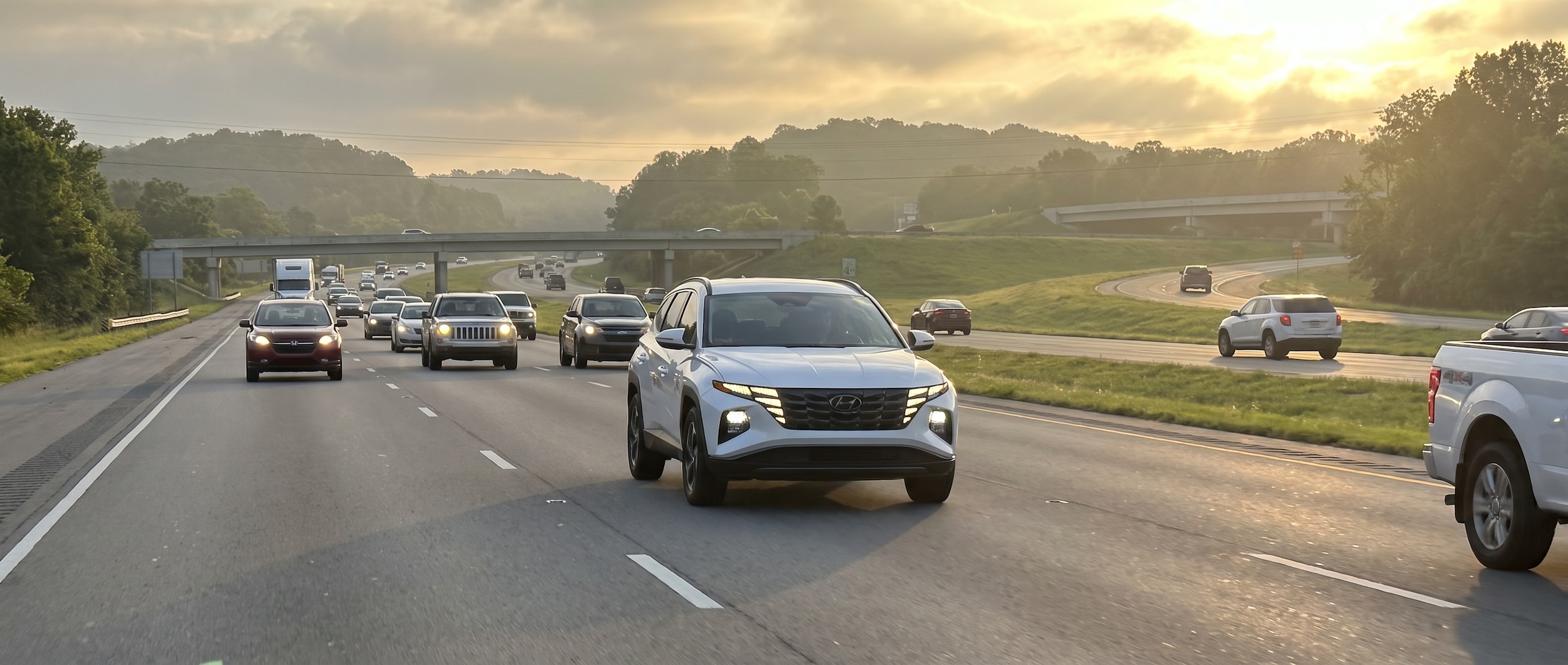
Every Birmingham commuter knows the drill. You leave Hoover or Vestavia Hills with plenty of time, you hit the stoplight cascade on Montgomery Highway or the brake-light queue stretching back from the Cahaba River bridge on Highway 280, and you arrive downtown having used twice the fuel you expected. The geometry of these two corridors -- a grade-heavy arterial on one side, Alabama's most congested non-interstate on the other -- puts real, measurable demands on a vehicle. The 2026 Hyundai lineup meets those demands with specific features that matter on these specific roads. The short answer: for Highway 280's punishing stop-and-go, a hybrid powertrain turns every brake event into a recharge. For Highway 31's grade over Shades Mountain, available all-wheel drive and responsive torque do the work without drama.
On Highway 280, the 2026 Hyundai Sonata Hybrid's regenerative braking turns the corridor's constant stop-and-go into a fuel-saving loop. The EPA estimates 47 city / 56 highway mpg on the Blue trim -- and city driving is where the hybrid system earns its keep most.
The 2026 Tucson Hybrid pairs standard HTRAC all-wheel drive with a 231-horsepower hybrid powertrain -- the combination that makes Highway 31 commuters in Pelham, Alabaster, and Vestavia Hills noticeably more confident on Shades Mountain.
Why Does the Road Geometry Actually Matter Here?
| Local condition / use | The feature that handles it | Why it matters on this commute |
|---|---|---|
| Highway 280 stop-and-go congestion past Cahaba River | Regenerative braking (hybrid system) | Each brake event recharges the battery; the Sonata Hybrid EPA-estimates 47 mpg city -- stop-and-go is the sweet spot |
| Highway 31 grade over Shades Mountain and Red Mountain | AWD torque distribution (Tucson Hybrid standard HTRAC) | All four wheels pull under acceleration; no wheelspin climbing the grade in rain or on worn summer pavement |
| Summer Alabama downpours (July heat plus afternoon storms) | Blind-spot monitoring and lane-centering steering assist | Highway 280's narrow lanes near Grandview Medical Center get treacherous in a hard rain; lane-centering keeps you straight when cameras struggle |
| Long idle time on 280 (ALDOT widening project ongoing) | Hybrid auto stop-start and cabin pre-conditioning | Engine shuts off during extended stops; remote start cools the cabin before you even open the door |
| Daily round trip from Shelby County to downtown | Fuel range between fill-ups | The Sonata Hybrid Blue's EPA-estimated 51 mpg combined and 13.2-gallon tank put the theoretical refuel interval well past 600 miles under favorable conditions |
The Sonata Hybrid and Highway 280: A Genuinely Good Match
Highway 280 earned its reputation as Alabama's most congested non-interstate corridor for a reason. The ALDOT widening project -- expanding the section between Lakeshore Parkway and I-459 from three to four lanes in each direction -- has brought intermittent lane closures on top of the existing rush-hour slowdowns. That pattern, long stretches of creep-and-stop traffic through the retail stretch east of the Homewood line, is exactly where a hybrid powertrain repays itself fastest.
The 2026 Hyundai Sonata Hybrid runs a 2.0-liter four-cylinder paired with a 39-kilowatt permanent magnet electric motor for a combined 192 horsepower. When you touch the brake on 280, the electric motor reverses into a generator, converting your forward momentum into battery charge rather than heat at the brake pads. In the EPA's testing, the Blue Hybrid trim returns an estimated 47 city / 56 highway / 51 combined mpg. The SEL Hybrid and Limited Hybrid trims come in at an EPA-estimated 44 city / 51 highway / 47 combined. The gap between the city and highway figures in the Blue Hybrid is narrower than you might expect -- and that is because the hybrid system uses lower-speed driving to lean on electricity more heavily.
For a Vestavia Hills commuter covering 20-plus miles of mixed 280 and city surface streets each way, that efficiency difference compounds daily in a way a straight MPG comparison does not fully capture.
Local detail: The Highway 280 bridge over the Cahaba River, just east of Grandview Medical Center, is an active construction zone with intermittent westbound lane reductions. Extended merge queues here are common in morning peak hours -- exactly the kind of low-speed stop-and-go where the Sonata Hybrid's electric assist mode kicks in most aggressively.
Highway 31 Asks More of Your Vehicle Than Most Commuters Expect
A lot of drivers think of Highway 31 as the slower, less dramatic alternative to I-65 -- and through Alabaster and Pelham it largely is. But the story changes when US 31 reaches Hoover, curves through Vestavia Hills onto Shades Mountain, and then descends the Red Mountain cut toward Homewood. That grade puts real load on a powertrain during the morning climb and real demand on brakes during the evening descent. Rain makes both worse -- and Birmingham's July averages put afternoon thunderstorms into the picture reliably.
The 2026 Tucson Hybrid addresses the grade directly with standard HTRAC all-wheel drive across every trim level. The hybrid powertrain pairs a turbocharged 1.6-liter four-cylinder with an electric motor for 231 combined horsepower and, per Hyundai, 271 lb-ft of torque. The electric motor delivers that torque from a standstill -- there is no waiting for a turbo to spool when you are merging onto Montgomery Highway out of a side street in Vestavia Hills with a gap that closes fast.
EPA fuel economy estimates for the Tucson Hybrid come in at 38 city / 38 highway / 38 combined mpg on the Blue SE trim, and 36 city / 37 highway / 36 combined on the SEL, SEL Convenience, and Limited trims. The flat city-to-highway figure on the Blue SE is unusual and commuter-friendly: your fuel economy stays consistent whether the day is mostly surface streets or mostly highway miles.
Next step: If you drive Highway 31 from Shelby County and the grade question is front of mind, ask to compare the Tucson Hybrid's AWD behavior to the standard gas Tucson -- the difference is most apparent in wet conditions on a climb.
The Sonata (gas) also deserves a mention for Highway 31 commuters whose route is flatter and longer. The 2026 Sonata SE earns an EPA-estimated 28 city / 38 highway / 32 combined mpg with a 2.5-liter, 191-horsepower four-cylinder -- a genuine high-mileage highway sedan that stays comfortable across a 30-to-40-mile one-way stretch from Alabaster or Calera.
Matching Your Specific Commute to the Right Model
Every 31 and 280 commute is slightly different. Here is a practical breakdown:
Highway 280 commuter (Hoover/Mountain Brook area toward downtown): The Tucson Hybrid or Sonata Hybrid. Your commute is stop-and-go heavy, so the hybrid's regenerative system earns its keep every morning. If you carry gear or have a family, the Tucson Hybrid's extra cargo room and standard AWD give you flexibility year-round. If your priority is pure cabin comfort over a long slow queue, the Sonata Hybrid's quieter, sedan profile reduces road noise noticeably.
Highway 31 commuter (Alabaster, Pelham, or Vestavia Hills toward downtown): The Tucson Hybrid is the practical pick. The grade and the rain exposure both call for AWD, and the 231-hp hybrid system has the torque to handle Shades Mountain without feeling strained. The Sonata (gas SE) works well for the longer, flatter Shelby County segments where the EPA's highway rating -- 38 mpg -- does the real work.
Mixed corridor (both 31 and 280 in the same day): Either hybrid. Both routes improve with a regenerative system, and both benefit from the standard forward collision avoidance, adaptive cruise control, lane departure steering assist, and blind-spot monitoring that Hyundai includes across the 2026 lineup.
Categories:
Social


