


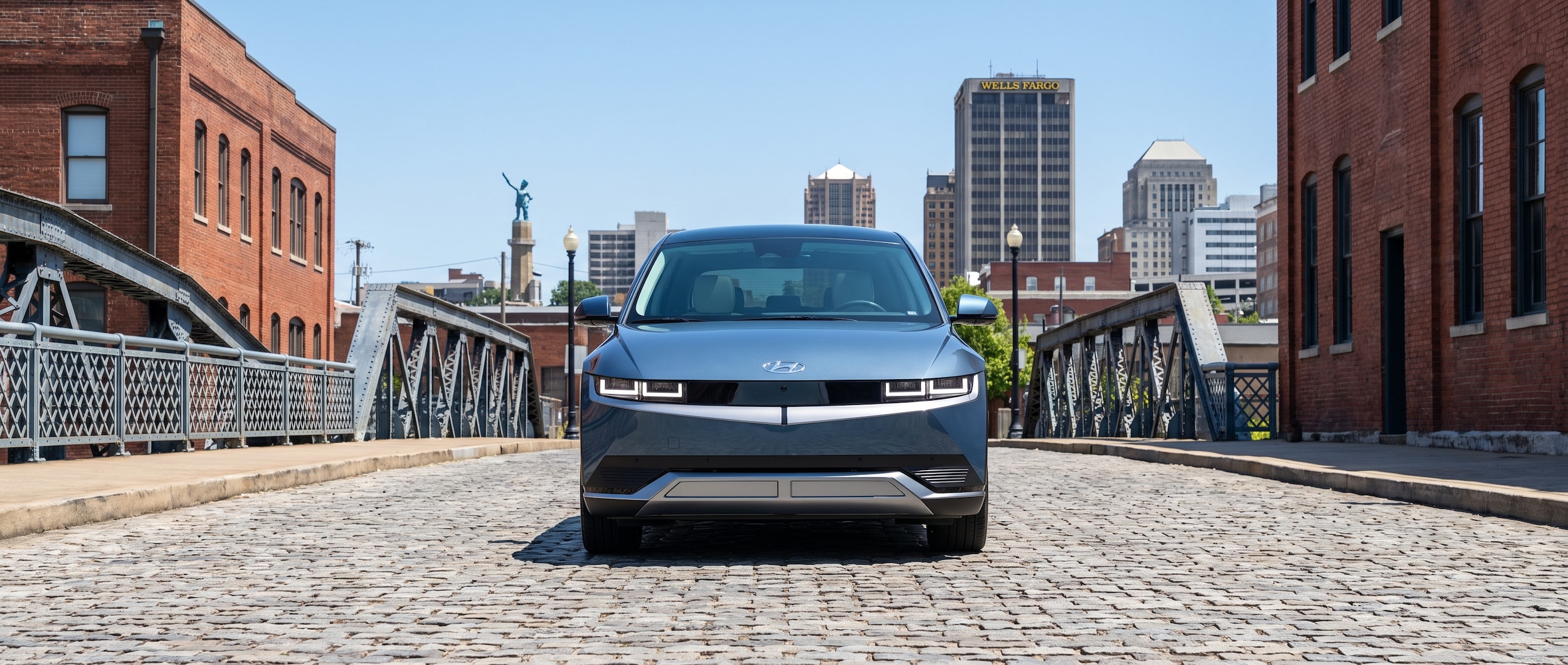
If you're considering an electric SUV in Birmingham right now, you've got a real question to answer before the test drive: will the range hold up when it's 95 degrees outside and the AC is running hard? That's not a hypothetical here in July. It's Tuesday. The answer is yes, with a few habits that take about a week to make automatic, and the 2026 Hyundai IONIQ 5 (the five-seat compact, not the three-row) is better equipped for this climate than most buyers realize when they first walk in.
Here's what a Birmingham driver actually needs to know.
How Far Will It Really Go Here?
The EPA rates the 2026 IONIQ 5 at up to 318 miles of range in the rear-wheel-drive SE/SEL/Limited configuration with the 84 kWh battery. That's the ceiling. In Birmingham's summer, your practical daily number looks a little different.
Research tracking real-world EV data shows that range barely moves at 90 degrees Fahrenheit, averaging around a 5 percent dip, but climbs toward 17-18 percent once temperatures hit 100 degrees. Birmingham sits squarely in that range during peak July afternoons. So on a brutal day, a 318-mile EPA estimate becomes closer to 265-275 real-world miles with AC running at a comfortable (not arctic) setting. That's still plenty for everything except a road trip.
On an average Birmingham summer day (high 80s to low 90s), the IONIQ 5's real-world range drop from AC and heat is modest, roughly 5-10 percent. Plan for a meaningful dip only on the hottest afternoons above 95 degrees.
The table below lays out what each 2026 IONIQ 5 configuration delivers, according to Hyundai's EPA-estimated figures, alongside a practical Birmingham-summer planning range. All EPA figures are estimates based on a fully charged battery; actual range varies with driving conditions, habits, and temperature.
| Trim / Config | EPA Est. Range | Summer Planning Range (90-95 degrees F) | Connector |
|---|---|---|---|
| SE Standard Range RWD | 245 mi | ~208-230 mi | NACS (CCS via adapter included) |
| SE / SEL / Limited RWD | 318 mi | ~270-300 mi | NACS (CCS via adapter included) |
| SE / SEL AWD | 290 mi | ~246-275 mi | NACS (CCS via adapter included) |
| Limited AWD | 269 mi | ~228-255 mi | NACS (CCS via adapter included) |
| XRT AWD | 259 mi | ~220-246 mi | NACS (CCS via adapter included) |
The Standard Range's 245-mile EPA figure is the one trim we'd walk through carefully with Birmingham buyers, specifically anyone who doesn't have a home charger yet. It's workable for a short commute. Drivers in Jefferson or Shelby County covering 40-60 miles round-trip per day will be much more comfortable with the long-range 84 kWh pack.
Where Do You Charge Locally?
Answering this question well is what actually moves someone from "interested" to "ready to buy," and Birmingham's charging infrastructure is more developed than most people expect. Browse our current IONIQ 5 inventory to see which trims are on the lot, then read this section so you know what comes after you drive it home.
The Birmingham-Hoover metro has 109 DC fast chargers across the region, according to PlugShare's current data. For daily errands and commuting from inside the city, UAB's Express Lot 4 (316 10th St. South) offers ChargePoint Level 2 stations open 24/7 to the public. If you're near the US-280 corridor, 16 Tesla Superchargers at the Target location on US-280 are now fully compatible with the IONIQ 5's NACS port (no adapter needed for 2026 models). The McWane Science Center parking garage on 19th St. North has Level 2 stations available on the second floor if you're downtown. And for road trips to Atlanta or Nashville, the fast-charge corridor along I-20 and I-65 has grown substantially.
The IONIQ 5's real advantage in this network goes beyond the quantity of chargers. It's the speed. The 800V architecture accepts up to 350 kW, and per Hyundai's specifications, that means 10% to 80% charge in approximately 20 minutes at a compatible 350 kW DC fast charger. Talk to our team about financing options that can factor home charging equipment into the purchase, which makes the public network your backup rather than your primary plan.
Charging tip for Birmingham summers: Pre-cool the cabin while the IONIQ 5 is still plugged in before your morning commute. The car's climate system does the heavy lifting from the grid, not the battery, so you start your drive with full range and a comfortable interior even on a 95-degree day. Most 2026 IONIQ 5 trims support remote climate scheduling through the Hyundai digital key app.
Three Things Birmingham EV Buyers Should Know Before They Decide
These points come up in actual conversations on our lot, so they're worth reading carefully before you decide.
- The 800V architecture is your road-trip answer. Most EVs use 400V systems and need 45-60 minutes at a fast charger to recover meaningful range. The IONIQ 5 can add roughly 100 miles in about nine minutes at a 350 kW station, per Hyundai's specifications. That changes the calculus for a Birmingham-to-Atlanta run entirely.
- The Standard Range trim is straightforward about its limits. The 63 kWh / 245-mile SE Standard Range model makes sense for short, predictable commutes with reliable home charging. If your route varies or you don't have a garage outlet, the 84 kWh pack (SE and above) is worth the step up.
- Summer AC costs less range than winter heating does. Research data on real-world EV fleets shows that cabin heating in deep cold can push range loss toward 30-40 percent, while cooling in typical Alabama summer heat costs roughly 5-15 percent. Birmingham winters are mild enough that the IONIQ 5 avoids the worst cold-weather penalty entirely.
- The NACS port matters. Starting with the 2025 model year, the IONIQ 5 switched to a Tesla-style NACS charging port. Every 2026 IONIQ 5 has it, opening access to the Tesla Supercharger network (now the densest fast-charge network in the US) in addition to CCS chargers via the included adapter.
Planning Your IONIQ 5 Life in Birmingham This Way
If you have a 240V outlet at home (even a standard dryer outlet), a Level 2 charger installed in your garage or carport turns the IONIQ 5 into a plug-in-nightly car. You leave with a full battery every morning. The public network covers road trips and the occasional long errand day. That's the setup that works.
If you can't charge at home yet, the UAB and US-280 fast-charge options are solid, but we'd encourage you to work through the logistics before purchase rather than after. Living with an EV without home charging is manageable, and the habit adjustment is real. We'd rather you know that upfront than be surprised six weeks in.
The tradeoff worth naming for Birmingham specifically: summer heat will shave your range on the worst afternoons, and that calls for a small mental shift from gas-car thinking (fill it when it's low) to EV thinking (plug in when you park). That shift takes about a week. After that, the 2026 IONIQ 5's combination of real-world range, an 800V fast-charge architecture that handles road trips with ease, and a local charging network that's grown quietly but meaningfully makes it one of the more practical EV choices for this market.
Schedule a service appointment when you're ready to ask our team about the IONIQ 5 directly. If you're weighing whether an EV makes financial sense given current incentives and the 2026 model's revised pricing, our team can walk you through the numbers.
Explore Financing Options for the 2026 IONIQ 5
Frequently Asked Questions
Does the IONIQ 5 lose a lot of range running the AC in Birmingham summers?
Less than you'd expect going in. Real-world EV data shows that range loss from AC typically sits in the 5-15 percent range in hot conditions, with meaningful dips only above 90 degrees Fahrenheit. On a typical Birmingham summer day in the high 80s, the EPA-estimated 318-mile long-range rear-wheel-drive IONIQ 5 will realistically deliver somewhere around 270-300 miles with AC running at a comfortable setting. Pre-conditioning is your best tool here: cool the cabin while the car is still plugged in, and you start your drive with the battery undepleted and the interior already comfortable.
Can I charge the IONIQ 5 in Birmingham without a home charger?
Yes, though it takes more planning. The Birmingham-Hoover metro has 109 DC fast chargers, per PlugShare. UAB's Express Lot 4 on 10th Street South has ChargePoint Level 2 stations open to the public around the clock, and the Tesla Supercharger bank on US-280 (16 stalls) is now fully NACS-compatible with 2026 IONIQ 5 models. A Level 2 home charger is still the easier daily setup. Our team can walk you through what home charging installation typically involves and what questions to ask an electrician.
How long does it take to charge the IONIQ 5 at a DC fast charger?
The 2026 IONIQ 5's 800V electrical architecture accepts up to 350 kW at compatible DC fast chargers. Per Hyundai's specifications, that enables a 10% to 80% charge in approximately 20 minutes. At a more common 150 kW charger, that time extends but still beats most EV competitors. For a Birmingham-to-Atlanta road trip (roughly 150 miles), one brief fast-charge stop is sufficient with the long-range pack, and that stop takes about as long as a bathroom break and a coffee.
Categories:
Social


