


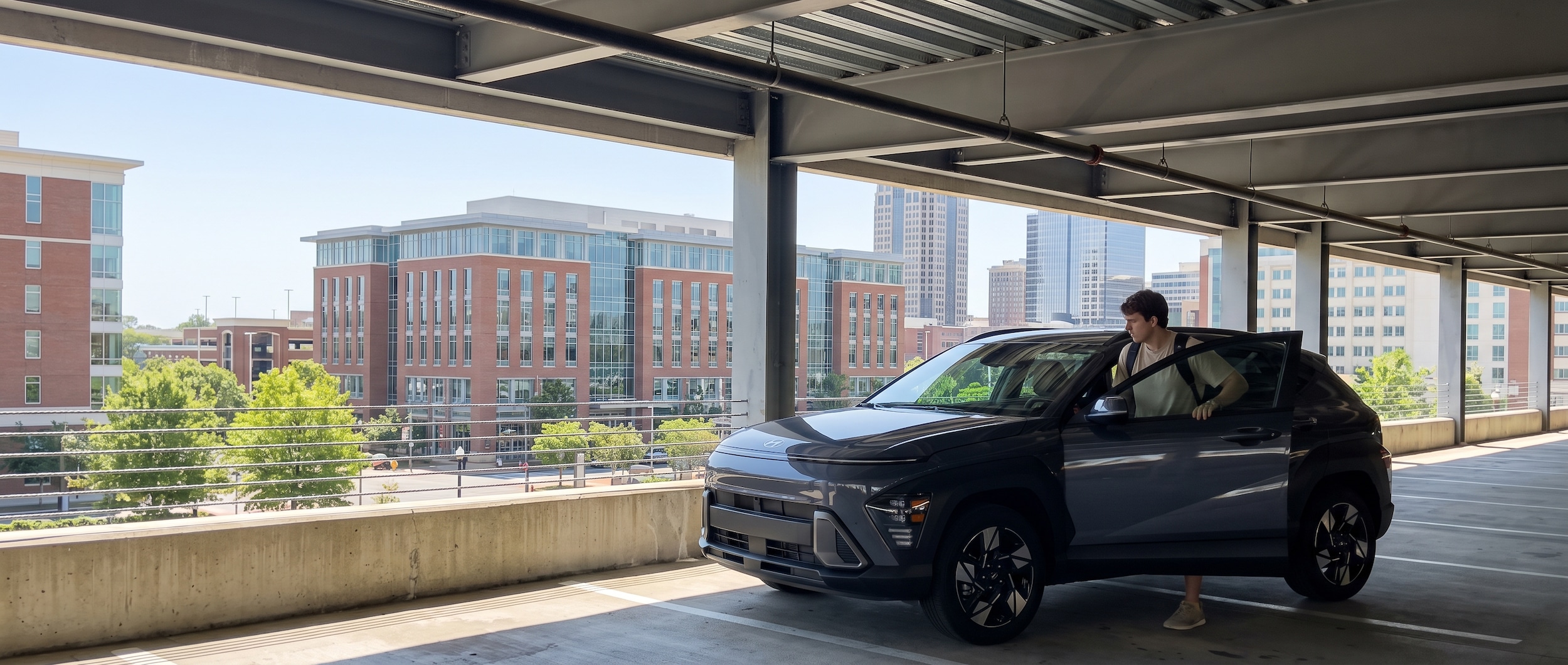
The Insurance Institute for Highway Safety tightened its Top Safety Pick+ criteria for 2026. Earning the award now requires a "Good" rating in the updated moderate front overlap test (previously only "Acceptable" was needed for TSP recognition) plus a "Good" rating in the pedestrian crash prevention evaluation. The 2026 Hyundai Kona earned TSP+ anyway. Per the official Hyundai newsroom announcement on March 24, 2026, the Kona is one of only six Hyundai vehicles to clear that bar this year.
That matters more than a badge. For a new driver learning the rhythms of University Boulevard, navigating UAB's tight parking decks, and sharing lanes with pedestrians and cyclists on every block, a safety suite that passed a stricter-than-ever pedestrian standard isn't just a selling point. It's the actual point.
The 2026 Hyundai Kona includes the full Hyundai SmartSense suite as standard equipment on every single trim level (from the base SE to the Limited) so you don't have to pay up to get the safety features that earned the IIHS award.
We have 2026 Kona models in stock right now if you want to see what the tech looks like in person. But first, let's walk through what these features actually do.
What Do the Safety Specs Actually Mean for a New Driver?
New drivers don't need a feature list. They need to know whether a system will help in the specific situations they actually face. So here's the verified spec breakdown, mapped to the scenarios that matter most near UAB. Read the descriptions carefully so you can match each system to your own commute.
| Safety Feature | Standard On | What It Does in Real Driving |
|---|---|---|
| Forward Collision-Avoidance Assist (FCA) | All trims | Detects vehicles, pedestrians, cyclists, and oncoming cars at intersections; applies brakes automatically if a collision is imminent |
| Junction Turning Detection | All trims | Specific to left-turn scenarios where a vehicle or pedestrian is in your path as you complete the turn |
| Lane Keeping Assist (LKA) | All trims | Applies steering correction if you drift out of your lane without signaling |
| Lane Following Assist (LFA) | All trims | Uses camera to track lane markings and actively centers the Kona within the lane |
| Smart Cruise Control with Stop & Go | All trims | Radar-based adaptive cruise that follows traffic down to a complete stop, then resumes automatically |
| Driver Attention Warning (DAW) | All trims | Monitors steering inputs for fatigue patterns; prompts a break before the problem compounds |
| Safe Exit Warning | All trims | Alerts occupants before they open a door if a passing vehicle or cyclist is detected from behind |
| Rear Occupant Alert | All trims | Uses ultrasonic sensors to detect a passenger or pet left in the rear seat after parking |
| Blind-Spot Collision Warning | SE Sport trim and above | Warns of vehicles in adjacent lanes during lane changes |
| Highway Driving Assist | Limited only | Combines adaptive cruise and lane centering on the highway for reduced fatigue on longer drives |
| 360 Surround View Monitor | Limited only | Stitches camera feeds into a bird's-eye view for tight parking maneuvers |
The honest tradeoff worth naming: NHTSA gave the 2026 Kona four out of five stars overall, with five stars in the side crash test and four stars in frontal and rollover. That's a solid result. It's not a five-star sweep. If maximum NHTSA overall ratings are your benchmark, Hyundai's own Tucson earned five stars overall this year. The Kona's stronger case rests in its active crash avoidance technology, where the IIHS TSP+ carries more weight for preventing incidents before they happen.
The Feature That Changes Daily Driving Near UAB
University Boulevard and its cross streets around the UAB campus are genuinely demanding for a new driver. Pedestrian traffic from the Hill Student Center to Collat School of Business, cyclists cutting through, and the controlled chaos of students crossing at 13th Street South and 14th Street South during class changes all create the exact scenarios the Kona's Forward Collision-Avoidance Assist with Pedestrian, Cyclist, and Junction Turning Detection was designed for. Per the IIHS, the 2026 system earned a "Good" rating in vehicle-to-pedestrian front crash prevention. That's the highest available rating.
When customers ask us about urban driving specifically, the FCA system's Junction Turning Detection is where the conversation focuses. It monitors the path you're completing mid-turn, which is exactly what happens when you're making a left off University Boulevard into a parking deck and a cyclist comes through. The system won't replace your attention. It will back you up when attention slips at the wrong moment.
Driver Attention Warning works on a different problem. A new driver who's nervous or been up studying late is exactly the profile the system monitors for. It reads steering-input patterns and alerts when the driving behavior suggests fatigue or distraction. The spec is that it monitors continuously, which matters on a commute that starts early or runs late.
For reference, our Hyundai Elantra also carries the SmartSense suite standard if a sedan footprint fits your situation better. And if your needs are growing toward something with more cargo and passenger space, the Hyundai Tucson steps up the safety and interior dimensions considerably.
Tip for UAB commuters: The 14th Street Parking Deck (at 14th Street South and 7th Avenue) is a tight multi-level structure. The Kona SE's compact dimensions and standard rear camera give you a solid baseline for navigating those turns. Stepping up to the Limited adds parking distance sensors and the 360 Surround View Monitor if you want the full picture-in-picture assist for deck parking specifically.
Pros and Cons for New Drivers
| Pros | Cons |
|---|---|
| Full SmartSense suite standard on every trim, including the base SE | NHTSA overall is 4 stars, not a 5-star sweep |
| IIHS Top Safety Pick+ under 2026's stricter pedestrian and rear-seat criteria | Highway Driving Assist and 360 Surround View are Limited-only |
| FCA with pedestrian, cyclist, and junction-turn detection standard | Standard 2.0L engine (147 hp) is adequate, not spirited |
| Safe Exit Warning helps in tight urban parking situations | Adaptive cruise lacks lane-centering on SE, SEL Sport, SEL Premium trims |
| Compact footprint is genuinely easier to manage for newer drivers | No hybrid option in the gas Kona lineup for 2026 |
| EPA-estimated 29 city / 34 highway / 31 combined mpg on the 2.0L FWD | AWD drops fuel economy and is not standard |
| Rear Occupant Alert standard, monitors for passengers or pets left behind |
Who the Kona Fits (and Where the Honest Fit Ends)
The 2026 Kona suits a student or young professional commuting to UAB as a first or early car. The compact footprint handles tight parking, the safety suite doesn't require a trim upgrade to activate, and the EPA-estimated 31 mpg combined on the 2.0L FWD keeps fuel costs predictable on a budget. For someone parking in UAB's zone-based permit system and making daily runs through downtown Birmingham's 20th Street corridor, that's a practical package.
Where it fits less cleanly is on sustained highway miles beyond Birmingham. On I-20 east toward Tuscaloosa or I-59 toward Gadsden, the Smart Cruise Control's lack of lane-centering on the lower three trims means you're managing steering yourself on those stretches. The Limited adds Highway Driving Assist, combining adaptive cruise and lane centering, and that combination genuinely reduces fatigue on longer drives. For a primarily urban commuter near UAB, the SE or SEL Sport is the smarter value. For someone who mixes UAB commuting with regular highway runs, the Limited is worth considering.
We'd also say this: the Kona's safety case is strongest when it's doing what it was designed for. Navigating dense, pedestrian-heavy urban environments at city speeds is exactly what the UAB campus corridor demands. A vehicle with strong IIHS pedestrian crash prevention, standard FCA with junction detection, and a compact enough footprint to maneuver the 14th Street deck isn't a coincidence with this reader's situation. It's the match.
Our financing team can walk you through options that fit your timeline and budget. We'll work through it together.
Frequently Asked Questions
Does the 2026 Kona have all the SmartSense safety features on the base SE trim?
Yes, and that's worth spelling out carefully because trim-level exclusions are common across the segment. Hyundai includes the full SmartSense suite as standard equipment across every 2026 Kona trim level, from the SE to the Limited. Forward Collision-Avoidance Assist with pedestrian, cyclist, and junction detection, Lane Keeping Assist, Lane Following Assist, Smart Cruise Control with Stop & Go, Driver Attention Warning, Safe Exit Warning, Rear Occupant Alert, and High Beam Assist all come standard. You don't have to buy up to activate the core safety technology. The Limited trim adds Highway Driving Assist, 360 Surround View, remote smart parking assist, and parking distance warning sensors as upgrades on top of that full standard base.
Is the 2026 Hyundai Kona's safety rating from IIHS different from its NHTSA rating, and which one should I pay attention to?
Both matter, and they measure different things, so it's worth understanding each on its own terms. Per NHTSA, the 2026 Kona earned a four-star overall rating, including five stars in the side crash test. Per the IIHS, the Kona earned Top Safety Pick+, the institute's highest designation, earned under 2026's tightened criteria that now require a "Good" rating in moderate front overlap and pedestrian crash prevention. IIHS testing focuses heavily on crash structure and crash avoidance technology. NHTSA's program emphasizes overall crashworthiness across frontal, side, and rollover scenarios. Neither replaces the other. For new drivers in a pedestrian-heavy urban environment like UAB, the IIHS pedestrian crash prevention result is particularly relevant to daily driving conditions.
Categories:
Social


