


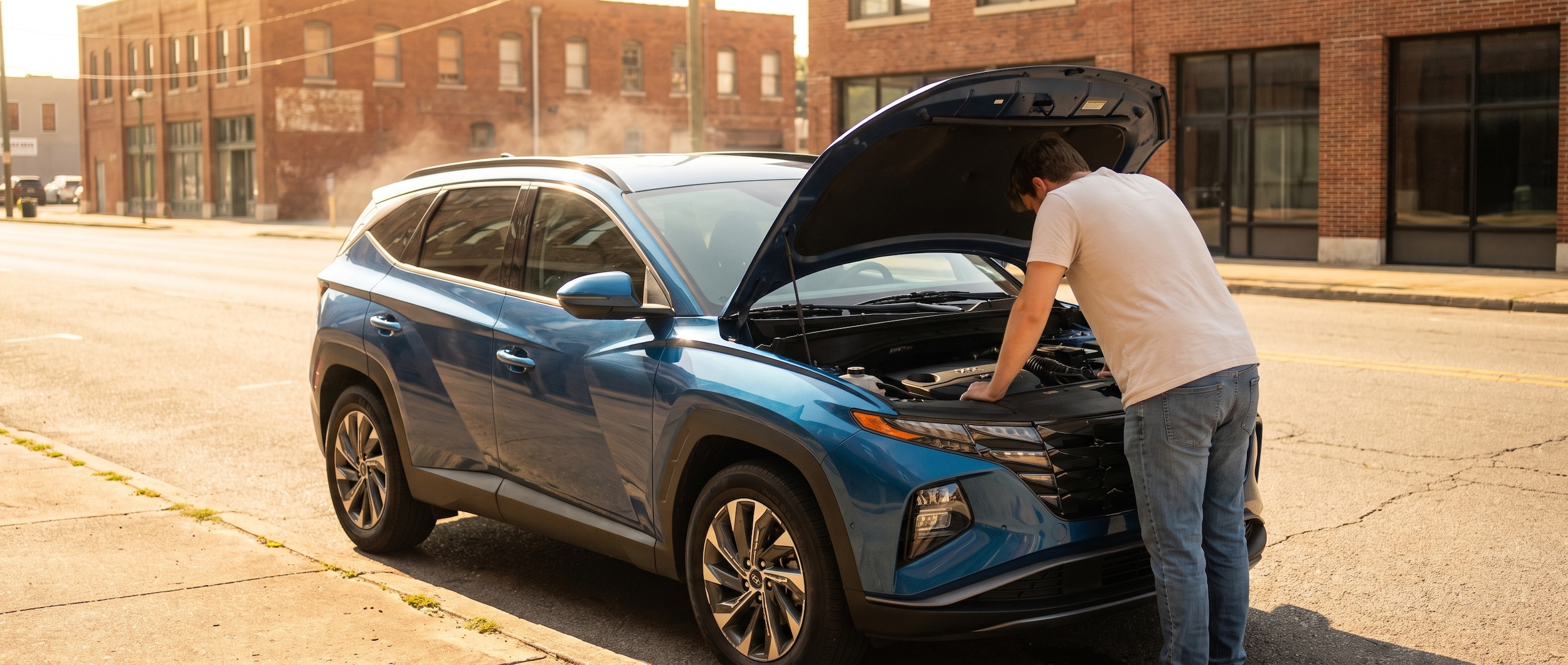
Birmingham's summer doesn't let up. July highs push into the mid-90s, and overnight lows barely dip below 70 degrees. Add the humidity and the heat index can exceed 105 degrees on a typical Birmingham afternoon. That combination does specific, measurable things to the systems in your Hyundai. A generic national checklist written for Phoenix or Minneapolis won't catch them. Here's what our service team at Hallmark Hyundai Birmingham actually checks when the Alabama heat is on.
Book your summer service visit here before peak-season appointments fill up.
What Goes on the Checklist?
Seven items belong on a Hyundai summer checklist here, and we'd work through them in order rather than picking and choosing, because each one targets a system that Birmingham's heat and humidity stress in a documented, predictable way.
- Battery load test (Have the battery tested with a load tester, not just a voltage reading.) Heat is the primary enemy of battery life, and the damage happens silently over summer.
- Coolant level and condition (Check the overflow reservoir when the engine is cold. Look for a brown or rusty tint; that signals degraded fluid.)
- Tire pressure (cold, morning only) (Check before the car has moved that day. Use the PSI on the driver-door jamb sticker, not the sidewall max.)
- Cabin air filter (A clogged filter forces your A/C blower to work harder.) Replace if it hasn't been changed in 12 to 15 months.
- Engine air filter (Alabama's summer thunderstorms kick up fine debris.) Hold it up to the light; replace if it's dark gray or blocked.
- Wiper blades (UV and humidity crack the rubber compound quickly in the South.) If they streak or chatter, they'll fail the first time you need them in a summer storm.
- Windshield washer fluid level (Pollen and road grime build up fast in humid air.) Top it off and keep a spare bottle in the trunk.
Why These Items Matter More in Alabama
On paper, those seven items look standard, and they'd fit any national checklist, but each one earns its place here once you factor in what Birmingham's summer actually does to the system behind it, and that gap is exactly where an Alabama checklist parts ways with a national one.
The battery issue is the most misunderstood. Heat quietly attacks one of the most important components under the hood. High temperatures speed up the chemical reactions inside a car battery, and that causes internal damage you won't spot until the engine refuses to start one morning. Winter tends to warn you with a sluggish crank, while heat-related failures come with little notice. Under-hood temperatures can reach 140 degrees or higher during a heat wave, and Birmingham sits in one from June through August. So a battery that tested "okay" in spring can turn up as a failure in July, because the damage builds before the symptoms show. It rarely warns you first.
Coolant protects more than the radiator. Hyundai says the coolant in most of its models should be replaced after the first 60,000 miles, then every 30,000 miles after that. If you're anywhere near those intervals and haven't had it checked, summer is the worst time to learn the fluid has degraded. Watch for engine overheating with a rising temperature gauge, a sweet or syrupy smell that often points to a coolant leak, and discolored or rusty fluid that no longer protects the engine.
The Tucson and the Santa Fe both run turbocharged engines, and those carry higher thermal loads than naturally aspirated ones. Modern Hyundai engines with turbochargers run hotter than older designs. The check matters even more there.
Tire pressure changes with temperature, and the direction can catch you off guard. For every 10 degrees the ambient temperature climbs, tire pressure rises by about 1 PSI, because the air inside expands as it heats and pushes harder against the inner liner. On a Birmingham afternoon, pavement temperature runs well above the air temperature. Overinflated tires have a smaller contact patch, which brings uneven wear and reduced traction. Underinflated tires add friction and heat buildup between the tire and the road, which can weaken the tire's structure and raise the risk of a flat or blowout during long summer drives. The only way to catch an accurate reading is to check cold, before the car has sat in the sun.
Load a Palisade with a full complement of passengers and luggage for a summer trip and two factors compound. The extra weight pushes pressure higher, and heavy load plus a hotter tire is exactly the scenario where a sidewall failure gets more likely.
Service tip: Birmingham's heat index and humidity keep the A/C system running almost nonstop from May through September. If yours blows cool but not cold, it may be low on refrigerant or leaking slowly at a fitting. Don't treat that as a filter-and-call-it-done fix. A certified Hyundai technician can run a proper leak test and recharge to manufacturer spec, and that matters because overcharging an A/C system causes compressor damage (not just inefficiency).
| Checklist Item | Why It Matters in Alabama Summer |
|---|---|
| Battery load test | Heat accelerates internal corrosion; damage is invisible until sudden failure |
| Coolant condition | Hyundai's 60k/30k interval matters more in sustained high-heat conditions |
| Tire pressure (cold) | Pressure rises ~1 PSI per 10 degrees; check before the car sees sun |
| Cabin air filter | Forces A/C blower harder; replace every 12-15 months minimum |
| Engine air filter | Summer storm debris clogs it faster than fall/winter driving |
| Wiper blades | UV and humidity crack rubber; streaking in a summer storm is dangerous |
| Washer fluid | High pollen and road grime loads drain it faster than you expect |
Your Print-and-Go Summer Recap
You can keep this whole checklist in one place, taped to the visor or photographed before your next service visit, and every item on it is something you can verify or act on yourself, with nothing vague and nothing that needs special tools beyond a tire gauge and your own eyes.
- [ ] Battery: load test performed (not just voltage)
- [ ] Coolant: level correct, fluid clear, no sweet smell or rust tint
- [ ] Tires: PSI set to door-jamb spec, checked cold before first drive of the day
- [ ] Cabin air filter: replaced if older than 12-15 months
- [ ] Engine air filter: clean and pale, not gray or blocked
- [ ] Wiper blades: no streak, no chatter, no cracked rubber
- [ ] Washer fluid: full reservoir, spare bottle in the trunk
- [ ] A/C: blowing cold consistently; if not, schedule a refrigerant check
If you knocked out all eight items, you've done the work that keeps a Hyundai road-ready through an Alabama summer. The reward's simple. You're not the person sitting in a parking lot waiting for a jump start when it's 95 degrees outside.
Frequently Asked Questions
Does summer heat actually kill car batteries faster than winter cold?
Yes, and this surprises a lot of drivers. Cold weather is what exposes a weak battery (it's harder to start an engine in cold temperatures, so a struggling battery shows its symptoms then). But the damage happens in summer. While the cold makes it harder to start your engine, the summer heat causes internal damage that can lead to permanent failure. The summer heat causes the damage, and the winter cold shows you the damage that's been done. In a climate like Birmingham's, where under-hood temperatures can climb well above 100 degrees for months at a time, that damage accumulates faster than in most of the country. If your battery's three years old or more, a load test before the heat of summer is worth doing.
How do I know if my Hyundai's coolant needs to be replaced?
The clearest signs are visible and have a smell. A sweet or syrupy odor around the engine often signals a coolant leak. Discolored or rusty-looking coolant is a sign of deterioration, meaning it's no longer effective at protecting the engine. You can also check the overflow reservoir yourself when the engine is cold. The fluid should be clear to slightly tinted, never brown or opaque. Beyond visual checks, Hyundai recommends replacing coolant in most of its models after the first 60,000 miles, then every 30,000 miles after that. Check your odometer against your last service record and use that interval as your guide.
Categories:
Social


