


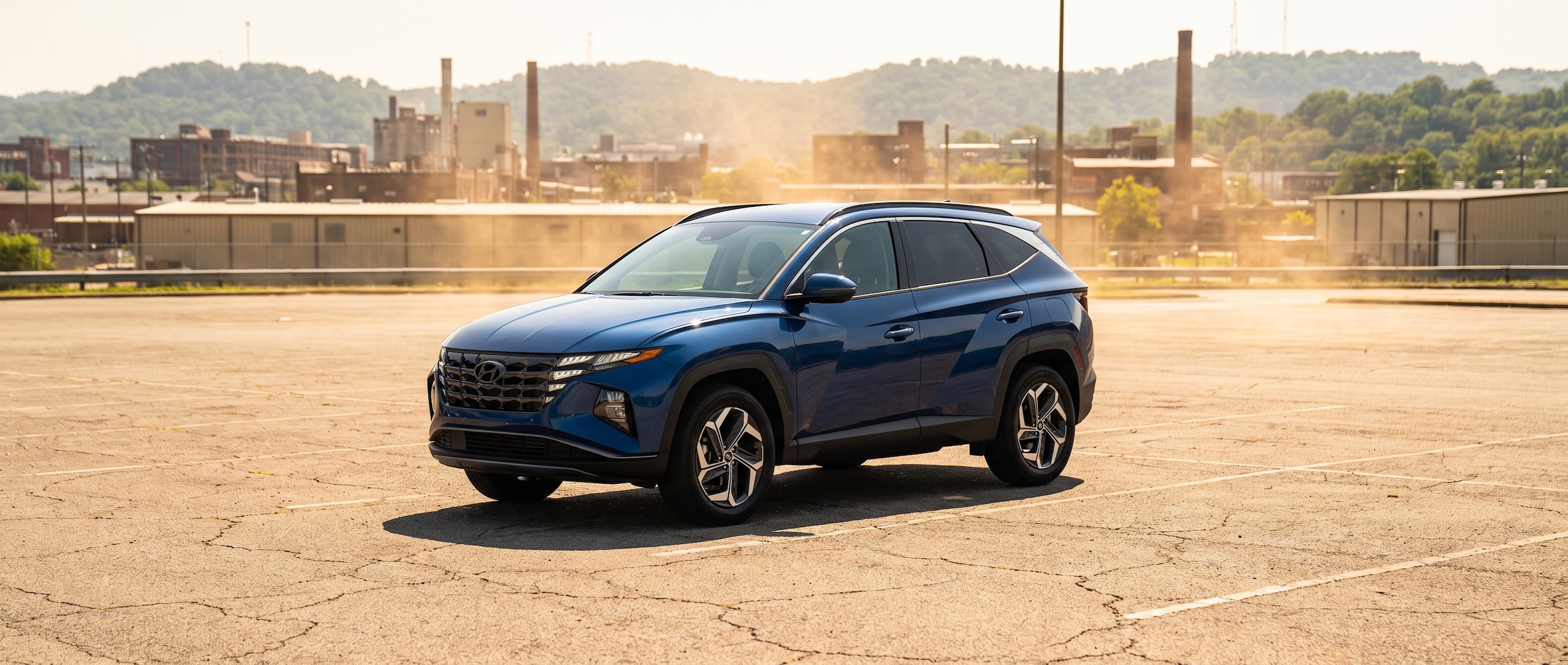
If you're shopping a used Hyundai Tucson right now, the model year you pick carries more weight than a lot of compact SUV guides let on. Hyundai gave the Tucson a full generational change for 2022, so there are two distinct vehicles wearing the same badge in Birmingham's used market today. Pick between them without knowing the reliability story and you're rolling the dice.
Here's the short version. The 2020 and 2021 model years hit the sweet spot for budget-minded used buyers, the 2022 first-year fourth-gen earns extra scrutiny before you sign, and July is a genuinely good month to run this search in Birmingham for reasons that go past dealer incentives.
The short version
- Sweet spot years: 2020 and 2021 (third-generation; 6-speed automatic; clean NHTSA complaint records, with the 2021 carrying just 1 recall and 58 total owner complaints per NHTSA data)
- Approach with eyes open: 2022 (first year of the 4th generation; 3 recalls and 433 owner complaints on file per NHTSA data; top issues in powertrain and fuel system)
- Strong years to avoid outright: 2016 and 2017 (third-gen first years; 2,016-plus NHTSA complaints for 2016 alone; DCT transmission and engine fire recall concerns)
- July advantage: Birmingham's average July high of 91 degrees F and 75% humidity let you actually stress-test A/C and cabin cooling on a test drive (the most honest conditions you'll get)
- Current new benchmark: the 2026 Tucson Hybrid is EPA-rated at 38 mpg combined (Blue SE trim), giving you a clear efficiency target when evaluating older hybrid years
Browse our current pre-owned Hyundai Tucson inventory
Which Tucson Model Years Are the Sweet Spot for Used Buyers?
The 2020 and 2021 Hyundai Tucsons give you the best mix of verified reliability, mechanical simplicity, and sensible used pricing in Birmingham's market today, with one caveat worth naming up front: they ride on older tech than the fourth-gen cars, so you trade a little cabin polish for a cleaner record. Both sit in the third generation (2016-2021) but show the generation at its most refined. Per NHTSA complaint data, the 2021 Tucson carried just 1 recall and 58 owner complaints, by far the cleanest record in the whole generation. The 2020 is nearly as strong.
What makes these years practical for Birmingham drivers is the powertrain. Third-gen 2019-2021 models came standard with a conventional 6-speed automatic, which replaced the 7-speed dual-clutch unit that gave early third-gen buyers so much grief. The dual-clutch's shuddering and delayed shifting under heat load (exactly the kind of driving you'll do crawling down I-20 in July) showed up among the most common complaints on 2016-2018 examples. That's a meaningful difference.
Beyond the transmission, the 2020 and 2021 also ride Hyundai's steady safety-tech expansion, with standard forward-collision warning, lane-keeping assist, and driver attention warning on both years. In Birmingham's stop-and-go merge traffic on I-65, those features do real work, not just checkbox duty.
| Model Year | Generation | Transmission | NHTSA Complaints (approx.) | Notable Recalls | Our Verdict |
|---|---|---|---|---|---|
| 2016 | 3rd gen | 7-spd DCT (1.6T) / 6-spd auto (2.0) | 2,087+ | 5 recalls; DCT, engine fire | Avoid |
| 2017 | 3rd gen | 7-spd DCT (1.6T) / 6-spd auto (2.0) | 1,373+ | Engine fire recall (2.0 GDI); verify Recall 209 completed | Avoid unless VIN-verified |
| 2018 | 3rd gen | 7-spd DCT (1.6T) / 6-spd auto (2.0) | 383 | ABS HECU recall (expanded Dec 2020) | Verify all recalls closed |
| 2019 | 3rd gen | 6-spd auto | 349 | ABS HECU recall | Watch; verify closed |
| 2020 | 3rd gen | 6-spd auto | Lower | ABS HECU recall (expanded to cover) | Sweet spot |
| 2021 | 3rd gen | 6-spd auto | 58 | 1 recall | Best used buy |
| 2022 | 4th gen | 6-spd auto / 8-spd auto | 433+ | 3 recalls; roof molding, brakes | Approach carefully |
| 2023 | 4th gen | 6-spd auto / 8-spd auto | Lower than 2022 | Fewer than 2022 | Solid if priced right |
| 2024-2025 | 4th gen | 6-spd auto / 8-spd auto | Early data | Emerging | Good, priced higher |
NHTSA complaint and recall data sourced from NHTSA.gov and recallexplained.com (covering through mid-2026).
The 2021 Hyundai Tucson logged just 1 NHTSA recall and approximately 58 owner complaints (the cleanest complaint profile in the third-generation lineup, per NHTSA data).
Which Tucson Years Should You Approach Carefully?
The 2022 Hyundai Tucson earns a longer look before you buy, while the 2016-2017 range is where we'd steer most buyers away outright, and the honest split is that one is a good car with first-year baggage and the other is risky even when it looks clean.
Begin with the 2016-2017 cars, because the numbers there are hard to argue with. Per NHTSA data compiled by recallexplained.com, the 2016 Tucson piled up more than 2,087 owner complaints, the highest volume in the nameplate's history. Pair a 7-speed dual-clutch transmission on the turbocharged 1.6-liter models with a separate engine fire recall on certain 2017 2.0-liter GDI versions, and these years get flat-out risky without documented recall completion. We've seen these come through our service lane, and the paperwork trail on a 2016-2017 either tells a clear story or it doesn't. If a seller can't show you recall completion documentation, walk away, plain and simple.
Now the 2022, which is a real dilemma. The fourth-generation Tucson is a better vehicle in almost every way, quieter and more tech-forward with stronger interior quality. But first-year production cars carry first-year problems, and the 2022 is no exception. Per NHTSA data, 433-plus owner complaints are on file, with the top reported areas being powertrain (82 complaints) and fuel propulsion system (76 complaints). Three recalls were issued. A 2022 that's been properly maintained and had its recalls addressed is a legitimate candidate, and we'd just insist on a clean VIN check and a pre-purchase inspection before signing anything.
ABS HECU recall: verify before you buy. On any 2019-2021 Tucson, confirm the ABS Hydraulic Electronic Control Unit recall is closed on the VIN. Per NHTSA records, Hyundai issued this recall in September 2020 for 2019-2021 Tucsons and then expanded it in December 2020 to cover 2016-2018 models as well. The HECU could corrode internally and cause a fire in the engine compartment. Treat it as a safety recall. Confirm it's closed on the VIN before purchase, not after.
See 2026 Hyundai Tucson specs and trim levels
Explore the 2026 Tucson Hybrid
Pros and Cons: Used 2020-2021 Tucson vs. Used 2022 Tucson
| Pros | Cons |
|---|---|
| 2020-2021: Proven 6-spd automatic; lowest complaint counts in 3rd gen | 2020-2021: Older tech stack; no 8-speed option; less cargo space than 4th gen |
| 2020-2021: NHTSA record is the cleanest in the generation | 2020-2021: ABS HECU recall must be confirmed closed on VIN |
| 2022: Full 4th-gen redesign; larger interior; stronger tech suite | 2022: Highest 4th-gen complaint count; powertrain issues documented |
| 2022: Closer to current-gen feature parity; more recently serviced | 2022: Roof molding detachment recall; brake control unit recall to verify |
| Both: Estimated annual repair cost is below the compact SUV average (per independent repair data) | Both: Hybrid variants require battery health check on any example over 40,000 miles |
Why Does July Matter for Used Tucson Shopping in Birmingham?
July matters for two concrete reasons in Birmingham, and both hold up better than the usual folk wisdom about summer car deals, even if neither one guarantees you a bargain on its own, since a good buy still comes down to the specific VIN in front of you. The heat hands you a free diagnostic, and the late-summer inventory cycle hands you a little leverage.
First comes the heat stress test. Birmingham's average July high runs 91 degrees F and humidity peaks at 75%, per climate data. Those aren't comfortable numbers. They're a diagnostic. A used Tucson with a marginal A/C compressor, a tired cabin blower motor, or a cooling system running on deferred maintenance will show you what it's hiding on a July afternoon test drive. We've had customers come back from summer test drives with clear evidence of a problem a February drive would have masked entirely. July strips out the ambiguity.
With the 2027 model year on the horizon, dealerships and private sellers holding 2023 and 2024 inventory start feeling pricing pressure in late summer. It gives the patient used buyer a structural advantage. You're not chasing scarcity in July, you're shopping a market that's loosening up rather than tightening.
On used Tucson Hybrids specifically: If you're buying a used Tucson Hybrid, the regenerative braking system behaves differently in summer than in winter. Birmingham's stop-and-go commute on I-20 through downtown is exactly the kind of driving where the hybrid system earns its efficiency. The EPA rates the 2026 Tucson Hybrid Blue SE trim at 38 mpg combined, with regenerative braking recovering energy on every deceleration. The same physics applies to a 2022 or 2023 used hybrid example, and you'll feel it working on a summer city drive in a way you simply won't on a flat highway cruise in mild weather.
Explore financing options at Hallmark Hyundai Birmingham
Which Tucson Year Is Right for Which Buyer?
Which Tucson year fits you comes down to how much risk you'll trade for how much tech, and after working through the data we land on four clear buyer profiles, each with a different best pick and a different thing to watch for before you sign.
You want the lowest ownership risk and don't need the latest tech. A 2020 or 2021 Tucson is your answer. Confirm the ABS HECU recall is closed on the VIN, look for a 2.4-liter non-turbo engine if fuel reliability tops your list, and budget for routine maintenance. Independent repair data puts the Tucson's estimated annual repair cost well below the compact SUV average, a reasonable baseline to plan around.
You want the most current features and you're willing to do the pre-purchase homework. A 2023 Tucson hits the fourth-generation sweet spot, past the 2022 first-year shakeout, carrying the full 4th-gen interior and tech package, with pricing softened against the 2024-2025 range. Do the VIN check, confirm recalls are closed, and get a pre-purchase inspection.
You're cross-shopping new vs. used and need a number to anchor on. The 2026 Tucson Hybrid earns an EPA-estimated 38 mpg combined on the Blue SE trim, and that's the current benchmark. A used 2022-2023 Tucson Hybrid will be meaningfully less efficient because the fourth-gen hybrid powertrain has been refined year over year, and the gap is worth weighing before you commit to a used example.
You drive hard commutes into downtown Birmingham on I-65 and need proven stop-and-go durability. The 2021 Tucson with the 2.4-liter naturally aspirated engine and the 6-speed automatic is the least complicated setup in the modern Tucson lineup. Simple, proven, and the complaint record backs it up.
A used Tucson from any of the recommended years is a practical vehicle. We'd rather you walk in knowing which year you want than spend an afternoon sorting options that don't fit your situation.
By the Hallmark Hyundai Birmingham Team | July 2026
Frequently Asked Questions
What is the best model year to buy for a used Hyundai Tucson?
The 2021 Hyundai Tucson is the strongest used buy in the third generation. Per NHTSA data, it logged just 1 recall and approximately 58 owner complaints (the cleanest record in the lineup before the 2022 redesign). The 2020 is nearly as strong. Both use a conventional 6-speed automatic transmission, which resolves the dual-clutch shuddering issues that affected 2016-2017 turbocharged models.
Which used Hyundai Tucson years should I avoid?
The 2016 and 2017 model years carry the highest risk. The 2016 Tucson accumulated more than 2,087 NHTSA owner complaints, and the 2017 2.0-liter GDI engine was subject to an engine fire recall that requires documented completion (Recall 209) before purchase. The 2022 first-year fourth-generation model also warrants careful scrutiny: 433-plus NHTSA complaints on file with reported powertrain and fuel system concerns. These years aren't necessarily unsellable, but each requires verified recall completion and a pre-purchase inspection.
Is July actually a good time to buy a used car in Birmingham?
July has two real advantages for Birmingham used-car shoppers. First, the heat is a natural stress test: Birmingham's average July high of 91 degrees F and 75% peak humidity will expose a marginal A/C system, a struggling compressor, or a cooling system running on deferred maintenance during a test drive in a way that cooler months simply won't. Second, the late-summer model-year pricing cycle puts downward pressure on 2023-2024 used inventory as the 2027 model year approaches, which tends to benefit buyers willing to shop in July and August rather than waiting until fall.
Categories:
Social


