

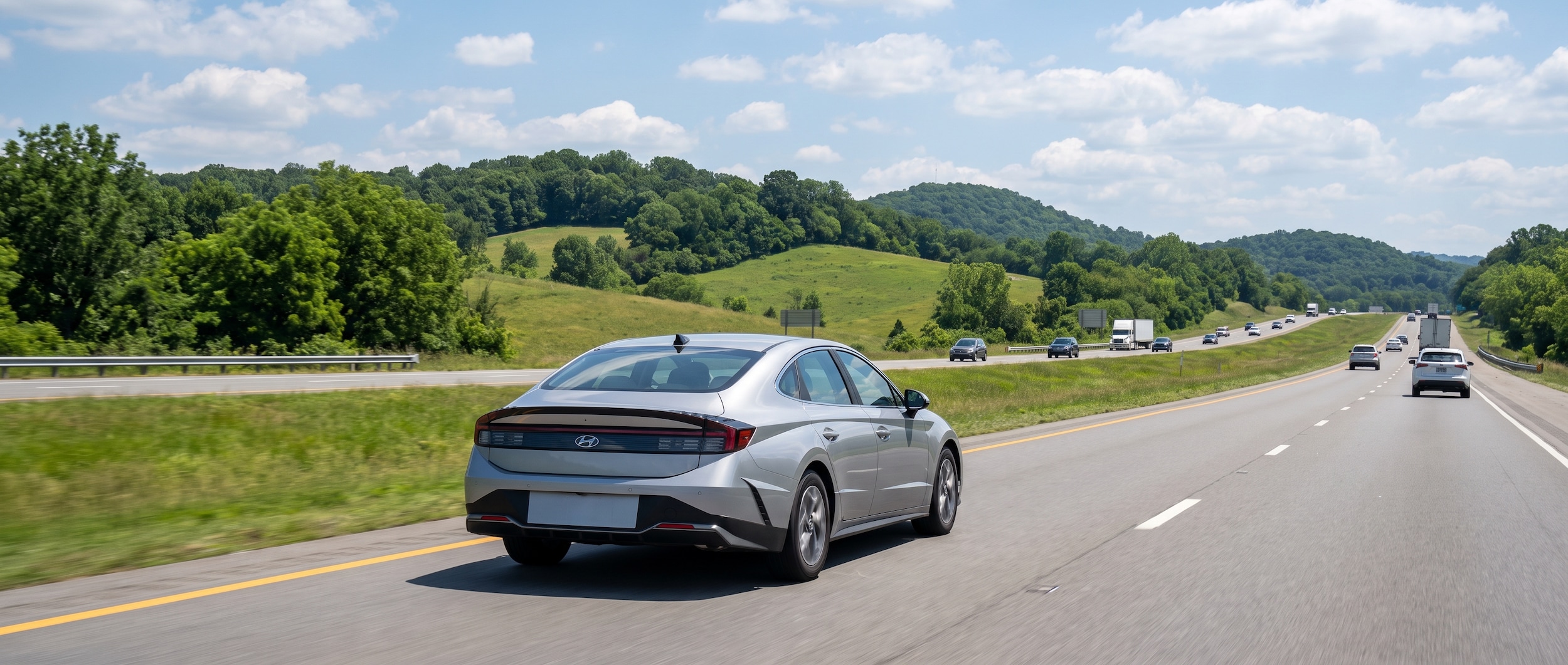
The Birmingham-to-Huntsville run on I-65 North covers about 102 miles -- roughly 90 minutes without traffic. That is short enough to feel routine and long enough for July's heat, afternoon thunderstorms, and summer construction slowdowns to turn a straightforward trip into something that demands real attention. The 2026 Hyundai Sonata earns its place on this corridor by pairing a genuinely comfortable cabin with a full suite of standard safety technology -- adaptive cruise with stop-and-go, lane-centering steering, and a driver attention warning system -- that actively handles the conditions most common between here and Huntsville.
The I-65 North Driving Playbook: What to Do and What to Avoid
The Sonata's technology is most effective when you use it correctly. July conditions on this corridor introduce three recurring hazards -- heat fatigue during the cruise, sudden afternoon thunderstorms near Cullman and Decatur, and construction-zone slowdowns on the north side of Birmingham -- and the do/don't table below maps them to specific inputs.
| Condition on I-65 North | Do | Do Not |
|---|---|---|
| Open highway cruise (Fultondale to Cullman) | Engage adaptive cruise and lane-centering to reduce fatigue on steady 70 mph stretches | Leave adaptive cruise off and attempt to manage following distance manually for 45-plus minutes in July heat |
| Afternoon thunderstorm | Reduce speed 5-10 mph below traffic flow; let the Sonata's AEB monitor the gap ahead | Rely on standard cruise control set to a fixed speed -- it does not adjust for sudden braking ahead |
| Construction work zone (I-65 near Gardendale or Fultondale) | Cancel cruise early, take manual control well before the cone zone begins | Attempt to let adaptive cruise manage a live work zone -- the system is designed for highway traffic, not variable construction patterns |
| Highway fatigue (mid-trip, anywhere north of Cullman) | Notice the driver attention warning chime, accept it, pull off at the next rest area or service plaza | Dismiss the chime and continue -- NHTSA's fatigue research links drowsy driving to roughly 100,000 police-reported crashes annually |
| Heavy rain on I-565 East into Huntsville | Increase following distance, slow to match visibility | Drive the posted limit if visibility drops to under 300 feet -- wet asphalt significantly extends stopping distances |
One Technique That Matters More Than the Rest
Browsing a new Sonata before a long drive is worthwhile, but so is knowing which single feature does the most work on this specific route.
Adaptive cruise control with stop-and-go is the right answer for I-65 North in July. The reason comes down to the specific way this corridor gets difficult: it is not one sustained challenge, but a repeating cycle of 70 mph open highway, sudden brake lights from construction slowdowns, and the occasional burst of rain that drops visibility and closes up following distances. A fixed-speed cruise control responds only to a steady road. The Sonata's adaptive system -- standard across the full 2026 lineup -- reads the vehicle ahead and adjusts throttle and braking continuously, so when a tractor-trailer drops from 70 to 45 in a work zone near Gardendale, the Sonata responds before you have consciously registered the situation.
The second feature worth activating for this run is lane-centering steering. North of Cullman, I-65 opens into long straight sections where the road feels effortless -- and that feeling is exactly when attention drifts. Lane-centering provides gentle, continuous steering inputs to keep the Sonata in the center of the lane. Combined with the driver attention monitor (which tracks steering behavior for signs of drowsiness and prompts you to take a break), these two systems work together across the full 102-mile run.
Checking your Sonata before a summer highway trip is also a practical step. Alabama's July heat index on I-65 regularly exceeds 100 degrees Fahrenheit -- conditions that stress tires and cooling systems on any vehicle.
The One-Line Safety Recap Before You Roll
Putting a Sonata in your driveway makes every I-65 run safer on day one -- but for today's trip, the short version is this: turn on adaptive cruise with stop-and-go, activate lane-centering, and respect the driver attention warning when it chimes. Those three features, all standard on the 2026 Hyundai Sonata, cover the three conditions that make the Birmingham-to-Huntsville corridor genuinely demanding in July.


