

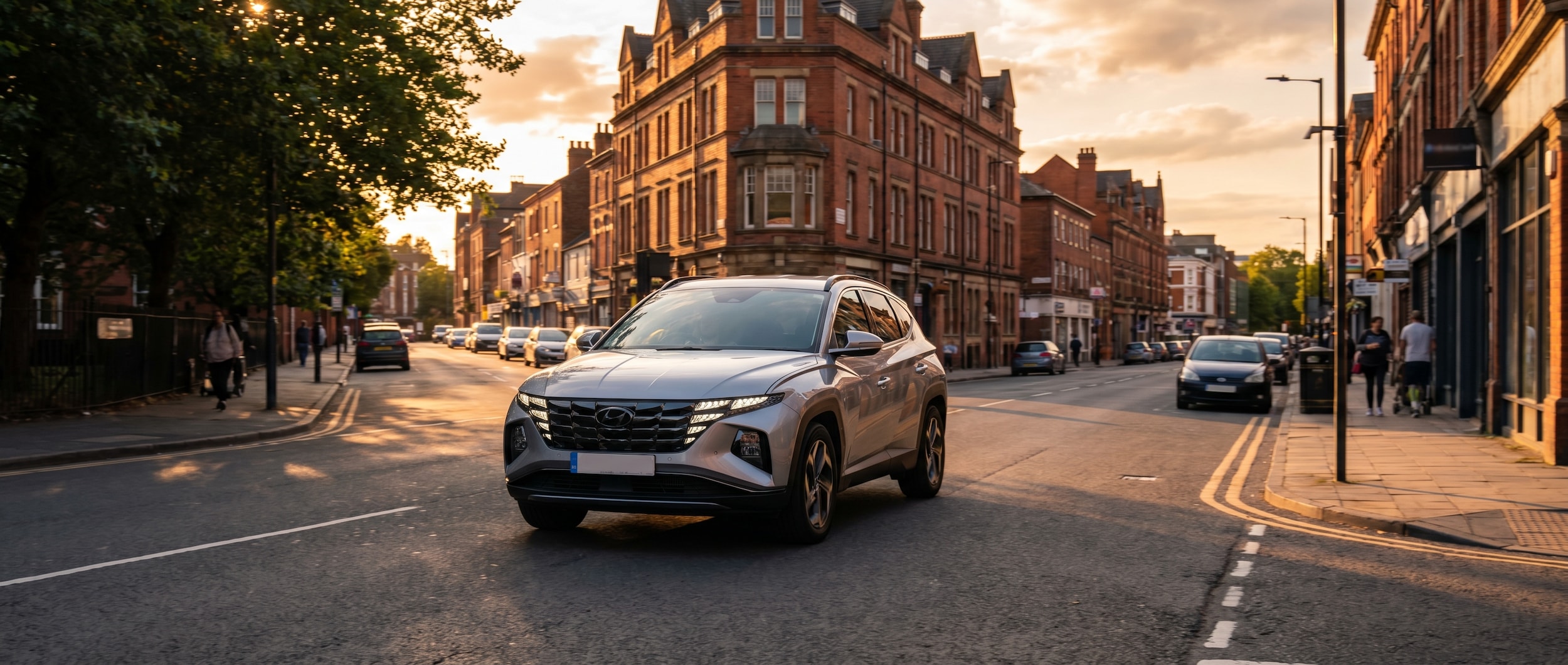
Birmingham drivers spend a lot of time sitting still. Between the I-20/I-59 interchange bottleneck near downtown, the crawl on Highway 280 through Mountain Brook heading toward Cahaba Heights, and the stop-and-go rhythm around Hoover and Vestavia Hills during rush hour, fuel efficiency in this city isn't just a nice talking point - it directly affects how much money leaves your wallet every week. The Hyundai Tucson Hybrid® was designed for exactly this kind of driving, and Birmingham, AL happens to be one of the places where its hybrid system pays off most.
How Stop-and-Go Traffic Actually Helps the Tucson Hybrid's Fuel Economy
Most gasoline engines waste energy in traffic - they keep burning fuel even when the car isn't moving. The Tucson Hybrid works differently. Its parallel hybrid system recovers energy during braking and deceleration, converting momentum back into electricity that gets stored and reused. This means every time you brake at the I-459 interchange or creep forward in line on Highway 31 through Homewood, the car is doing something useful with that energy instead of throwing it away as heat.
The EPA rates the 2025 Tucson Hybrid at 38 MPG combined for front-wheel drive models - a figure that holds up well in city-heavy driving patterns precisely because the hybrid system benefits from frequent speed changes.
Here's something most drivers don't consider: Highway 280 isn't just congested - it has significant elevation changes through the Appalachian foothills that force repeated acceleration and braking cycles. Those cycles are exactly where the Tucson Hybrid earns its efficiency gains compared to a traditional SUV.
Birmingham's Driving Reality: Where the Tucson Hybrid Fits the City's Geography
Birmingham, AL sits in a valley surrounded by ridges - Red Mountain to the south, Shades Mountain beyond that, and Jones Valley shaping the city's east-west spread. That geography creates a commuting pattern that's genuinely different from flat cities.
Drivers heading from neighborhoods like Trussville or Clay into downtown deal with sustained climbs and descents. Residents in Vestavia Hills or Hoover face similar terrain on their way to UAB, Protective Stadium events, or the Galleria area. These elevation changes demand more from an engine, and more engine demand means more fuel consumption in a conventional vehicle.
The Tucson Hybrid manages elevation well because its electric motor provides supplemental torque on climbs without forcing the gasoline engine to strain. On descents, regenerative braking recovers energy going downhill. The system isn't magic - it doesn't defy physics - but it manages the mountain-valley commute more efficiently than most drivers expect from a compact SUV.
Typical Birmingham commute scenarios where the Tucson Hybrid performs well:
- Hoover to UAB Medical District via I-65 (mixed highway and city)
- Trussville to downtown on I-20 with recurring stop-and-go
- Mountain Brook to Brookwood Village and back (surface roads with elevation)
- Irondale to Eastwood through city traffic
- Vestavia Hills to Lakeshore Drive along the ridge roads
The Tucson Hybrid isn't just efficient in ideal conditions - it's efficient in the conditions Birmingham drivers actually face.
Tucson Hybrid vs. Standard Tucson: What the MPG Difference Means Over Time
Numbers on paper don't always translate to real-world meaning. Let's put the efficiency difference in context that actually matters to a Birmingham commuter.
| Scenario | Standard Tucson (28 MPG Combined) | Tucson Hybrid (38 MPG Combined) |
|---|---|---|
| Daily 30-mile Birmingham commute | ~1.07 gallons/day | ~0.79 gallons/day |
| Weekly fuel usage (5 days) | ~5.4 gallons/week | ~3.9 gallons/week |
| Annual miles (15,000) | ~536 gallons/year | ~395 gallons/year |
| Annual gallons saved | - | ~141 gallons/year |
| Tank fill-up frequency | More frequent | Less frequent |
The difference isn't a rounding error. Over a full year of Birmingham commuting, the Tucson Hybrid consumes roughly 141 fewer gallons than its non-hybrid counterpart. Multiply that across your ownership period and the savings are tangible - regardless of what gas prices are doing at the pump.
Browse our new inventory to see current Tucson Hybrid configurations and available trim levels in stock.
Understanding the Tucson Hybrid's Features Beyond Fuel Economy
Efficiency is the headline, but the Tucson Hybrid brings other features worth knowing before you decide if it's the right fit.
Standard safety technology on Hyundai's SmartSense suite includes:
- Forward collision avoidance assist with pedestrian and cyclist detection
- Lane keeping assist and lane following assist
- Driver attention warning
- Blind-spot collision warning
- Rear cross-traffic collision warning
- Safe exit warning
These features matter in Birmingham's mixed urban and suburban driving environment. Downtown streets near Railroad Park and the entertainment district see significant pedestrian activity. The Galleria corridor in Hoover has dense surface road traffic with frequent merges. Having a system that actively monitors surrounding traffic reduces fatigue on longer commutes.
Beyond safety, the Tucson Hybrid's interior is well-organized for daily use. The 10.25-inch touchscreen, wireless Apple CarPlay and Android Auto, and heated front seats on most trims make it a genuinely comfortable daily driver rather than a vehicle you merely tolerate in traffic.
Strengths
- Strong real-world city fuel economy
- Electric motor adds smooth torque for hill climbs
- Full suite of driver assistance features standard
- Cargo space on par with non-hybrid models (no battery in the cargo area)
- AWD available for Alabama's wet weather conditions
Considerations
- Slightly higher upfront cost than the standard Tucson
- Hybrid system adds some complexity for DIY maintenance
- Plug-in hybrid (PHEV) version offers even more electric range if that's a priority
How the Tucson Hybrid Compares to Other Hyundai Models for Birmingham Commuters
The Tucson Hybrid is a strong fit for many drivers, but it's worth knowing where it sits relative to other Hyundai options before you make a decision.
The Hyundai Santa Fe Hybrid™ is worth a look if you need more passenger space or cargo room. It carries a third-row option (on the Calima trim), rides higher, and handles the same efficiency-focused hybrid system - making it a practical step up for growing families or those who frequently drive groups to events at Protective Stadium or Legion Field.
If your driving is almost entirely within Birmingham's city limits - short hops between Homewood, Forest Park, Five Points South, and downtown - the Hyundai Kona™ is worth considering. It's smaller, easier to park in tight urban lots, and still returns strong fuel economy numbers. It's also easier to maneuver through Lakeview's narrower streets during busy weekend nights.
| Model | Best For | Fuel Economy | Passenger Capacity |
|---|---|---|---|
| Tucson Hybrid | Birmingham commuters, mixed driving | 38 MPG combined | 5 |
| Santa Fe Hybrid | Families, longer highway routes | 36 MPG combined | 6-7 |
| Kona | City-focused, tight parking, short trips | 30 MPG (non-hybrid) | 5 |
The Tucson Hybrid lands in the middle of these two in terms of size and versatility - which is why it resonates with so many Birmingham drivers who split their time between city traffic, suburban errands, and occasional interstate runs toward Tuscaloosa or Gadsden.
What Birmingham Weather Means for Hybrid Ownership
Alabama's climate is worth factoring into your hybrid ownership expectations. Birmingham, AL sees hot, humid summers and mild-to-cool winters with occasional ice events. Hybrid batteries - specifically lithium-ion systems - are affected by temperature extremes, so understanding this matters.
Cold weather temporarily reduces electric range and regenerative braking efficiency. Birmingham rarely sees sustained sub-freezing temperatures, but January and February do bring cold snaps. The impact on a hybrid system is modest here compared to northern states, but it's not zero.
Summer heat, on the other hand, is where Alabama tests a hybrid more. The Tucson Hybrid's battery thermal management system helps regulate temperature, but parking in direct sun for extended periods does affect battery performance over years of use. Covered parking - whether at UAB, the Summit, or your home - extends long-term battery health.
The practical takeaway: Birmingham's climate is genuinely favorable for hybrid ownership compared to cities with harsh winters or extreme desert heat. You get most of the efficiency benefit year-round without the battery range losses that challenge hybrid owners in Minnesota or Montana.
Common Questions About the Hyundai Tucson Hybrid in Birmingham, AL
How does the Hyundai Tucson Hybrid perform in Birmingham's stop-and-go traffic?
The Tucson Hybrid is specifically well-suited for Birmingham's heavy urban traffic. Its regenerative braking system captures energy during stops and slow crawls, particularly on routes like Highway 280 and I-65 through the city. Drivers in stop-and-go conditions often see real-world fuel economy that meets or exceeds the EPA's 38 MPG combined rating.
Is the Hyundai Tucson Hybrid a good choice for Birmingham's hilly roads?
Yes - the Tucson Hybrid's electric motor provides supplemental torque during climbs, which is directly relevant to Birmingham, AL's valley-and-ridge geography. Routes through Vestavia Hills, Mountain Brook, and Trussville involve sustained elevation changes that challenge conventional engines. The hybrid system handles these gradients smoothly without excessive fuel consumption.
Does the Tucson Hybrid require special maintenance compared to the standard Tucson?
The Tucson Hybrid follows a similar maintenance schedule to the standard model for most services - oil changes, tire rotations, brake inspections, and fluid checks. The hybrid battery and electric components do require periodic inspection, but Birmingham's moderate climate means the battery management system faces less stress than in extreme climates. Hyundai covers the hybrid battery with a 10-year/100,000-mile warranty.
How does Birmingham's humidity and summer heat affect the Tucson Hybrid's battery?
Alabama's summer heat does create thermal stress on hybrid batteries over time, but the Tucson Hybrid includes an active thermal management system that regulates battery temperature during operation. Using covered parking when available - at the Galleria, Summit, or UAB facilities - reduces long-term heat exposure and helps maintain battery health across years of ownership.
What Hyundai Tucson Hybrid trim should Birmingham commuters consider?
The Blue trim offers the highest fuel economy at 38 MPG combined and includes core features like the SmartSense safety suite. The N Line and Limited trims add comfort and tech features at the cost of a small efficiency reduction. For commuters primarily motivated by fuel savings on Birmingham's congested corridors, the Blue or SEL trim represents a practical balance of features and efficiency.
Where can I test drive the Hyundai Tucson Hybrid near Birmingham, AL?
The team at Hallmark Hyundai Birmingham has Tucson Hybrid models available for test drives. Scheduling a drive on a typical weekday gives you a genuine sense of how the hybrid system performs in real Birmingham traffic conditions rather than an empty lot.
The Smart Call for Birmingham Drivers Who Are Tired of Paying at the Pump
Birmingham's roads aren't getting less congested. The commutes through Hoover, the crawl on 280, the interstate backups heading toward downtown - they're a consistent part of life here, and a conventional SUV turns every one of those idle minutes into wasted fuel. The Tucson Hybrid doesn't eliminate traffic, but it changes the cost equation for drivers who face it every day.
With 38 MPG combined, a safety suite that's genuinely useful in dense urban driving, and a size that works equally well in Lakeview parking or an interstate run toward Tuscaloosa, the Tucson Hybrid fits Birmingham driving in a way that feels deliberate rather than coincidental. When you're ready to see one in person, the team at Hallmark Hyundai Birmingham is here to help you find the right configuration for your commute and your priorities.


