

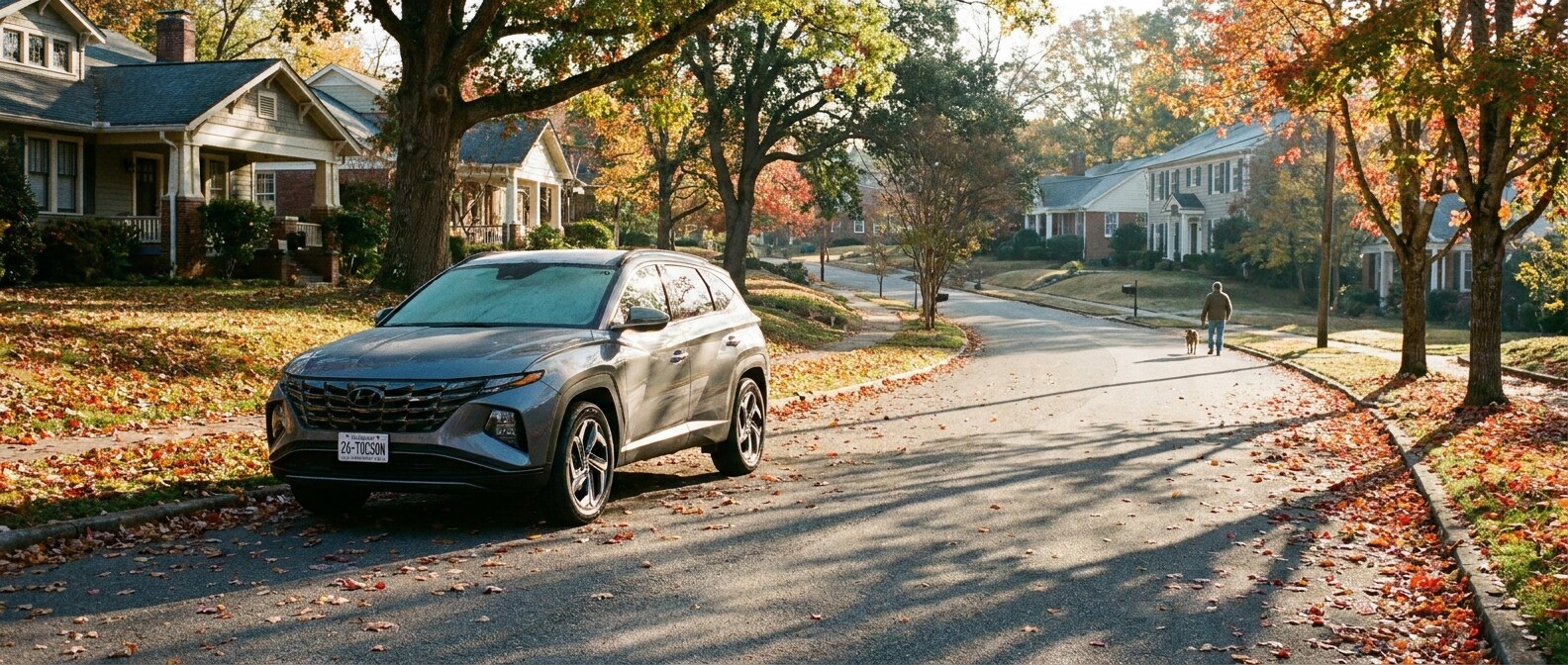
Yes, you do need to prep your Hyundai for winter in Birmingham, even if the forecast never shows a blizzard. A fair question before the first cold snap is whether mild weather lets you coast through, and the steps that are easiest to skip here are the ones that matter most. Alabama's winters don't deliver week-long deep freezes. What they deliver is a freeze-thaw cycle, temperatures crossing 32F repeatedly in a single day, and that pattern stresses tires, coolant, and batteries in ways sustained cold simply does not.
Add the ridge terrain that Mountain Brook sits on. The city grew up along the ridges of Red Mountain and Shades Mountain, with residential streets that wind through heavily wooded, north-facing slopes. Those shaded surfaces hit freezing faster than the open, flat roads downtown. Birmingham averages about 46 freezing nights per year per climate data, and every one of those nights runs the hill streets through a cycle that tests vehicle systems. Schedule the check now, before the first hard overnight low.
- Alabama's freeze-thaw cycle (temperatures crossing 32F repeatedly) is the main vehicle stressor in the Birmingham area, more disruptive to tires and coolant than sustained cold.
- Tire pressure falls roughly 1 PSI for every 10F temperature drop, per AAA's Car Care guidance, meaning a 30-degree overnight swing pulls 3 PSI from every tire before you leave the driveway.
- Hyundai's published maintenance schedule lists coolant concentration testing before winter and brake fluid inspection every 12 months, regardless of mileage.
- Mountain Brook's hilly, shaded residential streets along Red Mountain and Shades Mountain freeze before flat city roads, making traction-critical systems (brakes, tires) higher priority here than in flat suburban markets.
Book your pre-winter Hyundai service appointment now
Why Does Mountain Brook's Terrain Make Winter Prep Matter More Than You'd Expect?
Mountain Brook matters more than flat suburbs because it sits across the ridges of Red Mountain and Shades Mountain, where neighborhood streets wind through heavily wooded, north-facing slopes that freeze earlier than open ground, though the real risk tends to show up on isolated cold mornings rather than all winter long. The National Weather Service notes that black ice forms when roadway moisture freezes, and shaded, elevated surfaces reach freezing temperatures faster than open, flat roads. Alabama Law Enforcement Agency officials have specifically called out bridges, overpasses, and shaded areas as the highest-risk surfaces during Alabama winter weather events. Mountain Brook's residential streets fit that profile.
The freeze-thaw dynamic is the part worth sitting with. Birmingham doesn't sit in a sustained deep freeze the way Minnesota does. What it gets is temperatures that might reach 55F by afternoon and fall to 28F overnight. That cycle repeats, and it's genuinely harder on certain vehicle systems than steady cold. Tire pressure, coolant concentration, and battery state all respond to those swings. A vehicle that sits fine through a Midwest January may be less ready for Jefferson County's oscillating winter than you'd think.
Watch the morning commute routes out of Mountain Brook, too. U.S. Highway 280 and the Red Mountain Expressway (Alabama 149) use elevated bridge sections. Per the Alabama Department of Transportation, bridges and overpasses freeze before surface roads because cold air circulates below them. A vehicle with tires 3 PSI low and brakes not recently inspected sits in a different situation on those bridge sections than one that's been serviced.
Which Hyundai Systems Need Attention Before Alabama's First Freeze?
The systems worth attention are a focused handful that Alabama's freeze-thaw stresses hardest, and while the full manual lists more, the table below pairs each priority with a real service action and Hyundai's own schedule reference so you're working from the items that the pattern genuinely tests. Think of it as the short list, keyed to our local winter.
| Vehicle System | Why It Matters in Alabama's Freeze-Thaw Winter | Recommended Service Action | Hyundai Schedule Reference |
|---|---|---|---|
| Tire pressure | 1 PSI drops per 10F temperature fall; a 30-degree overnight swing pulls 3 PSI from all four tires | Check cold PSI against door-jamb placard; adjust to spec | Monthly checks; always after first cold snap |
| Engine coolant concentration | Hyundai specifies ethylene glycol coolant; diluted or aged coolant loses freeze protection and corrodes the water pump and radiator core | Test concentration; replenish or flush per schedule | First flush at 60,000 miles; every 30,000 miles after |
| Battery | Cold temperatures reduce battery output; freeze-thaw swings accelerate cell degradation in older batteries | Load test and cold-cranking amp check | Inspect at every service; replace proactively at 4+ years |
| Brake pads and fluid | Brake fluid absorbs moisture over time, reducing hydraulic pressure; stopping distance increases on wet, 34-degree hill roads | Inspect pad thickness; test brake fluid moisture content | Hyundai schedule: inspect every 12 months or 8,000 miles |
| Wiper blades and washer fluid | Alabama's primary winter precipitation is freezing rain, not snow; worn blades smear rather than clear | Replace blades if streaking; switch to freeze-rated washer fluid | Inspect every 6 months |
| Cabin air filter | Heating system works harder in cold; a clogged filter reduces defrost airflow to the windshield | Inspect; replace if visibly restricted | Inspect every 12 months or 15,000 miles |
Tucson owners running the turbocharged 1.6-liter engine should note one more item. Hyundai's owner's manual flags fresh engine oil before winter, because thermal breakdown from summer driving leaves oil with reduced cold-viscosity performance at startup.
Santa Fe and Palisade owners with the available all-wheel-drive system get one extra line. Hyundai's maintenance schedule lists transfer case and rear differential fluid as an inspect item at major service intervals for AWD-equipped vehicles. It runs about 10 minutes, and it's easy to let slide.
Schedule a Winter Vehicle Inspection
Which Services Can You Wait On, and Which Genuinely Cannot?
Some services can wait until mileage calls for them, but the ones that cannot are tied to Alabama's first-freeze trigger, the single overnight event that surfaces a weak battery, reveals coolant running at the wrong concentration, and delivers a tire pressure warning at the worst possible moment on a Mountain Brook hill road. Get ahead of that one night, and most of the drama goes away.
Brake fluid is the easy one to overlook. It's hygroscopic, meaning it absorbs moisture from the air continuously, whether you're driving or not. Hyundai's schedule calls for brake fluid inspection every 12 months precisely because of this. A vehicle that hasn't had its fluid tested in several years may be running on fluid with elevated moisture content, which reduces hydraulic pressure. On a wet, 34-degree morning on a residential hill road, that's the wrong moment to find out.
Coolant is the other non-negotiable. A 50/50 mixture of ethylene glycol and distilled water provides freeze protection to about minus 34 degrees Fahrenheit. Diluted coolant, the kind that gets topped off with plain water over time, loses that protection and also loses its corrosion-inhibiting properties for the water pump and radiator. Hyundai's owner's manual specifies ethylene glycol as the only acceptable coolant type because it handles both functions.
What can wait? Air filter replacement if it's not yet due by mileage. Cosmetic detailing. Tire rotation if you've rotated within the last 5,000 miles. We're not pushing services you don't need. The four that Alabama's winter stresses hardest are battery, coolant, brake fluid, and tire pressure. Address those four now.
Matching the Service to Your Hyundai and Your Driving Pattern
The right service priority this November depends on your specific Hyundai and how you drive it, so there's no single answer that fits every car, and the breakdown below sorts it by mileage, powertrain, and commute route using Hyundai's own maintenance documentation. Find your line and start there.
Higher-mileage vehicles with original batteries (4+ years): Battery load testing is the first call. Cold temperatures reduce the current a battery can deliver, and a battery that starts fine on a 65-degree October morning can behave very differently on a 25-degree January one. If the battery is original and the vehicle has more than 50,000 miles, test it proactively, before the mornings turn.
Hybrid owners: The 12-volt auxiliary battery in Tucson Hybrid, Santa Fe Hybrid, and Palisade Hybrid models is equally susceptible to cold-weather performance reduction as a conventional vehicle battery. Hyundai's hybrid maintenance documentation also includes inspection of the high-voltage cooling system, a separate circuit from the engine coolant loop. Have both checked.
Daily commuters into downtown Birmingham: Tire pressure and brake inspection first. The U.S. 280 corridor and the Red Mountain Expressway include bridge sections that ALDOT confirms freeze before surface roads. Getting tires to spec and confirming pad thickness buys real margin on those routes on a cold morning.
Newer vehicles or those with under 30,000 miles: Coolant concentration check and wiper blade inspection. The factory coolant fill is correct from the start, but vehicles with over 30,000 miles on the original fill are worth verifying. Alabama's freezing rain, the winter precipitation type the National Weather Service most commonly associates with Birmingham-area events, is exactly what worn wiper blades cannot handle.
We're at 1424 5th Ave N in Birmingham, and our service team can work through any of this with you. Same-day slots are often available now, at least for another few weeks. Availability tightens once the first cold front arrives.
Frequently Asked Questions
Do Birmingham-area drivers actually need to winterize their vehicles?
Yes, and Alabama's freeze-thaw cycle is the reason. Birmingham averages about 46 freezing nights per year per climate data, and the most stressful pattern for vehicle systems isn't sustained cold but temperatures that cross 32F repeatedly in a short period, as Alabama's winters typically deliver. That cycle drives tire pressure swings, stresses coolant that isn't at the correct concentration, and reveals battery weakness faster than steady cold would. Mountain Brook's hilly terrain and shaded roads make this more pronounced than in flat suburban markets.
Why does my Hyundai's tire pressure warning light come on every cold morning?
The air inside your tires contracts when temperatures drop. Per AAA's published Car Care guidance, tire pressure falls roughly 1 PSI for every 10-degree Fahrenheit drop in temperature. A 30-degree overnight temperature drop pulls about 3 PSI from each tire, often enough to trigger the TPMS light before you've driven a mile. Check cold PSI (before driving) against the pressure listed on your door-jamb placard, not the maximum printed on the tire sidewall, and inflate to spec. If the light returns after correction, have the tires and sensors inspected by a technician.
How often should my Hyundai's brake fluid be tested?
Hyundai's maintenance schedule calls for brake fluid inspection every 12 months or 8,000 miles, whichever comes first. Replacement is scheduled at 48,000 miles and then every 48 months after that. Because brake fluid absorbs moisture continuously from the atmosphere regardless of driving frequency, the inspection interval is time-based, not purely mileage-based. A pre-winter service visit is a practical time to address it before wet and cold road conditions arrive.


