

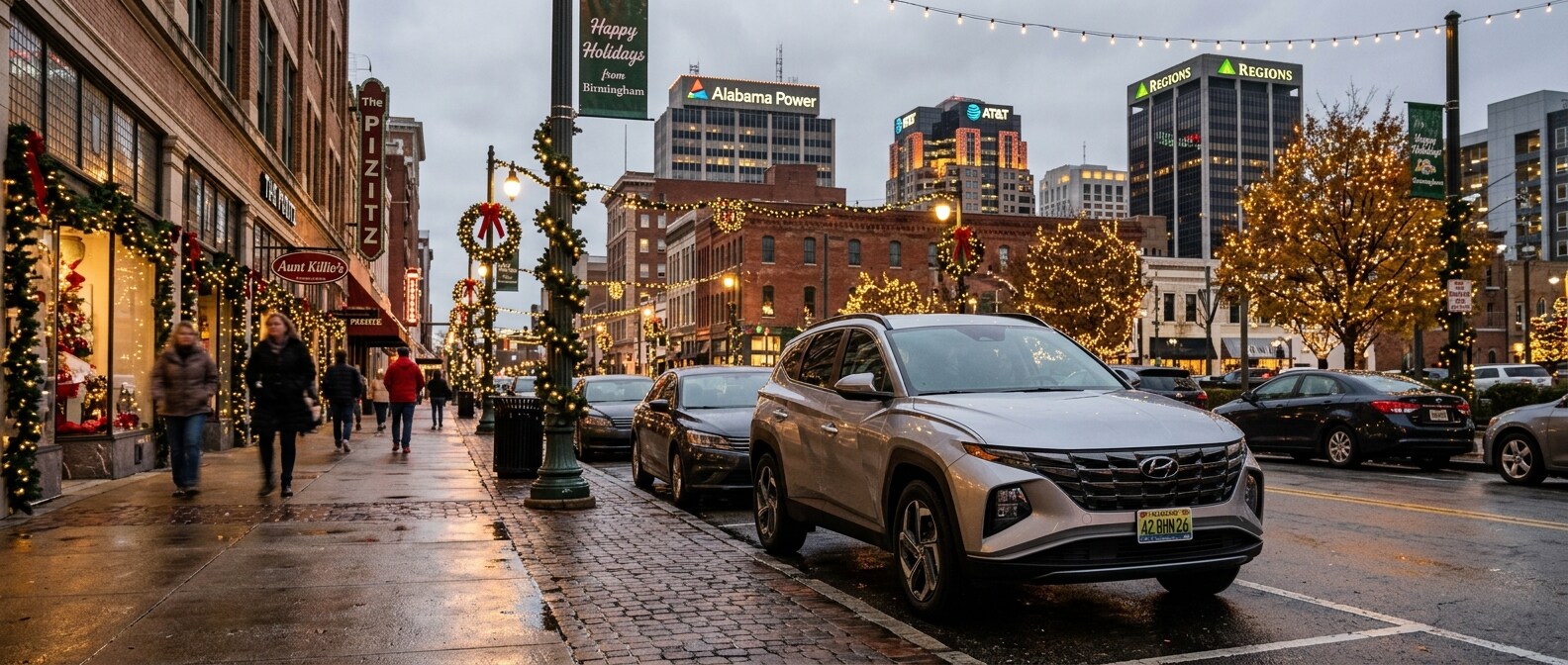
A lot of shoppers are surprised to learn that the worst stretch of holiday traffic in Birmingham is where the 2026 Hyundai Tucson Hybrid does its best work.
Most of the hybrid-saves-gas talk centers on long highway road trips, and for Birmingham that framing has it backwards. When you're inching through the I-65 and I-20/59 interchange at Malfunction Junction with half of Jefferson County on the same road, the Tucson Hybrid isn't suffering through the congestion, it's using it. Every time you lift off the throttle or touch the brake, the hybrid system's regenerative braking converts that kinetic energy back into electricity and tops up the battery. Stop-and-go is the exact operating condition where hybrids perform closest to their EPA ratings. The holiday corridor from Hoover up through downtown and out toward Vestavia Hills and Homewood works in this vehicle's favor, effectively a free recharge event built into every commute.
We want to make that case with real numbers, honest trade-offs included. Both sides are here.
Why Does the Tucson Hybrid Fit Birmingham's Holiday Roads?
The Tucson Hybrid fits Birmingham's holiday roads because the congestion that frustrates a gas engine is the same congestion a hybrid turns into recharging, though that advantage does narrow once you leave the city for steady open highway. The table below maps the driving conditions you'll actually face this November and December against the features built to handle them.
| Birmingham Holiday Condition | Tucson Hybrid Feature | Why It Matters Here |
|---|---|---|
| Stop-and-go on I-65 (Bessemer through Hoover to downtown) | Regenerative braking | Recovers kinetic energy on every deceleration; congested traffic replenishes the battery rather than draining it |
| Malfunction Junction merge (I-65/I-20/I-59) | 231 hp turbocharged hybrid system | Confident acceleration for lane changes and merges; no hesitation when the gap opens |
| Hwy 280 surface-street congestion | Idle Stop & Go system | Engine shuts off at a complete stop, restarts instantly; no fuel burned sitting at red lights |
| Holiday shopping runs (parking lots, short trips) | 36-38 mpg city (EPA estimate by trim) | City mpg matches or exceeds highway mpg; short errand trips don't penalize the Tucson Hybrid the way they hit a gas engine |
| November/December rain and occasional ice on overpasses | Standard HTRAC all-wheel drive | Available on every trim; traction management included with no AWD upcharge |
| Family road trip (I-65 south to the Gulf or north to Nashville) | 271 lb-ft torque; EPA-estimated 493-mile total range | Strong pull with a loaded cabin; covers serious distance on a tank |
The Efficiency Gap Is Widest Right Here in the City
The EPA rates the 2026 Tucson Hybrid at up to 38 mpg in city driving for the Blue SE trim, and that city figure is where the hybrid pulls furthest ahead of the gas model, though the margin tightens on open highway. The SEL, SEL Convenience, and Limited trims come in at 36 mpg city (EPA estimate). Compare those figures to the gas-only 2026 Tucson, which the EPA rates at 25 mpg city. You're looking at a gap of 11 to 13 mpg in urban driving. On the open highway the numbers tighten, with the gas Tucson earning 33 mpg highway against 37-38 for the hybrid. Still a real difference, though noticeably narrower than the city numbers show.
What all that tells you is simple. If your holiday driving skews heavily toward Birmingham's surface streets, suburban errands, and congested interstates, the Tucson Hybrid is about as well-matched to your situation as it gets. Check our current Tucson Hybrid inventory to see which trims are available right now. According to the EPA's fueleconomy.gov data, the Tucson Hybrid delivers substantial estimated annual fuel savings compared to the average new vehicle, and that calculation uses a blended city/highway cycle. Shift the mix toward Birmingham city driving, as the holiday season naturally does, and the savings lean further in the hybrid's direction.
Does the open highway change the math? Some. If your primary use is long, steady open-highway miles with almost no urban driving attached, the efficiency case for the hybrid is real but less dramatic. The gap over a gas Tucson narrows on uncongested interstates, and the premium takes longer to recover. Call that the honest trade-off, worth knowing before you decide.
231 Horsepower, Standard AWD, and a Powertrain That Earns Its Keep
The Tucson Hybrid pairs a 1.6-liter turbocharged four-cylinder engine with a 47.7-kilowatt electric motor, and Hyundai's specifications put total system output at 231 horsepower and 271 lb-ft of torque. That number means a lot for a compact SUV, and the vehicle doesn't feel sluggish at highway entry ramps or during the kind of confident, assertive merging Malfunction Junction demands on a busy Friday afternoon.
Hyundai's HTRAC all-wheel drive comes standard on every 2026 Tucson Hybrid trim, so you don't spec up for it. Birmingham sits in north-central Alabama. The area doesn't see northern-tier winter conditions, but November and December do bring temperature drops that can produce ice on bridges and overpasses along I-65, I-20, and I-59, particularly overnight and in the early morning. Standard AWD means you're not making a last-minute trim decision based on the weather forecast.
The 2026 Tucson Hybrid lineup spans four trims, the Blue SE, SEL, SEL Convenience, and Limited. The Blue SE leads on efficiency at 38 mpg combined (EPA estimate), while the other three sit at 36 mpg combined (EPA estimate) with added equipment at each step. All four carry standard AWD.
See Current Tucson Hybrid Offers
Who the Tucson Hybrid Fits and Where It Has Limits
For a Birmingham family doing a mix of holiday shopping runs, Homewood and Hoover suburban errands, and the occasional I-65 trip to visit family in Montgomery or Huntsville, the Tucson Hybrid is a genuinely practical fit, though a household regularly hauling more than five people will want to look higher up the lineup. The stop-and-go these routes generate during the holiday weeks isn't an inefficiency for this powertrain, it's the input the system is designed to convert.
Cargo space is real. Hyundai lists 38.7 cubic feet behind the rear seats and 74.1 cubic feet with the rear seats folded, which handles most holiday travel packing without creative tetris. Five adults fit comfortably for a mid-length road trip. If you're regularly traveling with more than five people or consistently hauling a third row of passengers, the Palisade Hybrid gives you that configuration with a hybrid powertrain. For the family of five doing the typical Birmingham-area holiday run, the Tucson Hybrid is sized right.
The 2026 model is the final year of the current generation. A redesigned 2027 Tucson Hybrid has been revealed, but it won't reach North American dealers until early 2027. So the 2026 is a known, well-developed vehicle with a clear track record, available now, with no waiting on inventory for a new model.
By the Hallmark Hyundai Birmingham Team | November 2026


