

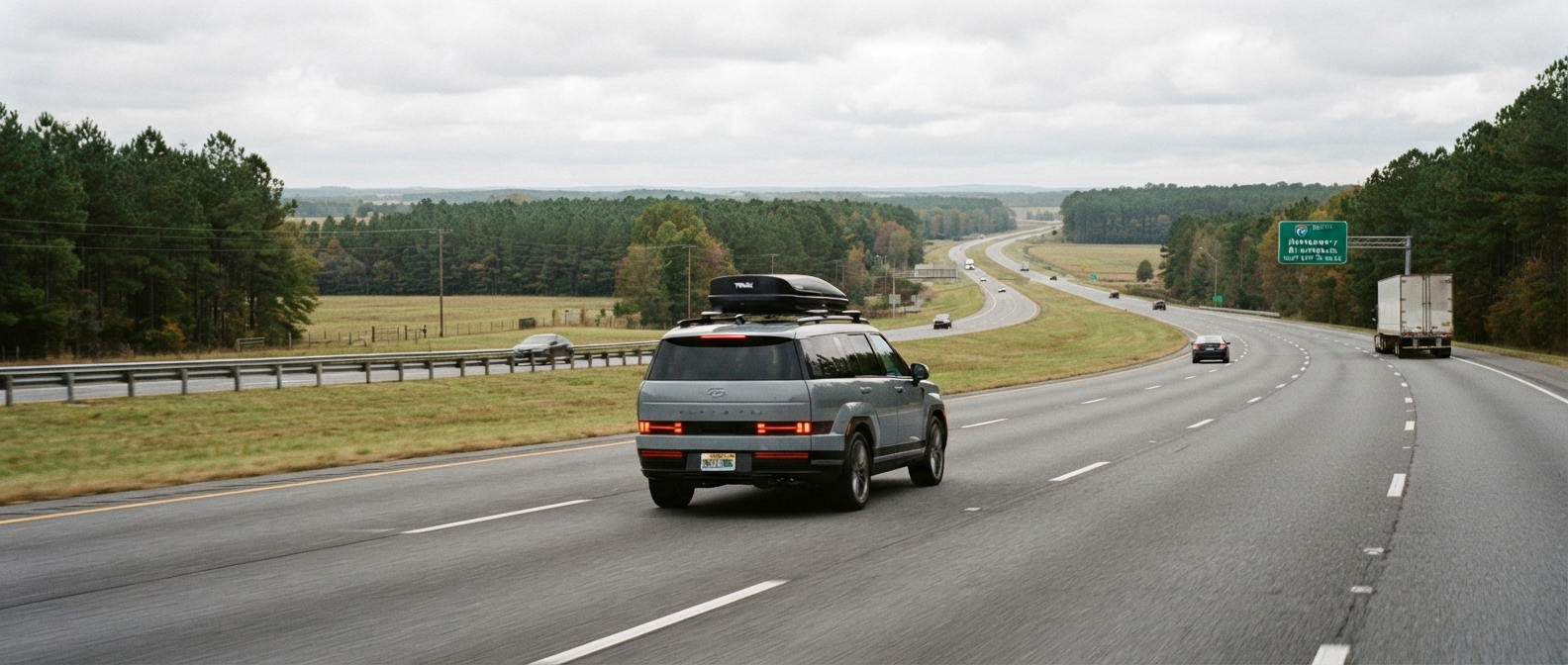
The Birmingham-to-Mobile run on I-65 covers about 257 miles of mostly flat, open interstate. It sorts the Santa Fe lineup fast, because the right version depends less on the SUV and more on who's riding with you.
Let's lay the tradeoff out plainly. The 2027 Santa Fe comes in three meaningfully different configurations. You've got the standard 2.5-liter gas model (including the off-road-ready XRT), the Hybrid, and the AWD variants within each. They seat the same number of people and carry identical cargo. But on a 4-to-5-hour run down I-65, the powertrain choice changes what you pay at the pump, how relaxed the third row feels at the midpoint, and whether you can back a boat trailer out at the Gulf State Marina. None of that is small.
- Best for fuel economy and small families: the 2027 Santa Fe Hybrid FWD (EPA-estimated 36 mpg combined). It's the version we'd put most Birmingham buyers in for this specific run.
- Best for towing and full 7-seat capacity: the 2027 Santa Fe gas (up to 3,500 lb tow rating, same cabin space, 277 hp).
- Best for grip and light off-road detours: the 2027 Santa Fe XRT AWD, with the highest ground clearance in the lineup and all-terrain tires standard.
- Honest downside shared by all three: the third row is there but tight. 30.0 inches of legroom means it's comfortable for kids and manageable for shorter adults on a trip this length, but not an all-day seat for a six-foot adult.
- The gas hybrid gap on this route: at EPA combined estimates, the Hybrid uses roughly 3.5 fewer gallons per leg than the XRT AWD. That adds up on a round trip.
The 2027 Santa Fe Hybrid is our top pick for this drive, but not for everyone. Read on for the full comparison.
How Do the Three Santa Fe Configurations Compare on This Route?
The three configurations split cleanly on fuel, towing, and traction even though they share one cabin. The Hybrid sips the least over 257 miles, the gas and XRT trims pull the heaviest trailers, and every one of them seats seven in the same footprint. Here's what those specs mean for a Birmingham-to-Mobile I-65 run of 257 miles.
| Configuration | EPA Combined MPG | Approx. Gallons (257 mi) | 3rd-Row Legroom | Tow Rating | Best For |
|---|---|---|---|---|---|
| Santa Fe Gas FWD | 24 mpg (EPA est.) | ~10.7 gal | 30.0 in | 3,500 lb | Full crew, trailer |
| Santa Fe Gas AWD | 23 mpg (EPA est.) | ~11.2 gal | 30.0 in | 3,500 lb | All-weather, trailer |
| Santa Fe Hybrid FWD | 36 mpg (EPA est.) | ~7.1 gal | 30.0 in | 2,000 lb | Fuel-conscious family |
| Santa Fe Hybrid AWD | 34 mpg (EPA est.) | ~7.6 gal | 30.0 in | 2,000 lb | Efficiency + grip |
| Santa Fe XRT AWD | 21 mpg (EPA est.) | ~12.2 gal | 30.0 in | 4,500 lb | Off-road, heavy towing |
EPA estimates for the 2027 Santa Fe lineup come from Hyundai's published specifications. Actual fuel economy varies based on load, speed, and conditions. All cargo figures stay identical across configurations. Expect 14.6 cubic feet behind the third row and 40.5 cubic feet with the third row folded.
Which Santa Fe Powertrain Makes Sense for a 4-Hour Highway Drive?
For this corridor the Hybrid wins, and the reason is structural rather than promotional. I-65 holds a steady cruise long enough that the electric motor keeps shaving load, so the efficiency gap over the gas trims actually holds on open road instead of collapsing the way it can with weaker hybrids.
I-65 between Birmingham and Montgomery runs at a sustained 70-mph cruise for nearly 90 miles before you hit any meaningful stop-and-go. On paper that's hybrid-unfriendly terrain (hybrids usually shine in city traffic where regenerative braking adds up). But the 2027 Santa Fe Hybrid's EPA highway estimate is 36 mpg even so, because the 1.6-liter turbo-hybrid system runs the electric motor to reduce load at highway speeds, not just to recapture braking energy. The upshot is that Hyundai rates the Hybrid at 36 mpg combined, against 24 for the standard 2.5-liter gas model, and that gap holds on open-road driving like I-65 because the system keeps the combustion engine out of its least-efficient operating range.
Pulling a trailer? The gas Santa Fe makes the stronger argument. The standard 2.5-liter turbo produces 311 lb-ft of torque and carries a 3,500-lb tow rating, versus the Hybrid's 2,000 lb. If you're loading a boat trailer for a weekend on Mobile Bay, that difference matters. The XRT pushes the gas model's tow rating to 4,500 lb with trailer brakes, and adds 8.3 inches of ground clearance, standard all-terrain tires, and Terrain Mode (Snow, Mud, Sand). For I-65 itself, you won't need any of that. But if the plan includes coastal back roads south of Mobile after you arrive, the XRT is the version that handles them.
The Palisade is worth a conversation if a full six-foot adult in the third row for the whole trip is non-negotiable. The Santa Fe's third row carries 30.0 inches of legroom, which is genuine and comfortable for kids, and workable for most adults on a one-stop trip. But it's not the Palisade's rear row.
The 2027 Santa Fe Hybrid FWD uses an EPA-estimated 7.1 gallons for the 257-mile Birmingham-to-Mobile run. The XRT AWD uses an estimated 12.2. On a round trip, that's more than 10 gallons of difference between those two versions of the same vehicle.
Pros and Cons: Santa Fe Hybrid vs. Gas vs. XRT for This Drive
| Pros | Cons |
|---|---|
| Hybrid: 36 mpg combined (EPA est.). Best fuel economy in the lineup | Hybrid: 2,000-lb tow limit rules out larger trailers |
| Gas FWD/AWD: 3,500-lb tow rating, 277 hp, 311 lb-ft torque | Gas: 24 mpg combined. About 3.6 more gallons per leg than Hybrid FWD |
| XRT AWD: 4,500-lb tow rating, 8.3 in ground clearance, all-terrain tires | XRT: 21 mpg combined, the least fuel-efficient Santa Fe for a highway run |
| All configs: identical 14.6/40.5/79.6 cu ft cargo, 7-passenger seating | All configs: 30.0 in third-row legroom. Comfortable for kids, tight for tall adults on 4+ hour drives |
| Hybrid: no plug-in required, no charging stop needed on I-65 | Hybrid: mild-hybrid architecture won't deliver EV-range savings like a PHEV |
Pick the Santa Fe That Fits Your Trip
The Santa Fe Hybrid FWD is the call for most Birmingham families making this drive regularly, since it asks for no charging on I-65 and no range planning, and the only real catch is the lighter tow rating that matters just to buyers hauling a trailer. The 17.7-gallon tank at 36 combined mpg gives you a theoretical range of around 635 miles. You'll finish Birmingham-to-Mobile and the return trip on one tank, without pushing it. The cabin matches every other Santa Fe, with 14.6 cubic feet behind the third row (enough for soft-sided bags for a weekend), 40.5 with the row folded, and 79.6 with both rear rows flat. If it's four people and gear, the third row folds, the second row reclines, and the trip is comfortable.
A trailer flips the recommendation to the gas Santa Fe. A boat, a small camper, a cargo trailer for a Gulf Shores move, the 3,500-lb rating on standard gas trims handles them. The XRT bumps that to 4,500 lb, adds available Terrain Mode, and is the version that makes sense if your trip regularly ends somewhere south of Mobile on unpaved county roads or coastal wildlife refuges where the surface gets soft. The XRT also drinks the most fuel of any Santa Fe. No way around that.
Hybrid AWD splits the difference. You get 34 mpg combined at EPA estimates, the same HTRAC all-wheel drive the gas models offer, and 35 city for those of you navigating Birmingham's Five Points South construction before you even reach the highway. It trades two mpg against the FWD Hybrid for genuine wet-road confidence. In November in Alabama, when the pine needles are down and the morning pavement is slick, that counts for something.
The bottom line on the third row is that it's genuine seating, not a penalty box. Hyundai lists 30.0 inches of legroom and 53.5 inches of shoulder room back there. On a 257-mile drive with one gas stop, or none in the Hybrid. Kids ride comfortably. If you're putting two adults in that row for the whole run, talk it through before you leave Birmingham.
Explore financing options for whichever configuration fits your trip profile. We're glad to walk through the build on any Santa Fe trim.
Frequently Asked Questions
Is the Hyundai Santa Fe Hybrid worth it for a long highway drive like Birmingham to Mobile?
Yes, and the reason is more specific than general hybrid praise. The 2027 Santa Fe Hybrid earns an EPA-estimated 36 mpg combined with front-wheel drive, including a 36 mpg highway estimate, because the 1.6-liter turbo-hybrid system reduces combustion engine load even at sustained highway speeds, not only in stop-and-go traffic. On the 257-mile Birmingham-to-Mobile I-65 corridor, that works out to roughly 7.1 gallons one-way at EPA combined estimates, compared to about 10.7 for the standard 2.5-liter gas model. The Hybrid requires no plug-in, so there's no charging stop needed on I-65. The tradeoff is towing capacity: the Hybrid is rated at 2,000 pounds, while the standard gas Santa Fe carries a 3,500-lb rating.
How much luggage fits in a 2027 Santa Fe with the third row in use?
Hyundai lists 14.6 cubic feet of cargo space behind the third row on all 2027 Santa Fe configurations, gas and Hybrid alike. That's enough for a weekend's worth of soft-sided bags or a stroller, but not a full set of hard-shell luggage for four. If you're traveling with the third row occupied by kids and the second row by adults, plan bags that can flex. Duffels and soft cases load more efficiently than rigid luggage in that space. Fold the third row and cargo jumps to 40.5 cubic feet. Fold both rear rows and the Santa Fe opens to 79.6 cubic feet. The hybrid battery does not reduce the cargo floor, so the layout is identical to the gas model.


