

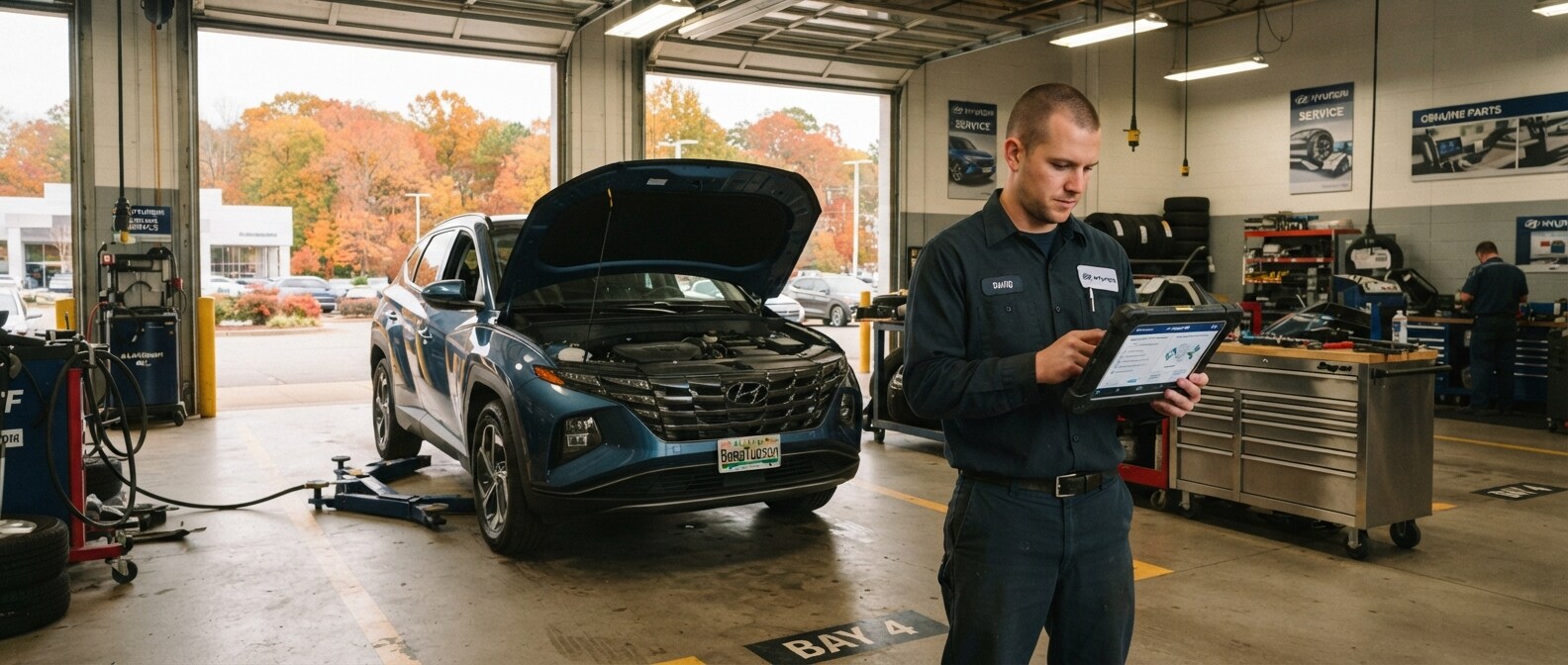
Your Hyundai starts fine every morning. Starting fine isn't the same as being ready for a loaded car, holiday traffic on I-20, and whatever the Alabama sky decides to do between now and Sunday.
A driveway walk-around catches plenty, and it still misses the three items behind most unplanned roadside stops during the holiday week. Think battery capacity under load, moisture contamination in brake fluid, and the under-car components a technician checks with the wheels off. We're not asking you to panic. We're asking you to know the difference between what you can clear yourself in ten minutes and what belongs with our team before you load the car.
- Tire pressure, washer fluid, and lights: check these at home the morning you leave. Cold tires, not after a warm-up.
- Battery, brake fluid moisture, and under-car inspection: these require a technician and a lift. If your battery is three or more years old, test it before the trip.
- Hyundai's multi-point inspection (MPI) covers six inspection zones at every service visit, and it's included at no extra charge when you're in for any other service.
- Schedule service now. Trussville shop schedules fill fast in the week before Thanksgiving, and any parts that need ordering won't arrive the day before you leave.
- Hybrid owners (Tucson Hybrid, Santa Fe Hybrid, Palisade Hybrid): regenerative braking slows pad wear, but it doesn't delay brake fluid service. Fluid still absorbs moisture on the same calendar schedule as a gas model.
Schedule your pre-trip service visit
How Do the Three Pre-Trip Service Levels Compare?
The three levels aren't interchangeable, because a driveway check, an oil service with MPI, and a full pre-trip inspection each catch different things, need different tools, and cost you a different amount of time, so the quick visual pass clears the easy stuff while only the shop levels get the car on a lift and the battery on a load tester. Below is what each one actually covers.
| Service Level | What It Covers | Time Required | What It Misses | Best For |
|---|---|---|---|---|
| At-home driveway check | Tire pressure (cold), washer fluid, all exterior lights, wiper blade condition, oil level on dipstick | 10-15 minutes | Battery capacity, brake fluid moisture, under-car components, brake pad thickness measurement | Every driver, the morning before departure |
| Oil & filter service with MPI | Engine oil and filter change, tire pressure check and rotation, 12V battery terminals and performance test, brake fluid level, cooling system hoses, under-car inspection (shocks, struts, CV boots, brake lines) | 60-90 minutes | Brake fluid moisture test (moisture strips or meter needed separately), alignment | Due for an oil change anyway, or any Hyundai with the MPI triggered by a service visit |
| Full pre-trip inspection | Everything in the MPI plus brake fluid condition test, tire tread depth measured at all four corners, alignment check, wiper blade replacement if worn, cabin air filter check | 90-120 minutes | Nothing material. This is the complete picture | A vehicle not recently serviced, a battery past 36 months, or a planned drive of more than 150 miles |
A driveway check is real and useful, so do it. Still, it confirms what your eyes can reach and won't put the car on a lift, slide a technician underneath, or hook the battery to a load tester. The oil service with MPI closes that gap.
Which Checks Actually Require a Hyundai Technician?
Three checks genuinely need a technician, and the reason is access rather than complexity, since battery load testing, brake fluid moisture, and the under-car inspection all call for tools or a lift you simply don't have in your driveway, even though each one goes quickly once the car is in the bay. Walk through them one at a time.
Battery load testing. Looking at your battery tells you next to nothing. A load test draws it down under real current demand and measures whether it recovers. Hyundai's MPI includes a 12V battery performance test at every service visit. A battery that reads 12.4 volts at rest can still fail under the load of cold-start cranking on a 38-degree November morning in Birmingham. If it's three or more years old, that test matters more than the voltage reading you'd get from a home tester.
the Tucson and the Santa Fe both run stop-start systems that cycle the battery more often than older conventional designs. Running stop-start that hard is why a load test earns its place before a highway trip, where a quick voltage check would leave you guessing.
Brake fluid moisture. Brake fluid is hygroscopic, meaning it pulls in moisture over time through the hydraulic lines. As moisture content climbs, the boiling point drops, and that matters most on a loaded car working the brakes in stop-and-go holiday traffic. Hyundai's maintenance schedule calls for brake fluid inspection at every 8,000 miles or 12 months, with replacement at 48,000 miles or 48 months. A moisture strip or meter test tells a technician whether the fluid is still performing, while a plain visual check can't read moisture at all. Brake fluid is an easy pre-trip item to skip, because the fluid looks fine long after its boiling point has fallen. The consequence is also the clearest of the three once you're past the service window.
The Palisade and Palisade Hybrid are worth calling out here. A three-row SUV loaded with passengers and luggage weighs more than you're hauling on a typical Tuesday, so the braking load is different, and so is the heat the system builds in traffic.
Under-car inspection. Shocks, struts, CV boots, steering linkages, brake lines, and hoses live where you can't see them, visible only from underneath the vehicle with the wheels off. A clean driveway and a flashlight don't get you there. The Hyundai MPI covers all of them, including rear and front shocks/struts and suspension, wheel end play and bearings, constant velocity boots, brake lines and hoses, and drive shaft boots. A torn CV boot doesn't strand you right away, but it lets grease escape and contaminants in, and it tends to announce itself at the worst possible moment on the worst possible road.
Short list: what the MPI covers in its six zones
- Exterior and interior: headlights, brake lights, fog lights, wiper blades, cabin air filter condition, windshield
- 12V battery: performance test and terminal inspection
- Under hood: cooling system, radiator and heater hoses
- Fluid levels: brake fluid, coolant, windshield washer fluid
- Under car: shocks/struts, CV boots, brake lines and hoses, steering linkages, wheel bearings
- Tire and brake: tire age (both sides), brake lining thickness (both sides)
Schedule Your Pre-Thanksgiving Service
Book It Early: Why the Week Before Thanksgiving Isn't the Time to Wing It
The week before Thanksgiving is the wrong time to wing it, because Trussville drivers heading toward family gatherings across Alabama, down I-20 toward Montgomery or up I-59 toward Gadsden and beyond, are all sharing those corridors with everyone who had the same idea, and an early appointment beats a Wednesday-morning scramble every time. Trussville sits northeast of Birmingham along I-59. Alabama sees some of its heaviest road traffic of the year in the days around Thanksgiving, and this November there's a credible chance of rain and wet roads across the Birmingham area on the busiest travel days. None of that is cause for panic. It's just a good reason to book before the rush instead of the morning you leave.
Match your situation to the right level of prep.
- Your Hyundai is current on oil and was recently serviced: do the driveway check, confirm the battery age, and you're likely in good shape.
- You're due for an oil change or haven't had a service visit in more than a year: book the full service with MPI now. You'll get the oil change, the battery load test, the under-car inspection, and the brake fluid check in one visit.
- Your battery is past 36 months, your brake fluid hasn't been tested in two years, or you're planning a drive over 150 miles: book the full pre-trip inspection. Don't combine "probably fine" with a loaded car on a wet interstate.
- You drive a Tucson Hybrid, Santa Fe Hybrid, or Palisade Hybrid: don't skip the brake fluid check because regenerative braking has kept your pads healthy. The pads wear more slowly. The fluid doesn't.
Book your service appointment at Hallmark Hyundai Birmingham
Frequently Asked Questions
Does my Hyundai really need a full multi-point inspection if it was just serviced two months ago?
It depends on what that service included. If it was a full oil service with an MPI, your under-car inspection and battery test are likely current. What to verify: the battery age (not just how recently it was looked at) and whether a brake fluid moisture test was specifically performed, not just a fluid level check. A level check is part of every MPI; a moisture condition test is separate and not always done by default. If your fluid hasn't been moisture-tested in two years, that's worth asking about before a holiday trip, even if the car was serviced recently.
My Tucson Hybrid barely uses the brakes. Does it still need brake service before Thanksgiving?
The regenerative braking system on the Tucson Hybrid does reduce pad wear significantly, and that's a genuine advantage. What it doesn't change is brake fluid service timing. Brake fluid absorbs moisture through the hydraulic lines on the same schedule regardless of how the pads are holding up. Hyundai's maintenance schedule calls for brake fluid inspection at every 8,000 miles or 12 months. If your fluid is approaching or past the two-year mark, have it tested before the trip, the pads may look perfect while the fluid is due.


