

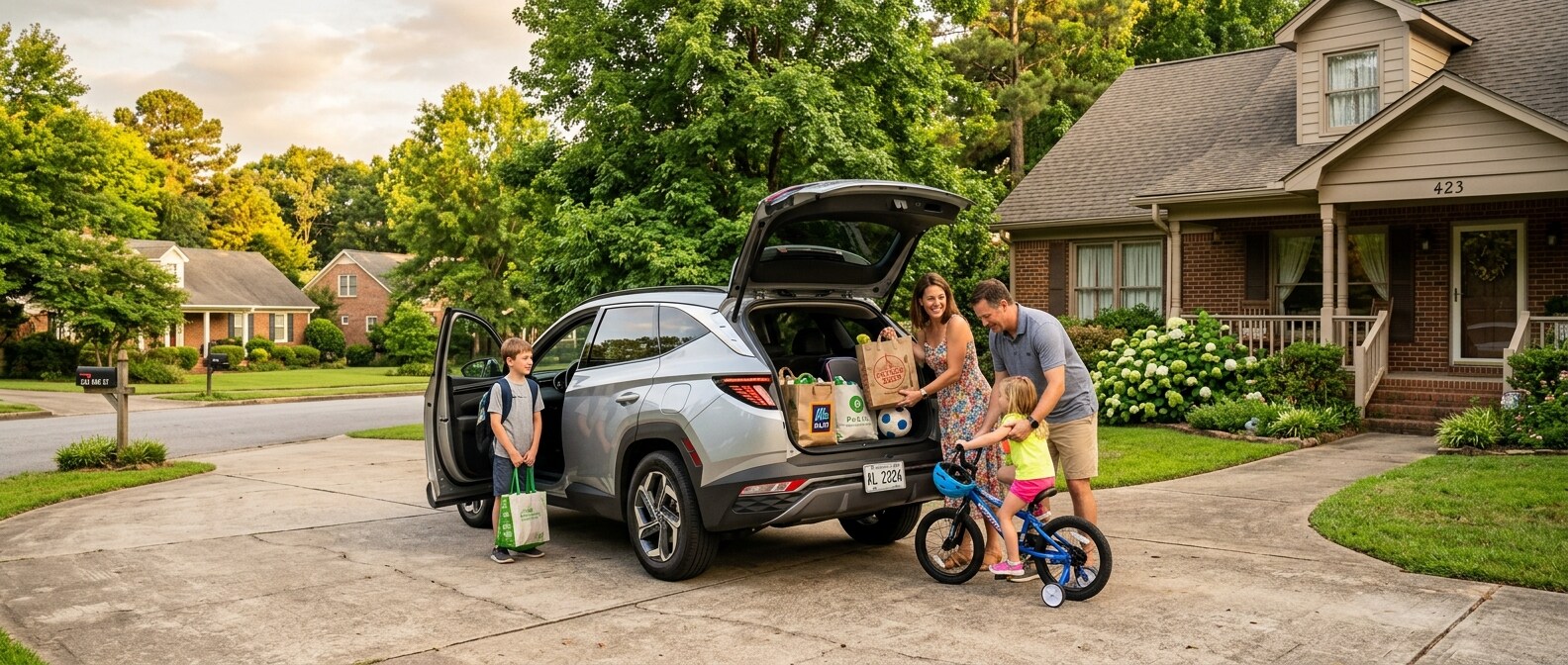
Birmingham summers are not gentle on a stop-and-go commute. With a triple-digit heat index, school pickup lines that stretch past the 4 o'clock sun, and a week of errands between Target on Lakeshore and the soccer fields, your compact SUV isn't a weekend toy; it's a daily workhorse. We've spent time with both the 2026 Hyundai Tucson and the 2027 Chevrolet Equinox, and the honest answer isn't that one is flat-out better. One of them simply fits Birmingham family life in ways that matter before you even leave the neighborhood.
The Tucson Hybrid makes the most of exactly the kind of driving Birmingham families actually do. The Equinox counters with more raw cargo volume once you fold the seats. Neither is a bad choice.
Why Does the Tucson Fit Birmingham Family Driving So Well?
| Birmingham Condition / Use | The Feature That Handles It | Why It Matters |
|---|---|---|
| Hot-weather stop-and-go (school runs, Lakeshore Drive at 5 p.m.) | Tucson Hybrid's gas-electric powertrain, 231 hp, 36 mpg combined | Hybrid systems recapture energy in traffic instead of burning extra fuel; efficiency advantage is largest in city driving |
| Five-passenger family load with gear | 38.7 cu ft behind rear seats, 74.5 cu ft folded (Tucson) | Fits a stroller, two backpacks, and a week of groceries without folding a seat |
| Long rear legroom for growing kids | 41.3 inches of rear legroom | More comfortable than many competitors in this class |
| Standard collision protection in every trim | Hyundai SmartSense: forward collision avoidance with pedestrian/cyclist detection, lane keeping assist, blind-spot warning, driver attention warning | No need to step up a trim to get the safety tech that matters |
| Available AWD for occasional winter ice | HTRAC AWD available on every Tucson trim | Birmingham winters are mild but ice events do happen; you don't have to guess which trim has it |
| Kids left in a parked car | Rear occupant alert (advanced trims) | Flags a detected presence in the rear seat when you exit |
The Equinox arrives for 2027 with a real step up of its own. Chevrolet swapped out the previous CVT transmission for an 8-speed automatic, and the difference in driving feel is noticeable. It carries over 15 standard safety and driver assistance features (Chevy Safety Assist includes automatic emergency braking, forward collision alert, lane keep assist with lane departure warning, following distance indicator, and IntelliBeam automatic high beams). AWD is available, and the standard 11.3-inch infotainment screen is well-sized for family navigation.
Where the Equinox clearly wins is cargo. Fold those second-row seats and you get 63.5 cubic feet of cargo space. The number lands as a meaningful lead over the Tucson's 74.5 (and 63.5 versus the Tucson Hybrid's 74.5). Sports equipment, a full Costco run, furniture from an estate sale. On sheer volume, the Equinox wins.
The Hybrid Efficiency Advantage Is Real in Birmingham Traffic
For Birmingham's stop-and-go reality the 2026 Tucson Hybrid holds a real, verifiable edge, rated at 36 mpg combined and earning that number in the city crawl you actually drive, though the all-gas Equinox claws some of it back with a lower cost to get in the door. Its 1.6-liter turbocharged engine pairs with an electric motor for a combined 231 horsepower and 271 lb-ft of torque. The pairing makes more power than the Equinox's 175-horsepower 1.5-liter turbo, and it uses less fuel doing the same work.
Stop-and-go is where hybrids earn their keep. The Equinox's gas engine is rated at 26 city / 29 highway. The Tucson Hybrid's 36 combined (36 city / 37 highway in AWD) closes a substantial gap over a full tank. For a Birmingham family putting 15,000 miles a year on a school run and Saturday errands, that difference adds up to real trips between fill-ups.
We'll be blunt about the tradeoff. The Tucson Hybrid costs more upfront than the base gas Tucson, and it costs more than the base Equinox. If budget is your first filter, that matters. What you're buying is an efficiency advantage that grows more valuable every summer Birmingham climbs past 95 degrees and the school-run line idles for 20 minutes.
Safety Tech That Comes Standard (Not Optional)
On core safety gear the two vehicles land close together, which is good news for families, and both the 2026 Tucson and 2027 Equinox include automatic emergency braking, lane keeping assistance, and blind-spot monitoring as standard, though the Tucson pulls ahead once you look past the basics. Neither makes you pay up for the core package.
Where the Tucson pulls ahead is depth. Hyundai SmartSense on the 2026 Tucson includes forward collision avoidance with separate detection modes for pedestrians, cyclists, and junction-turning scenarios. It also includes driver attention warning, a rear occupant alert (on higher trims), and safe exit assist (flags when a vehicle is approaching before a rear occupant opens a door). That last one is worth pausing on if you have small children.
Check the Equinox's Chevy Safety Assist and you'll find it covers the six core functions well. It does not, as standard equipment on the base and mid trims, include the driver monitoring and rear-occupant alert at the same level of trim depth. You can add surround vision on higher configurations. For families making a straight safety-tech comparison trim-for-trim, the Tucson's standard SmartSense suite is broader.
Cargo Space: Knowing When the Equinox Wins
The Equinox earns its cargo reputation here, and we'll say it plainly, because its 63.5 cubic feet of maximum volume with the seats folded is the bigger number, though the Tucson answers with smarter everyday packaging and more room for passengers. If you regularly haul large items, that's the right choice. It also offers a hidden storage compartment under the rear cargo floor, which is genuinely useful for keeping valuables out of sight.
The Tucson answers with smart packaging of its own. You get 38.7 cubic feet behind the rear seats without touching the seat fold, a dual-level cargo floor, and 41.3 inches of rear legroom that keeps three kids comfortable on a longer drive. If your family mostly loads gear without folding seats and values passenger comfort alongside cargo, the Tucson's numbers hold up well. The Tucson PHEV (plug-in hybrid) sacrifices cargo space (31.9 cubic feet behind the rear seats due to its battery placement), so if cargo matters most, the standard gas Tucson or Tucson Hybrid is the right call.
Both have available power liftgates (AutoSense on the Equinox, hands-free on the Tucson Limited). With a baby on one hip and a bag on the other, that feature earns its keep fast.
Explore financing options for either vehicle when you're ready to run the numbers on your trade.


