

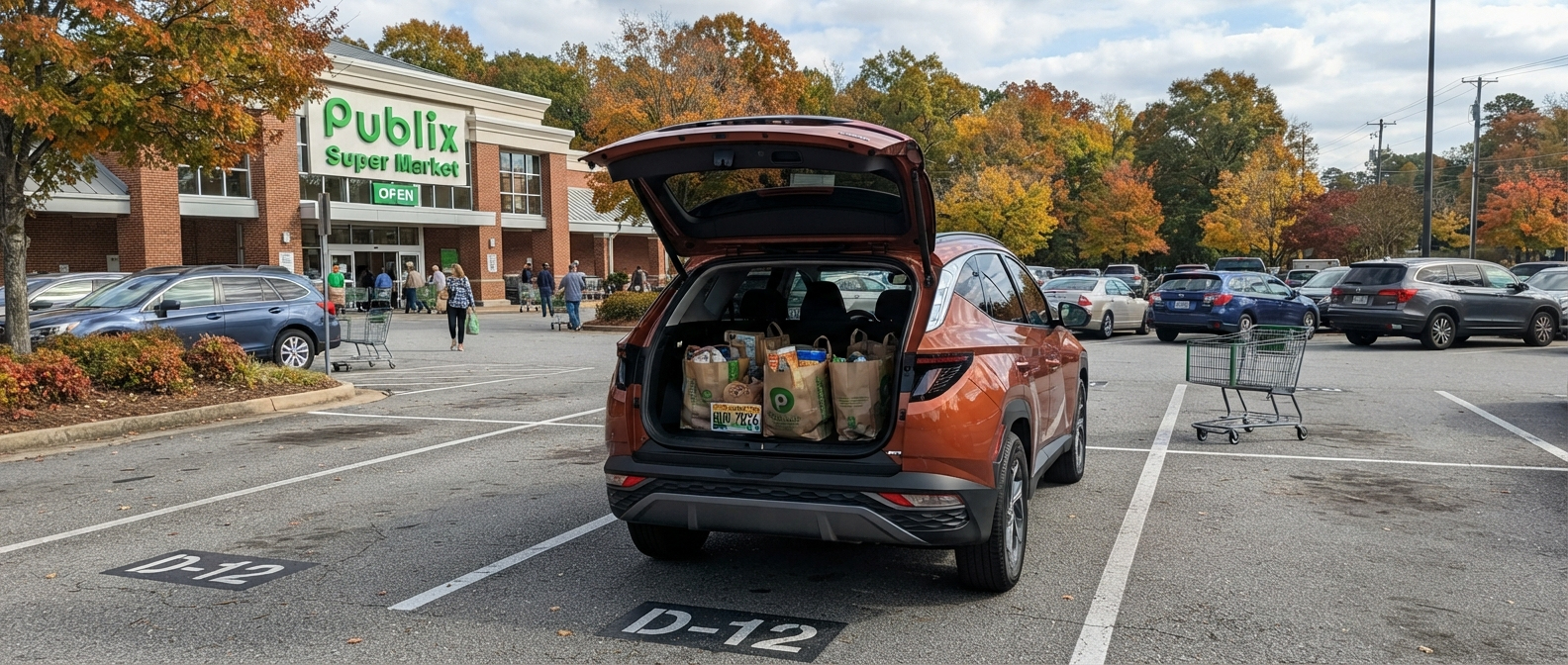
For the Thanksgiving errand loop, the Tucson Hybrid is the better pick, and we'll say it plainly. The gas Tucson still earns its spot, though. Whether it's the smarter choice for you comes down to one question. How much of your driving happens in stop-and-go traffic?
- The 2026 Tucson Hybrid posts an EPA-estimated 36-38 mpg in the city. The gas Tucson FWD manages 25 city mpg. That gap is widest on exactly the kind of short, repeated loops Thanksgiving errands create.
- Cargo space is identical: both carry 38.7 cubic feet behind the rear seat. The hybrid's battery doesn't eat into that number (only the plug-in version does).
- HTRAC AWD comes standard on every Hybrid trim. On the gas Tucson, AWD costs extra and isn't on the base SE.
- The gas Tucson makes sense if you want more trim choices at entry, do mostly highway miles, or want higher towing capacity (2,750 lbs vs the Hybrid's 2,000 lbs).
- Both earn the 2026 IIHS Top Safety Pick+ and an NHTSA 5-star overall rating.
What's the Real Difference Between These Two Tucsons?
The core difference is fuel economy, true enough, but the usual shorthand misses where that advantage actually shows up, and it isn't spread evenly across every kind of trip you take around Homewood and the broader Birmingham metro over a given week. The place it shows up is what counts. Trip type decides it.
| 2026 Tucson (Gas) | 2026 Tucson Hybrid | |
|---|---|---|
| Engine / Power | 2.5L 4-cyl, 187 hp | 1.6L Turbo + electric, 231 hp |
| EPA City MPG | 25 mpg (FWD) / 24 mpg (AWD) | 38 mpg (Blue SE) / 36 mpg (other trims) |
| EPA Highway MPG | 33 mpg (FWD) / 30 mpg (AWD) | 38 mpg (Blue SE) / 37 mpg (other trims) |
| Cargo (seats up) | 38.7 cu-ft | 38.7 cu-ft |
| AWD | Optional (not on SE) | Standard on all trims |
| Towing Capacity | 2,750 lbs | 2,000 lbs |
| IIHS Safety Rating | 2026 Top Safety Pick+ | 2026 Top Safety Pick+ |
| NHTSA Overall | 5-star | 5-star |
On the Hybrid, a 1.6-liter turbocharged engine pairs with an electric motor for a combined 231 horsepower, per Hyundai's specifications. That's 44 more horsepower than the gas Tucson's 187-hp 2.5-liter four-cylinder. You get off the line quicker, you run quieter at low speeds, and you glide more smoothly when you're inching through a parking lot. None of that costs you cargo room, either. Both variants carry the same 38.7 cubic feet behind the second row, according to Hyundai. We mention it plainly because a fair assumption is that the battery has to eat into the space somewhere, and here it doesn't.
Does the Hybrid's Fuel Economy Actually Matter for Short Errands?
Yes, and for short errands it matters more than it does on the highway, which runs counter to what you'd expect, because hybrid efficiency peaks in exactly the stop-and-go conditions a short errand loop keeps creating rather than the steady cruising the highway number rewards. The city figure carries this one.
Hybrid powertrains recover energy through regenerative braking. Every time you decelerate, every time you slow for a parking space, every time you creep through a light-change at US-31 and Oxmoor Road, the Hybrid's system is converting that motion back into stored electricity. So the EPA rates the Tucson Hybrid at 36-38 mpg *in the city*, while the gas Tucson comes in at 25 city mpg with FWD. The city figure matters more than the highway figure for the Thanksgiving errand run.
During that kind of driving, the gas Tucson sits at its relative *worst*. Short trips, a cold engine, repeated starts. None of it favors a naturally-aspirated four-cylinder. On longer runs the Hybrid's advantage narrows, which can catch you off guard if you expect a big gap everywhere. Around the city and suburbs, though, the gap is real and it holds up, errand after errand.
Browse Tucson Hybrid inventory to see current trim availability.
Brookwood Village to the Piggly Wiggly on US-31, then back through the Lakeshore Drive corridor and onto I-65 north. That round trip is exactly the kind of mixed city/suburban loop where the Hybrid earns its efficiency rating. November weather in Birmingham runs to average highs around 65 degrees Fahrenheit with increasing cloud cover and occasional rain through the back half of the month, per climatological records for Jefferson County. Mild. No ice to worry about. But wet roads and congested holiday traffic are real, and the Hybrid's standard HTRAC AWD means you're not choosing between a more efficient drivetrain and all-wheel traction.
Cargo, Comfort, and the Practical Stuff You Actually Care About
See gas Tucson availability for buyers who prioritize trim selection and towing flexibility.
Both Tucsons seat five, and Hyundai's published dimensions list more than 41 inches of rear legroom. That's room for a full back seat of adults, not only kids. On both, the cargo area carries a dual-level floor and six tie-down anchors, and LED cargo lighting comes standard across the lineup. All of it stays the same whether you pick the gas or hybrid powertrain, which is worth knowing before you start trimming your options.
The one real limitation on the Hybrid is towing. Hyundai rates the 2026 Tucson gas at 2,750 pounds, up from the prior model year, while the Hybrid's towing rating comes in at 2,000 pounds. If you're pulling a trailer to a family property over Thanksgiving, that's worth weighing. For groceries, pie tins, folding chairs, and a carload of casserole dishes, though? The Hybrid handles all of it without a second thought.
The gas Tucson also offers more trim variety at entry. The lineup includes the XRT trim with distinctive exterior styling, if trim range matters to you.
So Which One Should You Actually Pick?
Both Tucsons are strong, so the pick really comes down to where and how you drive, and if most of your miles are metro stop-and-go the Hybrid wins, while a lot of highway driving or heavier towing tips it toward the gas Tucson instead. The rest is detail.
Pick the 2026 Tucson Hybrid if: Your weekly driving stays mostly around Homewood and the Birmingham metro. You want AWD without paying extra for it. You spend a lot of time in stop-and-go. You want more horsepower and better fuel economy at once, which is genuinely unusual in this segment. The 36-38 mpg city number isn't marketing. It reflects real hybrid physics that favor the kind of driving a metro errand loop is made of.
Pick the 2026 gas Tucson if: You cover a lot of highway miles. You need to tow more than 2,000 pounds. You want the widest entry-level trim selection. Or you'd rather spend less upfront and you're fine knowing the fuel savings take time to add up. That's a fair trade. At 187 horsepower and 28 mpg combined, the gas Tucson is still a capable, well-rounded compact SUV.
One thing we'd push back on is the assumption that the Hybrid is only for "eco" buyers. It makes more power, it rides smoother in traffic, and AWD comes standard rather than as an upgrade. For anyone running errands in a busy suburb, that's a practical package, not just a choice for carbon-counters.
See our current Hyundai inventory at Hallmark Hyundai Birmingham and check live availability on both configurations.
By the Hallmark Hyundai Birmingham Team | November 2026
Frequently Asked Questions
Is the cargo space different between the Tucson gas and the Tucson Hybrid?
No. Both the 2026 Tucson gas and the 2026 Tucson Hybrid carry 38.7 cubic feet of cargo space behind the rear seat. Only the Plug-In Hybrid (PHEV) has a reduced cargo area due to its larger battery.
Does the Tucson Hybrid always come with all-wheel drive?
Yes. Every trim of the 2026 Tucson Hybrid comes standard with Hyundai's HTRAC AWD system. The gas Tucson offers AWD as an option on higher trims, but the base SE trim is front-wheel drive only.


