

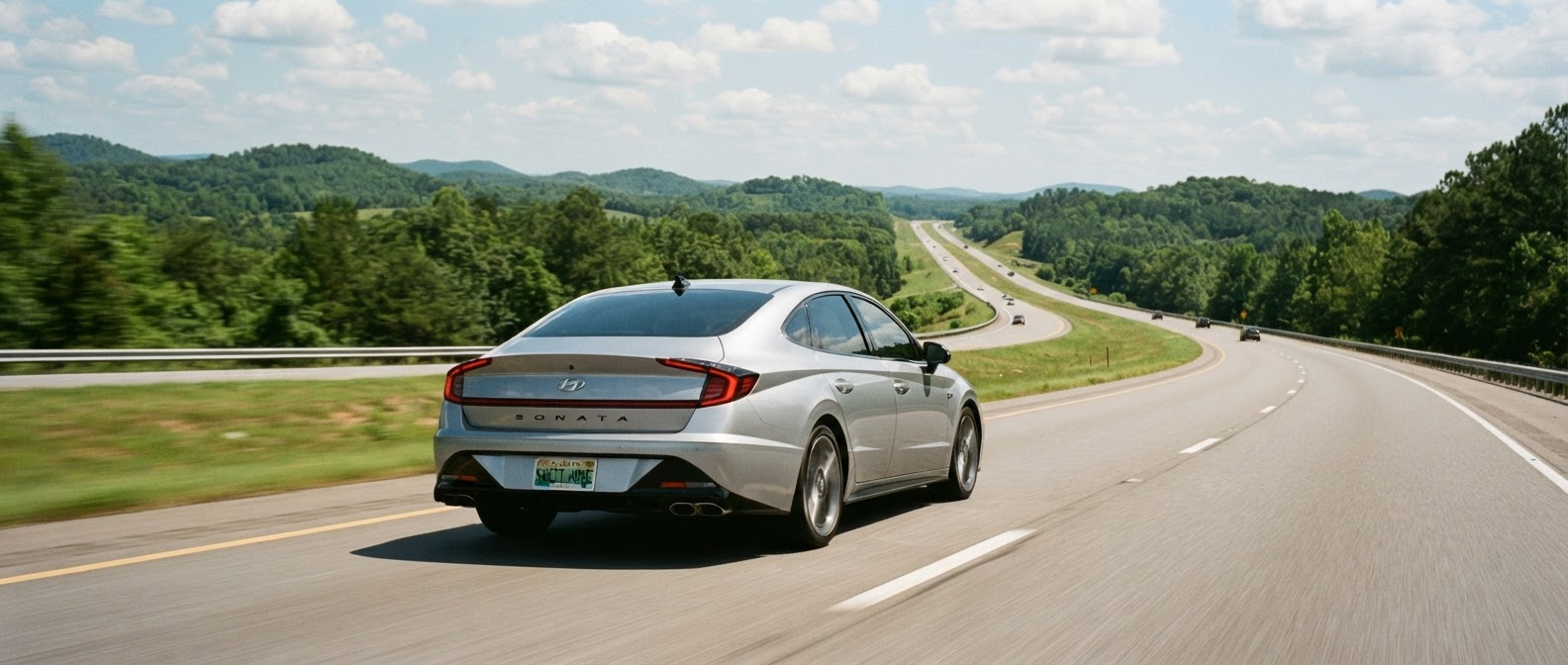
Birmingham sits at a geographic sweet spot. Atlanta is about 147 miles east on I-20. Nashville is around 193 miles north on I-65. Both are real, one-tank drives for a midsize sedan with a 15.9-gallon tank, and in our book both make the Sonata's natural proving ground, which is why we've started mapping trims against them.
The bottom line is straightforward. The 2026 Hyundai Sonata delivers genuine highway comfort and solid fuel efficiency across all its gas trims, and the Hybrid tiers add a meaningful efficiency step-up that makes mathematical sense over these distances. So what's the tradeoff you should know up front? Rear legroom is 34.8 inches, and Hyundai lists it at exactly that, which is on the tighter side for a midsize sedan. Front passengers have 46.1 inches to stretch. Two adults in your road-trip crew and you'll ride comfortable. Pack a third adult in the rear seat for three hours and you'll hear about it.
Value here means which tier of Sonata matches the kind of trip you're making, the number of people you're carrying, and how much technology you want working for you on a long interstate stretch. The goal isn't the cheapest car. You're after not overpaying for features you don't need and not underpaying for the ones you'll lean on at 70 mph on I-65.
What Do You Actually Get at Each Trim Tier?
You get six trims in the 2026 Sonata lineup, split evenly between three gas variants and three hybrid variants, and the upside is that even the base car ships loaded, with the tier-to-tier spread showing up in wheels, charging, and interior polish rather than in the safety tech, which you'll find standard throughout. The 2026 restructuring consolidated the old SEL and SEL Convenience into a single new SEL Sport trim, which now includes 18-inch wheels, wireless charging, paddle shifters, and a leather-wrapped steering wheel as standard. For the mid-tier buyer, that's a real improvement over what existed a year ago.
Every single 2026 Sonata, no matter the trim, ships with dual 12.3-inch displays, wireless Apple CarPlay and Android Auto, and the full Hyundai SmartSense driver assistance suite. For a highway run, that last item matters most. SmartSense includes Forward Collision-Avoidance Assist, Lane Keeping Assist, Lane Following Assist, Blind-Spot Collision-Avoidance Assist, and Smart Cruise Control with Stop and Go. You're not paying extra for adaptive cruise on a 193-mile interstate. You'll find it on the base SE.
| Trim | Powertrain | EPA Fuel Economy (city/hwy/combined) | Wheels | Key Road-Trip Features | Best For |
|---|---|---|---|---|---|
| SE | 2.5L I-4, 191 hp, FWD | 28/38/32 mpg | 16-inch alloy | SmartSense, wireless CarPlay, Smart Cruise Control | Solo commuters, couples, budget-conscious buyers |
| SEL Sport FWD | 2.5L I-4, 191 hp, FWD | 25/36/29 mpg | 18-inch alloy | Adds wireless charging, paddle shifters, leather-wrapped wheel | Those who want a step up without going hybrid |
| SEL Sport AWD | 2.5L I-4, 191 hp, AWD | 27 mpg combined | 18-inch alloy | Only AWD option in the gas lineup | Buyers who want all-season traction confidence |
| N Line | 2.5L Turbo I-4, 290 hp, FWD | 27 mpg combined | 19-inch alloy | Sport suspension, Bose audio, body kit | Enthusiast who still wants sedan practicality |
| Blue Hybrid | 2.0L Hybrid, 192 hp, FWD | 47/56/51 mpg | 16-inch low-rolling-resistance | Best fuel economy in the lineup, 12.3-inch screen | High-mileage commuters and frequent long-haul drivers |
| SEL / Limited Hybrid | 2.0L Hybrid, 192 hp, FWD | 44/51/47 mpg | 18-inch alloy | Adds panoramic sunroof (SEL gets it standard for 2026), more content | Comfort-first hybrid buyers |
EPA fuel economy figures per Hyundai and cross-referenced against published 2026 ratings. AWD fuel economy per Hyundai listing for the SEL Sport AWD configuration.
The Smart-Buy Case for Each Interstate Run
The smart-buy case comes down to the math on each route, and it swings by destination, since the gas SE handles the shorter Atlanta run cleanly on one tank while the Hybrid earns its keep once the Nashville miles stack up over a year. Run the numbers and the picture sorts itself out.
The Birmingham-to-Atlanta run on I-20 East is roughly 147 miles. The base Sonata SE, browsable in our current new inventory, earns an EPA-estimated 38 mpg highway. So the Atlanta round-trip consumes about 7.7 gallons of fuel on the highway legs. The SE does that run without drama, without extras, and without the complexity of a hybrid system you might not fully use in pure highway conditions. On a 15.9-gallon tank, you're not stopping for gas.
Nashville on I-65 North plays out differently. Figure approximately 193 miles each way, with a meaningful stretch of rolling Tennessee hill country after Huntsville in the driving profile. Total round-trip distance is pushing 390 miles. At 32 mpg combined, the gas SE handles it easily on one tank. But the Blue Hybrid at 51 mpg combined cuts the per-trip fuel consumption enough that over a year of repeat Nashville runs, the difference adds up. The Hybrid isn't just a city-efficiency story. Its EPA highway rating is 56 mpg, higher than the city figure, because the smaller 16-inch wheels reduce rolling resistance at speed.
The trade is real. The Blue Hybrid gives up some content (smaller wheels, less cabin polish) to reach that efficiency number. The SEL and Limited Hybrid trims add the panoramic sunroof and richer interior at the cost of a few mpg. For the person doing Nashville four times a year, the Blue Hybrid is the calculation. For the person doing Atlanta once a month with the occasional Nashville trip and caring more about the in-car experience, the SEL Hybrid makes the math work without feeling like a sacrifice.
One thing worth knowing is that the SEL Sport is the single 2026 gas Sonata trim where all-wheel drive is an option. If you're carrying a full car through winter weather on I-65 or running into Appalachian weather on the I-20 corridor in December, keep that in your back pocket.
Matching the Trim to Your Actual Trip Profile
The Sonata earns its value case most clearly once you match the trim to how you really use the car, weighing the routes you drive, the people you carry, and the efficiency you need rather than chasing a spec you'll rarely tap.
Check your usual route before you shortlist a tier. If your trips are mostly the Atlanta run, flat I-20 interstate in a two-hour window, the SE is genuinely well-equipped. Dual 12.3-inch displays, wireless CarPlay, adaptive cruise, and 38 mpg highway handle the route without you giving up anything you'll notice. The 2026 Sonata also earned a 2026 IIHS TOP SAFETY PICK+ award and a 5-star NHTSA overall rating, so the safety credentials are verified, not marketing language.
If your trips lean toward Nashville, or you run both routes and watch how often you hit the pump, the Blue Hybrid is worth pricing seriously. The entry point is lower than you might expect for a 51-mpg sedan, the technology level is competitive, and the highway efficiency, 56 mpg at speed rather than the city figure, is what makes the Nashville math work.
If you want AWD for the occasional winter run, and Birmingham does see ice while I-65 can turn unpleasant in January, the SEL Sport AWD is the one gas-trim path to it. We'd steer buyers toward the Hyundai Santa Fe when three-row or SUV capability is the actual need. But for a driver who genuinely wants a sedan with traction confidence through the winter months on these corridors, the SEL Sport AWD is a real answer.
The N Line is a different conversation. You're looking at a 290-horsepower turbocharged sedan with a sport suspension tune. It's fun. It also gives up fuel economy to get there, and that sport suspension wasn't tuned for three hours of I-65. The driver who truly benefits from the N Line usually drives it daily in Birmingham and takes the occasional trip, more than someone optimizing for long-distance comfort.
The bottom line is that the 2026 Sonata's trim structure is more logical than it looks on paper. Start with the SE, which does the job. The SEL Sport adds the mid-tier refinements cleanly. Hybrid tiers deliver real-world efficiency that makes sense for anyone logging these interstate distances routinely. And the honest limitation, rear legroom in the mid-30-inch range, is a known quantity you won't discover on hour two of a road trip.
Stop by or reach out. We'll match the trim to your trip.
Frequently Asked Questions
Is the 2026 Hyundai Sonata comfortable enough for a 3-hour drive to Nashville?
The 2026 Sonata is well-suited for highway runs of that length, particularly in the front seats. Front legroom is 46.1 inches and the front seat cushion is sized for sustained highway use. The genuine limitation is rear legroom. Hyundai lists it at 34.8 inches, which is on the shorter side compared to some rivals in the midsize sedan segment. Two adults in front will be comfortable for the full Birmingham-to-Nashville drive on I-65. A rear-seat adult passenger on the taller side will want to know that number before committing to a three-hour stretch. Every 2026 trim includes SmartSense with Smart Cruise Control standard, which does reduce the fatigue factor on long interstate runs.
Is the Sonata Hybrid worth it over the base SE for trips to Atlanta or Nashville?
For the Atlanta run, roughly 147 miles on I-20, the case for the Hybrid is modest. The SE's EPA-estimated 38 mpg highway handles the round trip comfortably on one tank. For Nashville, roughly 193 miles each way on I-65, the Hybrid's efficiency advantage is more meaningful, particularly the Blue Hybrid's 56 mpg highway EPA estimate. If you make that run frequently, or if you combine regular Nashville trips with everyday Birmingham commuting, the Hybrid's fuel savings become a real part of the value calculation. If your trips are mostly shorter and the Atlanta run represents your longest regular drive, the SE is genuinely well-equipped without the added complexity of the hybrid system.


