

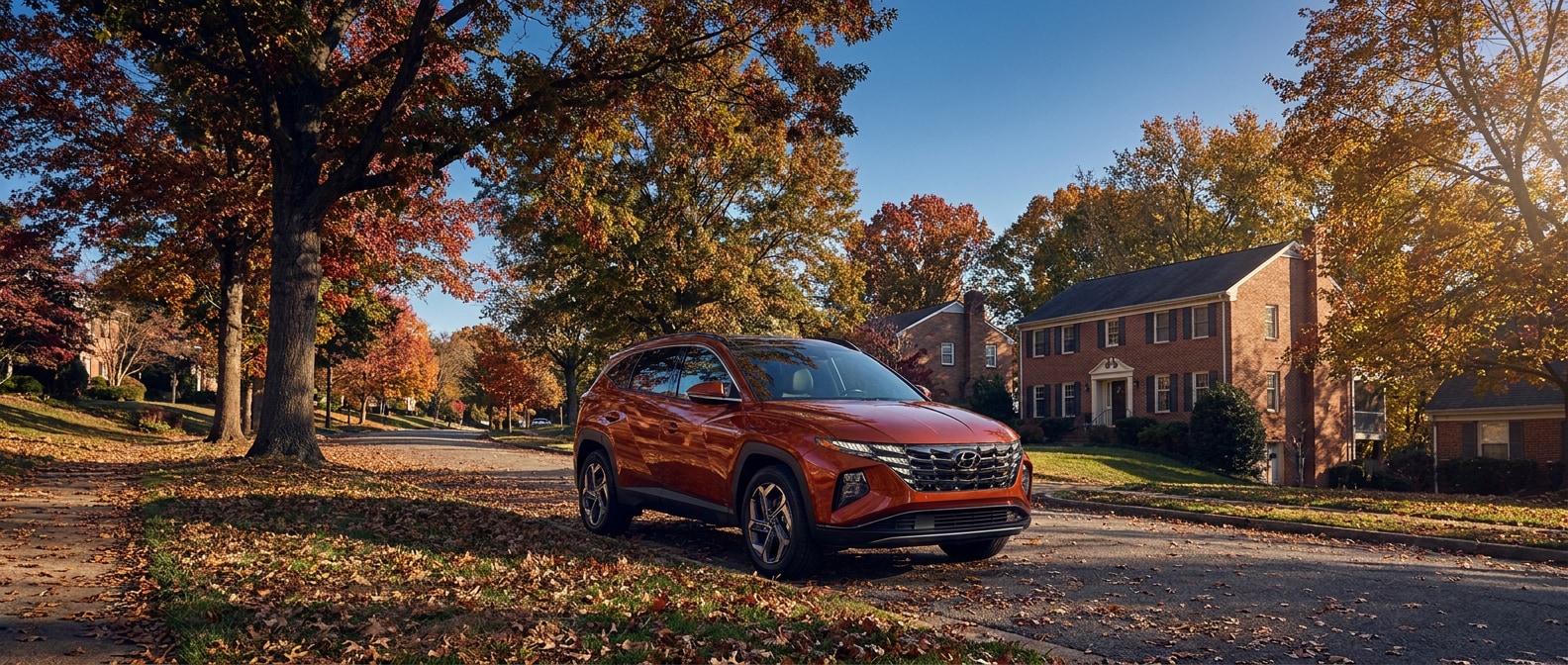
What's the Real Fuel Economy Difference Between These Two?
The gap runs about ten miles per gallon in the city, and that single number tells most of the story. The EPA rates the 2026 Tucson Hybrid Blue SE at 38 city / 38 highway / 38 combined, and the gas-only Tucson with front-wheel drive at 25 city / 33 highway / 28 combined. Those are verified EPA figures, and they hold up for the kind of errand driving this area actually involves.
The comparison across trims looks like this:
| Version | Drivetrain | City MPG | Highway MPG | Combined MPG |
|---|---|---|---|---|
| Tucson Hybrid Blue SE / SE | All-Wheel Drive standard | 38 | 38 | 38 |
| Tucson Hybrid SEL / Limited | All-Wheel Drive | 36 | 37 | 36 |
| Tucson Gas (FWD) | Front-Wheel Drive | 25 | 33 | 28 |
| Tucson Gas (AWD) | All-Wheel Drive | 24 | 30 | 26 |
Look at that first row. The Hybrid's city and highway figures are essentially the same, which is unusual. Most vehicles earn their best numbers on open roads, not in traffic. The Hybrid flips that logic because its regenerative braking system captures kinetic energy on every deceleration and feeds it back into the battery. As the U.S. Department of Energy explains at fueleconomy.gov, hybrids are most efficient in city and stop-and-go conditions specifically because more braking events mean more energy recovery. The gas Tucson, meanwhile, turns every hard stop into heat and nothing else.
Does the Hybrid Powertrain Actually Change How the Tucson Drives?
Yes, the Hybrid changes the character of the Tucson, and mostly for the better, though you'll feel the extra weight if you ever load it down. The gas Tucson runs a naturally-aspirated 2.5-liter four-cylinder producing 187 horsepower and 178 lb-ft of torque through an 8-speed automatic. Solid, predictable, nothing fussy about it.
The Hybrid pairs a 1.6-liter turbocharged engine with an electric motor for a combined output of 231 horsepower and 271 lb-ft of torque. You get more twist lower in the rev range, which makes it feel more effortless pulling out of parking lots and climbing Vestavia Hills' rolling terrain. We've noticed this on routes with any real incline. Vestavia Hills sits on hilly terrain between Shades Mountain and the Red Mountain ridge, and the Hybrid's torque delivery means it isn't working as hard on the climbs as you might expect.
The Hybrid does carry a real penalty. It weighs roughly 200-400 pounds more than the gas variant, depending on trim. You won't notice that in daily driving. You might notice it if you're towing (the gas Tucson tows up to 2,750 lbs for 2026 with trailer brakes, and towing specs for the Hybrid are meaningfully lower). If towing is part of your picture, that's worth knowing before you decide.
How Vestavia Hills Errand Driving Plays Into This
Vestavia Hills is built around car travel, and the daily rhythm here plays straight into the Hybrid's strengths, since the errands stack up in exactly the stop-and-go conditions where regeneration pays off. There's no real transit alternative. The day involves genuine stop-and-go, from congestion on US-31 through the Montgomery Highway corridor during school hours and evening rush, to signal-heavy surface streets connecting neighborhoods to shopping, to those rolling grades that create natural brake-and-accelerate cycles even on short hops. From most parts of Vestavia Hills, a round trip to downtown Birmingham and back runs roughly 15 to 30 miles depending on your neighborhood and destination.
That kind of short-to-medium loop is exactly the profile where the Hybrid's regenerative system does its best work. Browse our current Tucson Hybrid inventory to see available trims, but the pattern worth understanding is simple. A gas engine is at its least efficient on short trips under moderate-to-heavy traffic because it doesn't reach optimal operating temperature efficiently and wastes energy in repeated braking. A hybrid with regenerative capability doesn't waste that braking energy. Per fueleconomy.gov, hybrids are specifically more efficient than comparable gas vehicles in stop-and-go conditions because braking recovers energy rather than dissipating it.
Factor the season into it too. Fall makes this more relevant, not less. Shorter days mean more driving in lower-light conditions. The school-year routine means more peak-hour errand loops. October and November in Birmingham bring comfortable temperatures (generally 50s-70s Fahrenheit) that are near-ideal for hybrid battery efficiency, unlike the deep summer heat that can mildly reduce battery performance in any hybrid.
So Which One Should You Pick?
The Hybrid is the right call if your week is dominated by Vestavia Hills errand loops, the school-pickup circuit, and Birmingham commute traffic, and the gas model really only pulls ahead on value when you're logging mostly interstate miles. You'll see the biggest fuel-economy gap at the city end, and those miles add up.
Don't overlook the standard all-wheel drive on the Hybrid. It comes standard (versus an upcharge on gas trims), which means you're getting traction capability for Alabama's occasional winter ice on the hills without giving up efficiency.
See the Tucson Hybrid lineup here if that profile matches your week.
Choose the gas Tucson for a few reasons. The bulk of your miles are interstate (think regular Birmingham-to-Huntsville runs or weekend trips south to the Gulf), you want the flexibility of a lower entry point, or towing capacity matters to your use case. The 28-mpg combined EPA figure for the FWD gas model is competitive for a non-hybrid compact SUV of this size. It isn't a poor choice. It's just a different optimization.
A buyer comparison in plain terms:
| If you mostly... | The better pick is... |
|---|---|
| Run school-and-errands loops in Vestavia Hills | Tucson Hybrid |
| Log significant interstate mileage weekly | Either; the gap narrows on the highway |
| Need towing capacity above 1,500 lbs | Tucson Gas |
| Want AWD without an upcharge on the base trim | Tucson Hybrid Blue SE |
| Prefer the lowest possible upfront investment | Tucson Gas |
Frequently Asked Questions
Does the Tucson Hybrid really get better MPG in city driving than on the highway?
For the 2026 Tucson Hybrid Blue SE trim, the EPA rates city and highway MPG identically at 38 mpg, which is unusual. For SEL and higher trims, city comes in at 36 and highway at 37. The reason the city number holds up so well relative to highway is regenerative braking: every deceleration and stop in traffic recovers energy that would otherwise be wasted as heat. Per the U.S. Department of Energy, hybrids are most efficient in stop-and-go conditions specifically because more braking means more energy recovery. On a steady highway cruise at 70+ mph, the regenerative system has fewer opportunities to work, and the advantage over a gas engine narrows.
Is the 2026 Tucson Hybrid the same size as the regular Tucson?
Yes. Both share the same body, the same five-passenger interior, and the same 38.7 cubic feet of cargo space behind the rear seats. The Hybrid's 1.49-kWh battery pack is packaged below the rear seat floor, so it does not eat into cargo volume. The Hybrid also comes standard with AWD across the lineup for 2026, while AWD is an option on gas trims. If you are choosing between the two based on practicality for family hauling, the cabins are effectively equivalent.


