


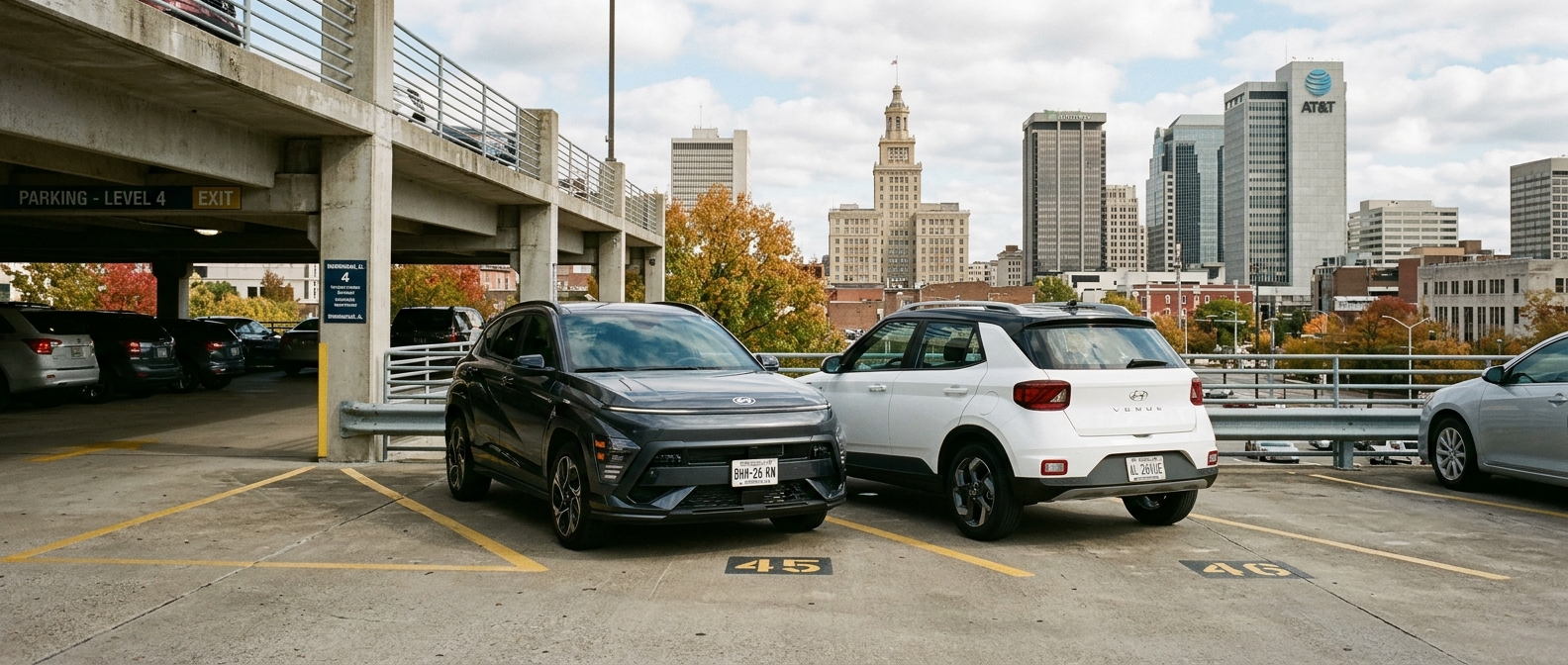
If you park near UAB, commute through Malfunction Junction, or just want a sensible small Hyundai without overthinking it, both the 2026 Hyundai Kona and the 2026 Hyundai Venue belong on your short list. They're not the same vehicle, though, and for Birmingham's particular mix of cramped downtown decks and full-speed interstate merges, that difference matters more than the spec sheets suggest.
The short answer, before we get into it, runs like this. The Venue wins on pure city maneuverability and entry point, and the Kona wins on cargo, rear passenger space, available AWD, and highway confidence. Which one is right depends on how much of your driving happens on 20th Street and how much happens on I-65 southbound at 70 mph.
How Do These Two Actually Compare on the Road Here?
On paper these two look like twins, since the EPA rates both the 2026 Venue and the 2026 Kona SE FWD at 31 mpg combined, yet the moment you add downtown deck parking and a full-speed merge onto I-65, they stop being interchangeable. Identical numbers on paper. Slot a 171.3-inch Kona into a tight deck off 20th Street a few times and you'll feel those extra 12 inches at the turn. Stop at the window sticker, though, and you miss almost everything that matters for a Birmingham commute.
| Birmingham Driving Condition | Venue (2026) | Kona (2026) | The deciding factor |
|---|---|---|---|
| Downtown / UAB deck parking | 159.1 in length, easiest to slot in | 171.3 in, still compact but 12 in longer | Venue wins on footprint |
| Stop-and-go on I-65 / Malfunction Junction | 121 hp, fine for city pace | 147 hp base (or 190 hp turbo) | Kona pulls ahead more confidently |
| January ice on Red Mountain grades | FWD only, no AWD option | HTRAC AWD available, up to 8.3 in ground clearance | Kona is the only choice if you want AWD |
| Weekend Costco or Home Depot run | 18.7 cu ft seats up | 25.5 cu ft seats up, 63.7 cu ft folded | Kona by a wide margin |
| Rear passengers (adults) | 34.3 in rear legroom | 38.2 in rear legroom | Kona is meaningfully roomier |
| Highway cruise to Tuscaloosa | 11.9-gal tank, ~369 mile range | 12.4-gal tank (2.0L), ~370 mile range | Essentially equal |
| Budget per month on fuel (daily commuter, FWD) | 31 mpg combined EPA est. | 31 mpg combined EPA est. (SE/SEL Sport FWD) | Tied on efficiency |
EPA estimates. Actual mileage varies with driving conditions, load, speed, and temperature.
Where Will It Really Go on a Birmingham Tank?
Both vehicles cover roughly the same ground per tank at highway speeds, so range alone won't settle this for you, though the picture shifts once you climb into the Kona's turbo trims where the tank grows and the efficiency gives a little back. The Venue's 11.9-gallon tank at its EPA-estimated 31 mpg combined works out to about 369 miles between fill-ups, per Hyundai's published figures. Step over to the Kona SE and SEL Sport and you get a 12.4-gallon tank with that same 31 mpg combined EPA estimate, which lands in the same neighborhood.
Once you step up to the Kona's turbocharged SEL Premium or Limited trims, the tank grows to 13.2 gallons. That turbo trades some efficiency (28 mpg combined FWD EPA est.) for 190 horsepower instead of 147. Coming out of Homewood during rush hour and merging onto I-65, that extra 43 horsepower is genuinely noticeable. The Venue's 121-hp engine is adequate for city traffic, and it isn't the one you'll want when you need a fast gap on the interstate.
None of that is a knock on the Venue. It's a vehicle built for a specific job, and it does that job well.
Just know your real highway miles first.
Where Do You Stand on Cargo?
Cargo is where these two stop resembling each other, because the Kona offers 25.5 cubic feet behind the rear seats against the Venue's 18.7, a gap you'll feel the first weekend you load up. With all five seats in use, that 6.8-cubic-foot difference is the equivalent of a full set of rolling carry-on luggage.
See Kona inventory at Hallmark Hyundai Birmingham
Fold the seats flat and the gap becomes the story. Kona opens up to 63.7 cubic feet, which handles furniture runs, full camping gear, or a double stroller without drama. The Venue reaches 31.9 cubic feet folded, enough for bikes in bags, a reasonable grocery haul, or a few weekend bags. It just isn't enough for the kind of hauling that occasionally tempts you to rent a truck.
We see this split along how people actually load up. A solo commuter or a couple who parks in a tight deck and rarely carries more than groceries will find the Venue genuinely sufficient, most weeks anyway. A young family with a stroller, a diaper bag, and a dog leans toward the Kona, no roof rack required.
See Current Offers on Kona and Venue
What About AWD for Birmingham Winters?
The answer on AWD is clean enough, the Venue doesn't offer all-wheel drive on any trim, while the Kona makes HTRAC available across every trim, so if winter traction in Birmingham is a priority for you, the decision is more or less made. The tradeoff is simple to state. The Venue never has offered AWD, and the 2026 model doesn't change that. Front-wheel drive only, across both the SE and SEL trims.
Through most of the year, Birmingham winters stay mild. January and February do bring occasional freezing rain and ice events, particularly on elevated roads and shaded bridge decks. The grades coming down from Vestavia Hills into the valley, or any of the Red Mountain approaches, get slick in a way flat roads don't. The grades matter here.
The Kona does what the Venue can't on this one. HTRAC AWD is available on every 2026 Kona trim for an additional cost, and the AWD configuration raises ground clearance to up to 8.3 inches compared to the base 6.7 inches on both FWD Kona and Venue. Worth noting that AWD costs you some efficiency, with the Kona SE AWD dropping to an EPA-estimated 28 mpg combined versus 31 mpg for the FWD version.
Worth knowing: For most Birmingham-area winters, FWD with good all-season tires handles the occasional ice event fine. AWD is a confidence margin and a capability upgrade, not a necessity. If you're buying primarily for the rare January freeze, weigh that against the efficiency trade.
Plan It This Way: A Print-and-Go Checklist Before You Decide
Before you walk onto the lot, run your real week through this list, since the right pick depends less on the brochure than on how your own commute, parking, and cargo habits stack up. Run through this before you walk in:
- [ ] Measure the parking deck or garage you use daily. If the clearance is tight, the Venue's 159.1-inch length and narrower 69.7-inch width give you more room to maneuver.
- [ ] Count your weekly highway miles. If a meaningful chunk of your drive involves I-65, I-20, or I-459, the Kona's stronger engine options will feel less strained.
- [ ] Think honestly about rear passengers. Adult passengers behind a 6-foot driver will notice the 3.9 fewer inches of legroom in the Venue.
- [ ] Decide on AWD before you walk in, not after. The Venue cannot be optioned with AWD at any price. The Kona can. If you want the option, that decision is made for you.
- [ ] Check your cargo reality. Do you fold the rear seats regularly? The Kona's 63.7 cu ft folded cargo is more than double the Venue's 31.9 cu ft. If that matters in your life, it matters a lot.
- [ ] Both vehicles include Hyundai SmartSense as standard on every trim. Forward Collision-Avoidance Assist, Lane Keeping Assist, Smart Cruise Control with Stop & Go, and Driver Attention Warning come standard regardless of which model or trim you pick.
- [ ] If the Kona's turbocharged SEL Premium or Limited trims are in consideration, the 190 hp engine is a meaningful step up for highway driving, but AWD on those trims drops the EPA-estimated combined rating to 26 mpg.
Explore financing options at Hallmark Hyundai Birmingham
Both of these vehicles carry Hyundai's full SmartSense safety suite on every trim, and that counts for something. Forward Collision-Avoidance Assist with Junction Turning Detection and pedestrian/cyclist detection, Lane Following Assist, and Safe Exit Warning are standard equipment whether you're in a Venue SE or a Kona Limited. Neither vehicle makes you pay to get to safe. We appreciate that.
Come in, tell us how you actually drive in Birmingham, and we'll put you in the right one.
Frequently Asked Questions
Is the Hyundai Venue big enough for a Birmingham family?
The 2026 Hyundai Venue seats five and carries 18.7 cubic feet of cargo with all seats in place. For a couple or a solo driver who parks downtown and commutes short distances, that's genuinely sufficient. For a family that regularly carries a stroller, a larger dog, or adult rear passengers on longer trips, the Venue's 34.3 inches of rear legroom and 31.9 cubic feet of folded cargo space become real constraints. The Kona offers 38.2 inches of rear legroom and 63.7 cubic feet of folded cargo, which makes it the more practical choice for family use.
Can you get all-wheel drive on the 2026 Hyundai Venue?
No. The 2026 Hyundai Venue is front-wheel drive only across every trim level, with no AWD option available at any price point. If AWD matters to you for Birmingham's occasional winter ice events or hilly terrain, the 2026 Hyundai Kona is the one to consider. HTRAC AWD is available on every Kona trim and raises ground clearance to up to 8.3 inches compared to the standard 6.7 inches.
Do both the 2026 Kona and Venue get the same fuel economy?
At the base trim level with front-wheel drive, yes. The 2026 Hyundai Venue is EPA-estimated at 29 city / 33 highway / 31 combined mpg across all trims. The 2026 Hyundai Kona SE and SEL Sport with FWD are EPA-estimated at 29 city / 34 highway / 31 combined mpg. The numbers sit close enough that fuel economy alone shouldn't drive the decision. Where they diverge, the Kona's turbocharged trims (SEL Premium and Limited FWD) drop to an EPA-estimated 28 mpg combined, and all AWD configurations on the Kona lose 2 to 3 mpg combined compared to their FWD counterparts. All figures are EPA estimates, and actual mileage will vary.
Categories:
Social


