

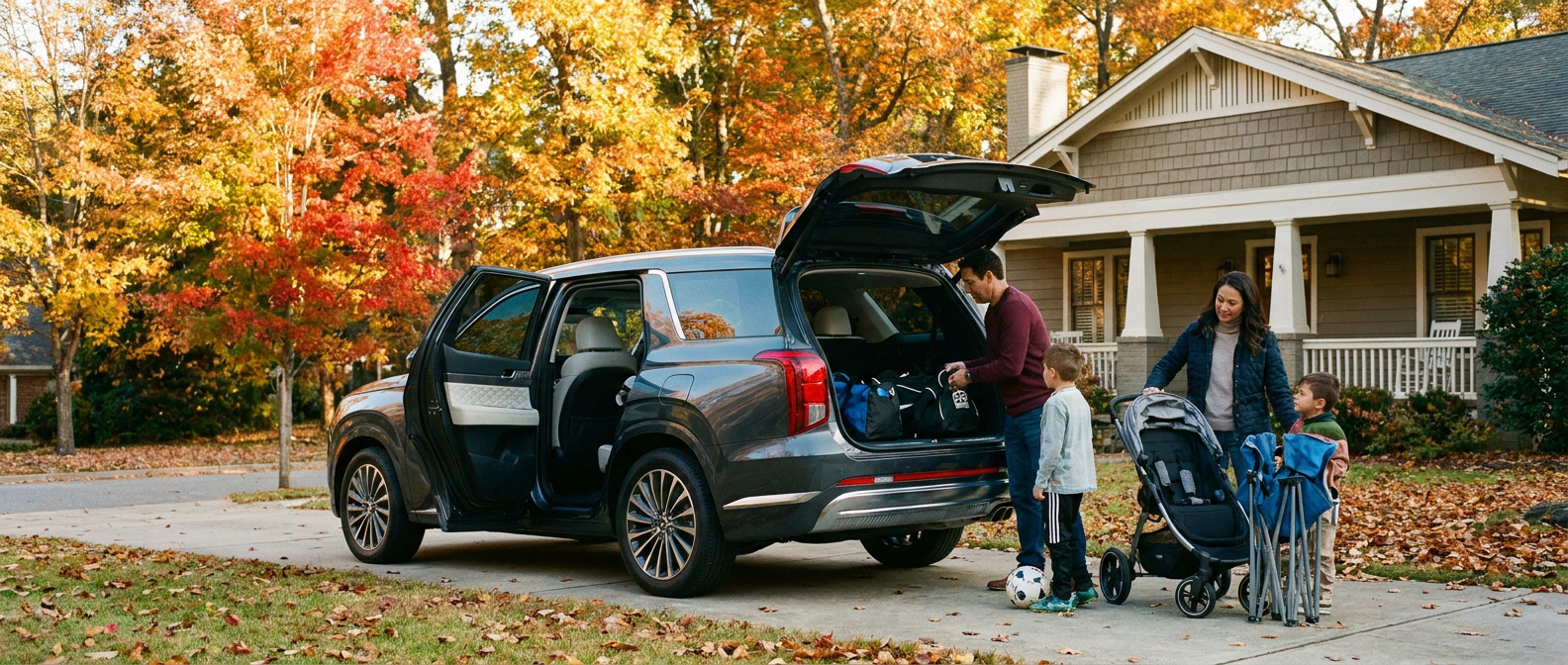
Chelsea families already know the drill. You're on US-280 by 7:15 a.m., merging into stop-and-go traffic toward Birmingham, running on two cups of coffee and three different school schedules. The question we hear on our lot goes deeper than "which Hyundai SUV is nice?" You want to know which one actually fits your life, and how to set it up so it works every single day.
This guide answers exactly that. Match your family size and commute to the right 2026 Hyundai model, then follow the setup steps so the first week of ownership isn't a guessing game.
If you're not sure yet which model is on your shortlist, browsing the 2026 Tucson is a solid starting point while you work through the steps below.
What Do You Need to Know Before You Start?
Before you configure anything, pin down two numbers (how many people regularly ride with you, and how far you drive each way on a typical weekday). Those two figures narrow the choice faster than any feature list, and they keep you from paying for rows or a powertrain your week never actually uses.
Below is the quick-reference spec table for all three 2026 models. Every figure comes from EPA and Hyundai Motor America data.
| Spec | 2026 Tucson (Gas, FWD) | 2026 Santa Fe (Gas, FWD) | 2026 Palisade Hybrid (AWD) |
|---|---|---|---|
| Seating capacity | 5 | 7 | 7 or 8 |
| Cargo behind 2nd row | 41.2 cu ft | 40.5 cu ft | 46.3 cu ft |
| Max cargo (all rows folded) | 80.3 cu ft | 79.6 cu ft | 86.7 cu ft |
| EPA combined MPG (est.) | 28 mpg | 24 mpg | 29 mpg |
| Third-row legroom | N/A | 30.0 in | 32.1 in |
| Towing capacity | N/A listed | N/A listed | 4,000 lb (Hybrid) |
One tradeoff is worth naming up front. The Santa Fe's third row is real, but the EPA lists 30.0 inches of third-row legroom. That fits children and shorter adults. A full-grown passenger on a two-hour road trip will feel it. If your family carries adults in row three week after week, the Palisade's 32.1 inches of third-row legroom is the meaningful upgrade.
How to Match, Configure, and Set Up Your Hyundai SUV for Chelsea Family Life
Work through these steps in order, because each one narrows the decision before the next one asks you to configure anything. You don't have to finish all six in a single sitting, but skipping ahead tends to leave you with a model that fits the brochure instead of your Tuesday.
Step 1: Count your regular passengers (not your theoretical maximum).
Picture the school run on a Tuesday rather than the family reunion in June. A household of two adults and two kids rides in four seats for 98 percent of trips. The Tucson handles that with 41.2 cubic feet of cargo space behind the second row, a hands-free liftgate on SEL and above, and EPA-estimated 28 mpg combined (FWD) that trims the cost of the US-280 daily run over a year. Once you're a household of five, or you're carpooling a third child, the Santa Fe's standard seven-passenger seating starts earning its keep.
Step 2: Decide whether the third row is a real seat or a cargo shelf.
This step is where it's easy to talk yourself into more vehicle than you need, or out of more than you should have. The 2026 Santa Fe gives you a third row that works well for kids. The seat folds flat with a 50/50 split, and with both rear rows down, Hyundai lists 79.6 cubic feet of max cargo. Plenty of room for a Shelby County household that hauls mulch on Saturday and seven passengers to a soccer tournament on Sunday. The Palisade goes further, with 86.7 cubic feet max and up to 8 passengers, plus 32.1 inches of third-row legroom that fits a teenager without complaint.
Step 3: Run the commute math on powertrain.
US-280 at rush hour is stop-and-go driving, and stop-and-go is exactly where a hybrid earns its keep. The EPA estimates the Palisade Hybrid at 29 mpg combined with AWD (the setup worth having for Alabama's occasional winter ice). The gas-only Palisade V6 is EPA-rated at 20 mpg combined with AWD. Over a 40-mile round-trip commute, that difference compounds fast. If the Palisade is your direction but the hybrid premium gives you pause, be realistic about your annual mileage. Long commutes make that gap meaningful. Short ones narrow it.
Step 4: Configure your seat layout for the week you actually live, not the one you're planning for.
Once you've chosen a model, set it up before you drive off the lot. On the Tucson, fold the rear 60/40 split toward the driver's side if you have one child in a booster on the passenger side and need to load a stroller without rearranging every trip. On the Santa Fe, set row three folded flat as your default when kids ride there fewer than twice a week, and the load floor becomes a flat, usable surface. On the Palisade, use second-row captain's chairs (available on most trims) to create a clear walk-through aisle to row three. It takes eight seconds with a child versus two minutes of wrestling a bench seat.
Step 5: Program the driver-assistance features before the first school run.
Every 2026 Hyundai in this lineup ships with Hyundai SmartSense as standard. That bundle covers forward collision avoidance with pedestrian detection, lane-keeping assist, blind-spot monitoring with rear cross-traffic alert, and adaptive cruise control. On the Tucson and Santa Fe, the 12.3-inch digital cockpit display is standard. On US-280 where lane changes happen fast and traffic backs up without warning, adaptive cruise with stop-and-go capability is the one feature worth configuring correctly out of the gate. Set your following-distance preference in the vehicle settings menu before your first commute. One tap, saved for good.
Step 6: Match your cargo mode to your actual weekly gear.
Alabama's fall and winter calendar means the gear changes week to week (soccer bags, hunting equipment, school project supplies). The Tucson's dual-level cargo floor hides smaller items below the lip and creates a flat surface when both sections are raised. The Santa Fe and Palisade use a similar system. Set the floor to the lower position when you're loading bulky items like gear bags and strollers, and to the upper position for everyday grocery trips so bags don't tip. This sounds minor. After a month it becomes habit, and it protects items that would otherwise slide into the wheel wells.
A Quick Print-and-Go Recap Before You Visit
The decision comes down to your row count and your commute, so bring this table to the lot and point to the line that matches your week. None of the three is a wrong answer for a Chelsea family, but one of them will fit your week with less waste than the other two.
| Your situation | The right model | The one tradeoff |
|---|---|---|
| Family of 4, long US-280 commute, fuel economy matters | 2026 Tucson Hybrid (36 mpg combined, EPA est.) | Five seats only, no third row |
| Family of 5-7, kids in row three, cargo flexibility | 2026 Santa Fe (7-passenger standard) | 30.0 in of third-row legroom fits kids, tighter for adults |
| Family of 6-8, adults in row three, hybrid efficiency on a daily commute | 2026 Palisade Hybrid (29 mpg combined AWD, EPA est.) | Largest footprint of the three |
If you're still deciding between the Santa Fe and the Palisade, the tie-breaker is simple. Sit an adult in row three of each, and you'll know in 30 seconds. We keep both on the lot for exactly that reason. When you're ready, our new inventory is updated daily and filterable by model and trim so you can narrow it down before you make the drive up 280.
See Current Hyundai Family SUV Offers
Choosing a family SUV has little to do with finding the one with the longest feature list. What matters is matching the real shape of your week to a vehicle that handles it without making you work around it. The 2026 Tucson, Santa Fe, and Palisade each do something specific well. Follow the steps above, and you'll land on the right one.
Our team at Hallmark Hyundai Birmingham is glad to walk you through any of these configurations in person. Bring the family along.
Frequently Asked Questions
Which 2026 Hyundai SUV is best for a family of five near Chelsea, AL?
The 2026 Santa Fe is the natural fit for a family of five. It seats seven as standard across the gas-powered lineup, gives you 40.5 cubic feet of cargo behind the second row, and carries an EPA estimate of 24 mpg combined in FWD. Fold the third row flat when nobody's back there, and you get a cube-shaped cargo area that Hyundai lists at 79.6 cubic feet maximum. For a family that needs that third seat now and then without stepping up to a full-size three-row SUV, the footprint stays manageable.
Is the Palisade Hybrid worth it for the US-280 commute from Chelsea to Birmingham?
For a commute that runs through steady stop-and-go traffic, the hybrid system has a clear advantage. The EPA estimates the 2026 Palisade Hybrid AWD at 29 mpg combined, against 20 mpg combined for the gas V6 AWD. City driving is where the hybrid recaptures the most energy through regenerative braking, so the stop-and-go pattern on US-280 at peak hours is close to the best-case scenario for hybrid efficiency. The tradeoff is the larger upfront investment in the Hybrid trim compared with the gas V6.
Does the 2026 Hyundai Tucson have enough cargo space for a family?
That depends on your gear, and for most family loads the answer is yes. The EPA-rated 2026 Tucson offers 41.2 cubic feet of cargo behind the rear seats and expands to 80.3 cubic feet with those seats folded flat. Above-average for the compact SUV class. A stroller, two gear bags, and a week of groceries fit without drama. Where the Tucson draws a line is passenger count, since it seats five and has no third row. For families who need five seats and strong fuel economy (the EPA rates the Tucson Hybrid at 36 mpg combined with AWD), it's a genuinely practical choice.


