
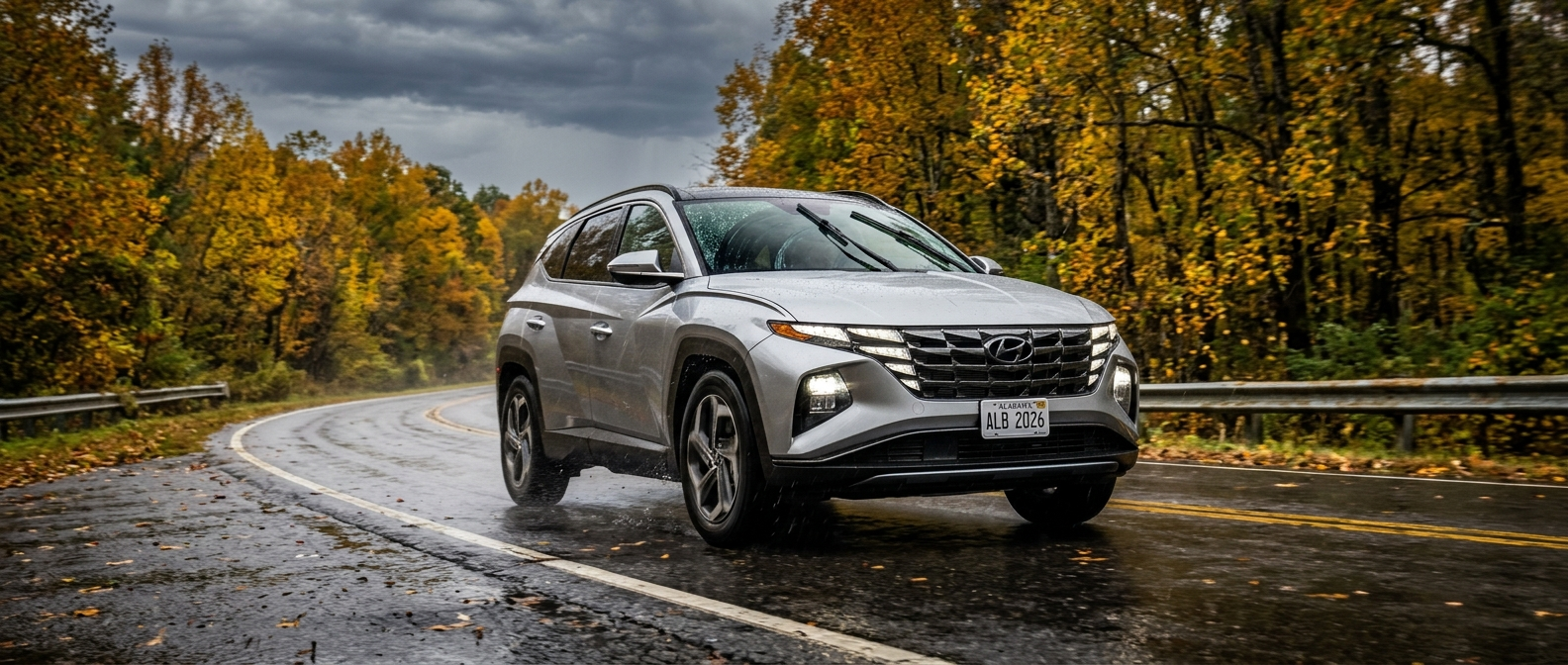
Birmingham gets around eight rainy days in October, and the number ticks upward through November. That's not a monsoon. But it's steady enough that wet asphalt, soaked leaves on the on-ramps, and spray-filled interstates ride along with your commute for weeks at a stretch. The 2026 Hyundai Tucson has features built for exactly this. The question is which ones matter most in a Southern city where the worry is consistent rain, not ice, and whether the trim you pick puts those features in your corner by default.
We walk customers through the same answer below.
Explore the 2026 Hyundai Tucson at Hallmark Hyundai Birmingham
- The 2026 Tucson ships Hyundai SmartSense across every single trim at no extra cost, so forward collision avoidance, lane keeping assist, and blind-spot warning aren't upgrades you have to hunt for.
- HTRAC AWD is the feature with the biggest wet-road payoff. On gas trims it's optional. On the Tucson Hybrid, it's standard across every trim in the lineup.
- The Tucson Hybrid's combined output of 231 horsepower and 271 lb-ft of torque (EPA-estimated 36 to 38 mpg combined) gives you all-wheel drive without the fuel economy penalty you'd expect.
- SmartSense sensors (camera plus radar) can lose performance in heavy spray. That's not a Hyundai problem; it's how these systems work across the segment. HTRAC is the backup that keeps working when the sensors can't see clearly.
- For most Birmingham commuters, an AWD Tucson Hybrid is the most complete answer to fall rain.
What Actually Matters When Choosing a Tucson Setup for Wet Roads?
Two variables separate a good rainy-day Tucson from a great one, and getting both right matters more than chasing any single feature, namely whether the traction system works mechanically or leans on sensors and whether you can add all-wheel drive without surrendering fuel economy. Everything after that is comfort and convenience.
| Feature | Best For | Key Spec | Tradeoff |
|---|---|---|---|
| Hyundai SmartSense (standard all trims) | Moderate rain, highway spacing, lane discipline | Radar + camera, FCA + LKA + BSW standard | Sensor performance can reduce in heavy spray or road debris |
| HTRAC AWD (gas trims: optional) | Wet on-ramps, leaf-covered curves, sudden grip changes | Electronically controlled multi-plate clutch, variable front/rear torque split | 2 mpg combined drop vs. FWD gas (26 vs. 28 EPA combined) |
| HTRAC AWD (Hybrid trims: standard on all) | All of the above plus high-efficiency daily commuting | AWD with EPA-estimated 36-38 mpg combined | Towing drops to 2,000 lbs vs. 2,750 lbs for gas AWD |
| Snow/AWD Lock Drive Mode | Slick on-ramps, standing water acceleration, parking garage exits after rain | Splits torque more evenly front-to-rear at lower speeds | Auto-disengages above threshold speed; not a replacement for tires |
| Rain-sensing wipers (Limited trim) | Hands-free wiper management in variable drizzle | Auto mode adjusts speed by detected moisture | Fixed-interval setting not available in Auto mode; manual Lo works as override |
HTRAC AWD Is the Decision That Changes Everything
Birmingham's fall rain isn't severe enough to make front-wheel drive a liability, yet it's consistent enough that all-wheel drive genuinely earns its keep, and the way the Tucson Hybrid hands you that traction as standard equipment is what changes the whole buying calculus. So nobody here needs to panic about grip, but AWD is worth having.
See the 2026 Hyundai Tucson Hybrid in our inventory
On the gas Tucson trims, the SE, SEL, XRT, SEL Plus, and Limited, HTRAC is an option you add on. On the Tucson Hybrid, every trim from the Blue SE through the SEL, SEL Convenience, and Limited comes with HTRAC standard, and there's no upgrade to chase. The EPA rates the Hybrid Blue SE at 38 mpg combined and the remaining Hybrid trims at 36 mpg combined. That's with all-wheel drive running. The gas AWD model, by comparison, is EPA-rated at 26 mpg combined.
The gas model makes you pick between traction and efficiency. The Hybrid hands you both.
Talk to our financing team about Tucson Hybrid options
How HTRAC works: HTRAC runs through an electronically controlled multi-plate clutch that varies torque between the front and rear axles. Under dry, normal conditions, most of the power heads to the front wheels. When traction changes (a wet on-ramp, a corner under leaf cover, standing water on an acceleration lane), the system sends power rearward on its own. The AWD Lock mode and the Snow drive-mode setting hand you extra control at lower speeds when you'd rather be deliberate about it. There's nothing to switch on.
- HTRAC uses no driver input to engage during normal traction events
- The AWD Lock mode distributes torque more evenly at low speeds for garage exits and tight corners after rain
- The Snow drive mode softens throttle response and smooths out the power delivery when grip is uncertain
- Available on every Hybrid trim; on gas trims it adds AWD capability with a modest fuel economy tradeoff
Match the Features to How You Actually Drive in Birmingham
Matching the Tucson to your real commute beats chasing every feature on the spec sheet, because a few predictable conditions show up on most Birmingham fall drives and they reward the same handful of equipment choices nearly every time you head out. None of those conditions involve ice, and none involve deep mud.
- The main corridors are downtown I-20 and I-65, not unpaved back roads
- The Tucson's 7.1 inches of ground clearance (gas SE) is enough to handle standing water in the surface dips that collect after a good rain on older city roads
- Soaked leaves on on-ramps and acceleration lanes are the most common grip surprise, not deep mud or ice
Sensor performance on wet interstates. Check your route before you weigh the safety tech, because if your drive runs mostly highway miles, SmartSense does real work. Lane Following Assist keeps the Tucson centered when the lane markings still read through the rain. Blind-Spot Collision Warning earns its place when spray from trucks squeezes your visibility on the interstate. Forward Collision-Avoidance Assist leans on radar, which holds up better in rain than a pure camera system, alongside the camera to watch the car ahead.
One thing deserves straight talk, though. In a hard downpour, the sensors get challenged, and that's no defect. These camera-and-radar systems behave this way across the compact SUV segment. The Tucson stacks a mechanical traction layer in HTRAC and an electronic assist layer in SmartSense, so you're never leaning on either one alone.
For families and commuters who genuinely want the confidence of AWD through a full two-month rainy stretch, the Tucson Hybrid's standard AWD structure is the more complete answer.
Browse available 2026 Tucson configurations at Hallmark Hyundai
Frequently Asked Questions
Does the 2026 Hyundai Tucson come with AWD standard, or do I have to pay extra for it?
On the gas Tucson trims, the SE, SEL, XRT, SEL Plus, and Limited, HTRAC AWD is available but not standard, so you select it and add it on. The Tucson Hybrid works differently. HTRAC AWD comes standard on every hybrid trim from the entry Blue SE through the Limited. So if AWD on every drive is your priority and you'd rather not weigh an upgrade decision, the Hybrid lineup takes that choice off the table and still returns EPA-estimated fuel economy of 36 to 38 mpg combined.
Do the Tucson's SmartSense safety features still work in heavy Birmingham rain?
SmartSense features like Forward Collision-Avoidance Assist and Lane Keeping Assist use a combination of radar and cameras. Radar generally holds up better in rain and spray than camera-only systems, but in a very heavy downpour the camera component can lose effectiveness. You might see a sensor-unavailable notice in sustained heavy rain, which lines up with how these systems behave across the segment and isn't unique to the Tucson. The practical answer is that HTRAC AWD runs independently of the sensors and keeps working mechanically no matter how hard it's raining. Together, SmartSense and HTRAC give you two layers of support instead of one.


