

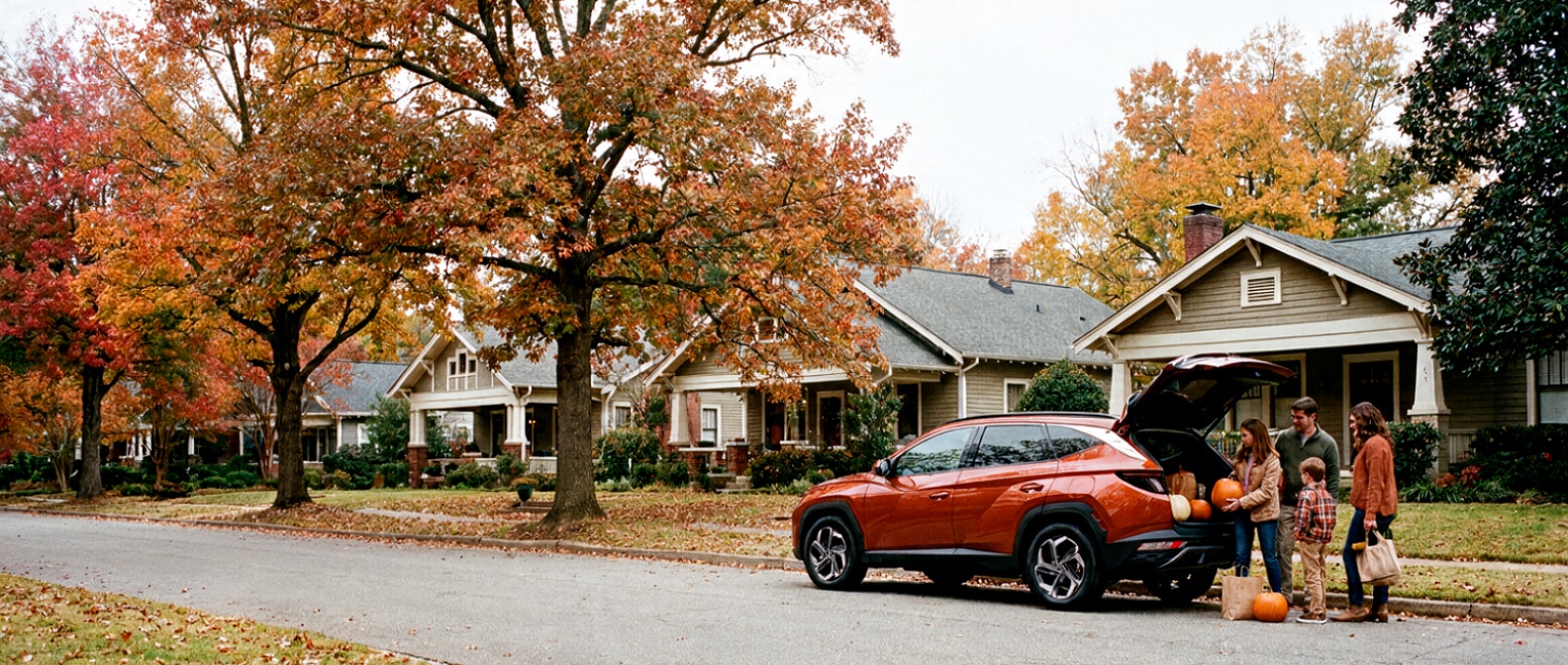
October is the first real month of fall in Homewood. The thermometer that was pushing 95 degrees in August finally backs off, overnight lows drop into the low 50s, and the commute on US-31 north toward downtown Birmingham starts to feel like a different drive. At Hallmark Hyundai Birmingham, we treat this stretch of the calendar as a natural moment for local drivers to rethink what they're driving and why. The season practically invites it.
The 2026 Hyundai Tucson comes in three distinct powertrains. There's a conventional gasoline engine, a standard Hybrid, and a Plug-In Hybrid, or PHEV. They share a body and a name, but they're genuinely different vehicles for different drivers. We'll walk you through which one fits your situation, and we'll be straight about where each one falls short.
Browse the 2026 Hyundai Tucson on our lot
- Gas Tucson (FWD): The EPA rates it at 28 mpg combined. Lowest entry cost, simple ownership, best pick if you want the Tucson with no extra complexity.
- Tucson Hybrid: EPA-rated 38 mpg combined (Blue SE) or 36-37 mpg combined (SEL and above). All-wheel drive comes standard on every hybrid trim. The sweet spot for most Homewood commuters doing stop-and-go miles on US-31 and I-65.
- Tucson PHEV: EPA-rated 77 MPGe combined in electric mode, 32 miles of electric-only range. It only makes financial sense if you have (or will install) a Level 2 home charger. Without one, you're paying more for a capability you won't use.
How Do the Three Tucsons Actually Compare?
All three Tucsons ride on the same platform, so the split really comes down to how they make power and what that does at the pump, with the gas model keeping things simple, the Hybrid adding an electric motor for stop-and-go efficiency, and the PHEV layering in 32 miles of plug-in range for anyone who's set up to charge at home.
| Gas (FWD) | Hybrid (AWD) | PHEV (AWD) | |
|---|---|---|---|
| EPA City MPG | 25 | 38 (Blue SE) / 36 (SEL+) | 35 (gas mode) |
| EPA Hwy MPG | 33 | 38 (Blue SE) / 37 (SEL+) | 35 (gas mode) |
| EPA Combined MPG | 28 | 38 / 36 | 77 MPGe (EV) |
| EV Range | None | None | 32 miles |
| Horsepower | 187 hp | 231 hp | 261 hp |
| Torque | 178 lb-ft | 271 lb-ft | 271 lb-ft |
| Drivetrain | FWD standard / AWD available | AWD standard | AWD standard |
| Transmission | 8-speed automatic | 6-speed automatic | 6-speed automatic |
| Best For | Simple, low-cost daily driving | Homewood stop-and-go commuters | Short-range electric commuters with a home charger |
The gas Tucson uses a 2.5-liter four-cylinder producing 187 horsepower and 178 lb-ft of torque, paired with an eight-speed automatic. Step up to the Hybrid and you get a turbocharged 1.6-liter four paired with an electric motor for 231 combined horsepower and 271 lb-ft of torque. The PHEV wrings 261 horsepower from a similar layout and adds a 32-mile all-electric operating range. Both electrified variants run a 6-speed automatic rather than a CVT, which keeps the feel closer to what you're used to.
See the 2026 Tucson Hybrid in inventory
Why Does October in Homewood Change the Calculus?
October changes the math here, because the weather that defines a Birmingham fall maps almost perfectly onto what each powertrain does best, and it's the kind of local context a generic Tucson review tends to skip when it treats every commute as if it happens in the same climate.
Birmingham sits at the leading edge of what climate data shows is a two-stage fall. The first half of October stays warm, with highs still reaching the upper 70s and low 80s along Lakeshore Parkway, followed by a real cool-down as the month ends and overnight lows dropping toward the low 40s. The humidity that robbed the summer of comfort is mostly gone. It's pleasant driving weather, and for many Homewood households it's the first time all year they're thinking clearly about what their vehicle costs to run day to day.
The Hybrid fits a Homewood commute for one spec-level reason. Its electric motor recovers energy under braking (regenerative braking) and feeds it back into acceleration, and you'll feel that assist most in traffic.
US-31 through Homewood is a stop-and-go corridor, and so is the I-65 merge into Birmingham at morning rush. That deceleration-then-acceleration pattern is exactly where hybrid technology earns its keep. The EPA rates the Hybrid at 38 mpg combined for the Blue SE trim and 36-37 mpg for the rest of the lineup, and that's a meaningful improvement over the 28 mpg combined figure for the gas FWD.
The October temperature range matters for the PHEV in particular. Lithium-ion battery efficiency drops in cold temperatures, and below about 40 degrees Fahrenheit that efficiency begins to taper. October in Homewood sits right at the warm edge of that threshold, which makes October through November the best window of the year to evaluate what 32 miles of EV range means for your commute before winter trims that figure. If your round-trip daily drive along US-31 and the Shades Creek Greenway corridor is under 30 miles and you can charge overnight at Level 2, the PHEV argument is legitimate. If that combination doesn't describe you, the standard Hybrid is the smarter move.
Prefer something smaller? The Hyundai Kona is worth a look too
Pros and Cons of Each Powertrain
| Pros | Cons |
|---|---|
| Gas Tucson | |
| Simplest ownership and lowest up-front cost | Lower EPA fuel economy at 28 mpg combined |
| AWD available if you want it (not standard) | No torque boost from an electric motor |
| Familiar 8-speed automatic feel | Fuel costs add up on longer Birmingham-area commutes |
| Hybrid | |
| EPA-rated 38 mpg combined (Blue SE) saves real fuel on stop-and-go routes | Costs more than the base gas model |
| AWD is standard across every trim | Slightly smaller fuel tank (13.7 gallons vs. 14.3 gallons in the gas model) |
| 231 hp / 271 lb-ft means it actually feels quicker than the gas version | Not plug-in capable; you can't run on electricity alone |
| PHEV | |
| 32 miles of all-electric range covers most Homewood daily commutes without gasoline | Requires a Level 2 home charger to make the economics work |
| 261 hp makes it the strongest Tucson | No DC fast charging. Level 2 is your fastest option |
| EPA 77 MPGe in electric mode | Higher entry cost; if you rarely charge, you're paying for range you don't use |
Which Tucson Makes Sense for Your Situation?
The right Tucson comes down to two things, how you drive and what charging you have at home, so the gas model wins for simple low-cost miles, the Hybrid wins for anyone fighting Birmingham traffic, and the PHEV wins only when a short commute pairs with a Level 2 charger you'll actually use.
Choose the gas Tucson if you want the most straightforward version of a well-equipped compact SUV and you're not trying to optimize for fuel costs. The EPA rates FWD models at 25 city / 33 highway. If you mostly do highway miles on I-65 rather than urban stop-and-go, the efficiency gap between gas and Hybrid narrows considerably, because regenerative braking captures less energy at consistent highway speeds. The 2.5-liter engine and 8-speed automatic are plenty capable.
Choose the Tucson Hybrid if you commute into Birmingham with any regularity. US-31 and I-65 are stop-and-go enough that the hybrid system earns its efficiency advantage almost every morning. AWD comes standard, which means you get all-weather traction without a trim-level decision. The 231-horsepower output makes this variant feel more responsive than the gas model. Keep it for several years and the fuel savings tend to close the up-front gap. The tradeoff is real. You'll pay more up front.
Choose the PHEV if and only if your daily round trip is reliably under 32 miles and you can charge at Level 2 speed at home, or at work. Homewood to downtown Birmingham and back is roughly 8 to 10 miles round trip. For a driver in that situation, the PHEV can cover most weekday driving on electricity alone. The 32-mile electric range doesn't accommodate a trip to Tuscaloosa and back, but it handles a Homewood work commute with range to spare. Without the charger, the PHEV is a more expensive Hybrid with a heavier battery pack, and a purchase that doesn't match your infrastructure turns into a frustration at every fill-up. We say that plainly.
View current Tucson inventory at Hallmark Hyundai Birmingham
Frequently Asked Questions
Does the 2026 Hyundai Tucson Hybrid get worse fuel economy in Alabama's heat or cold?
The Tucson Hybrid's EPA-estimated 38 mpg combined (Blue SE AWD) is measured under standard test conditions. In real-world Alabama driving, October's moderate temperatures (average highs in the mid-70s, lows in the low 50s) actually represent near-optimal conditions for the hybrid system. Extreme summer heat can increase cabin cooling loads, which pulls on the electrical system. Deep winter cold (sustained temperatures below 40 degrees Fahrenheit) reduces battery efficiency and increases cold-start combustion engine use, which can pull real-world results below the EPA estimate. October sits in the sweet spot between both extremes, meaning drivers who test-drive or purchase a Tucson Hybrid this month are likely to see efficiency close to the EPA estimate during their first weeks of ownership.
Is the Tucson PHEV worth it without a home charger in Birmingham?
For most Homewood and Birmingham-area drivers, no. The Tucson PHEV's 32-mile all-electric range only pays off economically if you're regularly charging the 13.8 kWh battery at Level 2 speed (roughly a 2-hour full charge). Without overnight Level 2 charging at home, the PHEV operates primarily as a conventional hybrid on its gas engine, with the EPA rating of 35 mpg combined in that mode. The standard Tucson Hybrid reaches 36-38 mpg combined at a lower up-front cost and with no infrastructure requirement. If you're considering the PHEV but don't yet have a home charger, we'd suggest pricing out a Level 2 installation alongside the vehicle before deciding, the combination can be practical, but the charger is genuinely part of the purchase.


