


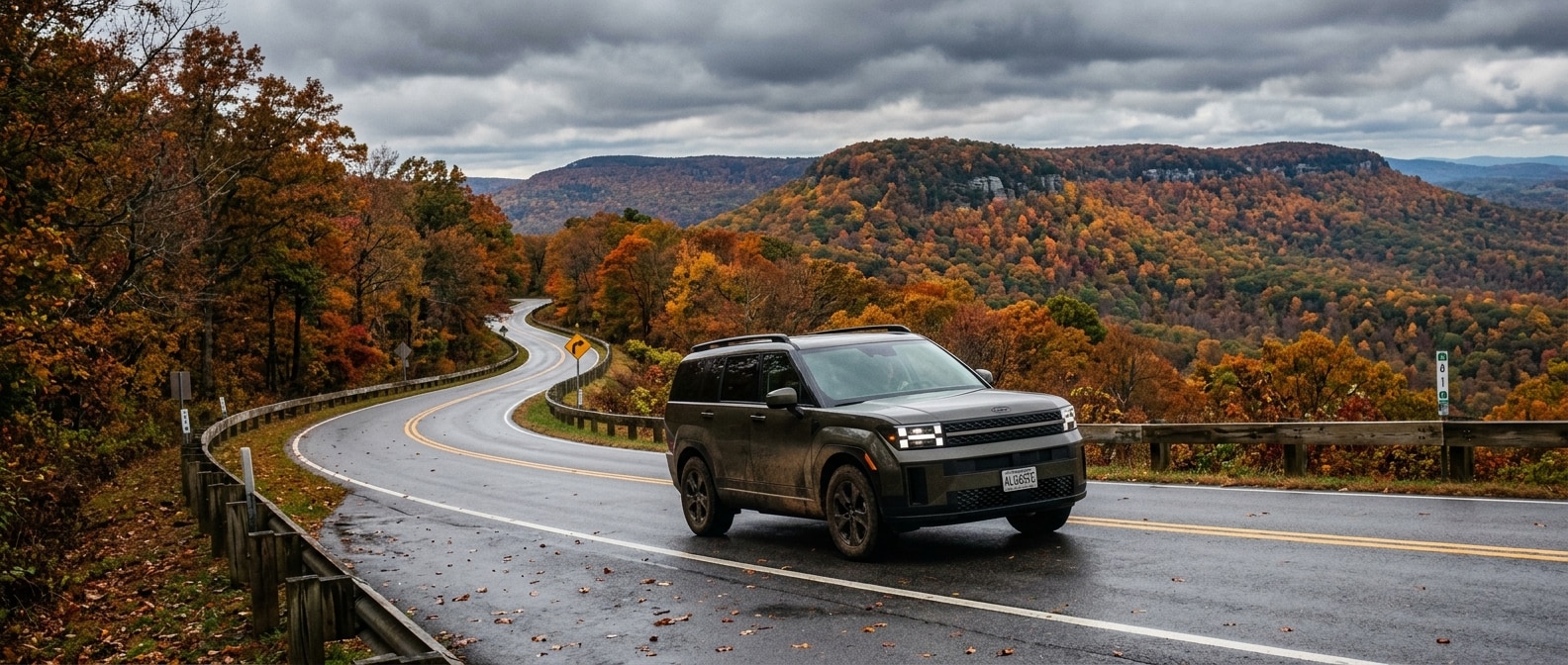
Drive SR-117 down from Mentone into Valley Head once and you'll already know the answer in your gut. That descent drops nearly 800 vertical feet in a handful of miles, on a road Wikipedia's own highway records describe as "slightly mountainous terrain" before the understatement kicks in. Nobody's really asking whether AWD sounds appealing on a mountain road. The question worth answering is whether the specific system in the Hyundai Santa Fe actually does something useful there, or whether you're paying for a feature that mainly shows up in marketing photography.
The short version comes down to timing. HTRAC AWD earns its keep on Lookout Mountain in fall and winter specifically, less so on a dry July afternoon, and that changes how you'd choose between the Santa Fe's FWD and AWD trims.
On a sustained mountain descent like SR-117, HTRAC's torque-vectoring calibration redistributes power before wheelspin starts (that pre-emptive response is what separates it from older reactive AWD systems), and it matters most when leaf litter, morning moisture, or light ice are part of the picture.
The Santa Fe Hybrid brings HTRAC AWD as standard equipment on every trim, which is worth noting before you start comparing trims.
How Does HTRAC AWD Actually Work?
HTRAC earns its money by reading road conditions before the wheels ever slip, and that's exactly what you want on a descent like SR-117, even if the same system stays quiet and essentially invisible on a flat dry commute across Birmingham most days of the year. Most all-wheel-drive systems are reactive instead. They sense wheelspin after it starts, then shift torque rearward to compensate. That reaction takes time, measured in fractions of a second, but on a wet or leaf-covered switchback, fractions of a second matter. HTRAC works differently.
| Feature | FWD (Santa Fe) | HTRAC AWD (Santa Fe) | HTRAC AWD (Santa Fe Hybrid) |
|---|---|---|---|
| Torque distribution | Front wheels only | Up to 50% to rear axle | Up to 50% to rear axle, standard on all trims |
| AWD engagement | Not available | Electronic, pre-emptive torque-vectoring | Electronic, pre-emptive torque-vectoring |
| Engine | 2.5L turbo, 277 hp | 2.5L turbo, 277 hp | 1.6L turbo + motor, 226 hp combined |
| EPA fuel economy (est.) | ~25 city / 28 hwy | ~24 city / 27 hwy | ~33 city / 30 hwy (EPA estimate) |
| Towing capacity | 2,000 lbs | Up to 3,500 lbs | 1,650 lbs |
| Best for Lookout Mountain | Dry-season weekend drives | Year-round, including fall/winter descents | Year-round, efficiency-focused drivers |
Hyundai's HTRAC system uses steering angle sensors, throttle position, and individual wheel speed data to anticipate (rather than react to) traction loss. The system continuously monitors those inputs and preloads the rear axle when the algorithm reads a low-traction scenario, say a tight corner combined with light throttle, a sustained descent, or a surface with variable grip. On the SR-117 run from Mentone down to Valley Head, that kind of sustained downhill twisting is exactly what triggers the pre-emptive response.
The tradeoff is real enough. On a flat, dry Birmingham commute, that rear-axle engagement is essentially invisible. FWD is lighter, a bit more fuel-efficient, and capable on the city driving that makes up most of your miles. You won't feel the difference.
Which One Do You Actually Need for Mentone and Lookout Mountain?
Which one you actually need comes down to when you drive it as much as where you drive it, so lean AWD if your fall and winter runs up the mountain matter and stay with FWD if you're mostly a fair-weather visitor to the ridge. Mentone sits atop Lookout Mountain at an elevation of 1,686 feet. The town on the valley floor (Valley Head) sits at roughly 1,000 feet.
SR-117 connects them through terrain that ALDOT's own route descriptions call narrow and twisting. Picture a two-lane road with real corners rather than a gentle highway pass.
The practical split works out like this.
Choose FWD if you make this run predominantly in summer and early fall on dry pavement, and you want the best day-to-day fuel economy from the 2.5L turbo. The Santa Fe FWD is not a fragile vehicle. It's a capable mid-size SUV that handles the Lookout Mountain route without drama in good conditions.
Choose HTRAC AWD if you plan to make this drive in late October through February, when morning moisture, leaf cover, and the occasional ice patch are realistic. The 800-foot grade is sustained enough that a pre-emptive AWD system provides genuine reassurance (not just psychological comfort) on a surface you didn't expect to be slick. The towing capacity jump to 3,500 lbs is also relevant if you're hauling a trailer to Little River Canyon for a kayaking weekend. Browse our current Santa Fe inventory to see which AWD trims we have in stock.
Choose the Santa Fe Hybrid with HTRAC if you're watching fuel costs and want AWD standard without having to hunt for a specific trim. The EPA estimates the Santa Fe Hybrid at approximately 33 city / 30 highway. The gap from the turbocharged non-hybrid's ~24/27 with AWD is meaningful. The tradeoff is towing capacity, which drops to 1,650 lbs, and the combined 226 horsepower feels a touch softer on a sustained climb than the 277-hp turbo. Our team finds the Hybrid's torque character genuinely pleasant on winding roads because the electric motor fills in low-end response right away, even if the peak number is lower. We also carry Santa Fe and Santa Fe Hybrid options for buyers who want this capability with a shorter wait time.
Terrain Terms Worth Knowing
Three terms come up over and over when you research AWD systems, and they're worth pinning down because the marketing language tends to blur them, especially the difference between a system that reacts to slip and one that anticipates it before it happens. Read the table before a salesperson (ours included) starts using them loosely.
| Term | What It Actually Means |
|---|---|
| Torque vectoring | Directing more torque to specific wheels based on driving conditions, not just front/rear split |
| Pre-emptive AWD | System engages before wheelspin occurs, using sensor data to anticipate low-traction situations |
| Reactive AWD | System transfers power after wheelspin is detected (the older standard approach) |
| Torque split | The percentage ratio of power sent to front vs. rear axle; HTRAC allows up to 50/50 |
What This Means for Your Next Vehicle Decision
What this means for your decision is that the Santa Fe's AWD pays off if your calendar includes real cold-season mountain runs, and it mostly sleeps the rest of the year, so match the trim to how you'll actually use it. The SR-117 descent from Mentone sits only about 90 minutes from downtown Birmingham on I-59. The drive is close enough to run several times a year without much planning, weather permitting, whether that's fall color in October, summer camp weekends, or Little River Canyon day trips from the Mentone side. If that pattern sounds like yours, and you're making even a handful of those trips between November and February, the AWD argument for the Santa Fe holds up.
If your pattern is purely Birmingham metro commuting with the occasional summer mountain drive, FWD gives you slightly better economy and a lower starting point without giving up anything you'd notice.
The Santa Fe Hybrid threads the needle if your goal is year-round AWD confidence with the most favorable EPA fuel economy estimates in the lineup. The roughly 9 mpg EPA advantage over AWD non-hybrid is significant on a round-trip to Mentone. What you give up is towing capability and a small amount of upper-end power.
We can walk you through the current trim options in person and tell you exactly what we have on the lot. That conversation takes about ten minutes and saves you from choosing a trim you'll second-guess every October. Explore financing options to see what fits your budget alongside the trim you actually want.
Frequently Asked Questions
Is the Hyundai Santa Fe's HTRAC AWD system the same as 4WD?
No, and the difference is practically significant for a vehicle like the Santa Fe. HTRAC is an electronically controlled all-wheel-drive system built on a unibody crossover platform. Traditional 4WD typically involves a transfer case, locking differentials, and is designed for off-road or low-speed torque applications. HTRAC is optimized for on-road traction management (variable torque split, continuous sensor monitoring, and pre-emptive engagement). It's the right system for what most Birmingham-area drivers actually do: highway driving, wet-road commutes, and mountain routes like Lookout Mountain. It was not designed for, and is not suitable for, serious off-road use.
Does the Santa Fe Hybrid come with AWD standard, or is it an option?
The Santa Fe Hybrid comes with HTRAC AWD standard on every trim level. That's a meaningful distinction from the non-hybrid Santa Fe, where AWD is an available upgrade depending on trim. For buyers who want AWD without having to cross-shop trims, the Hybrid removes that variable entirely. The tradeoff, as noted above, is a lower towing capacity compared to the AWD non-hybrid.
Categories:
Social


