


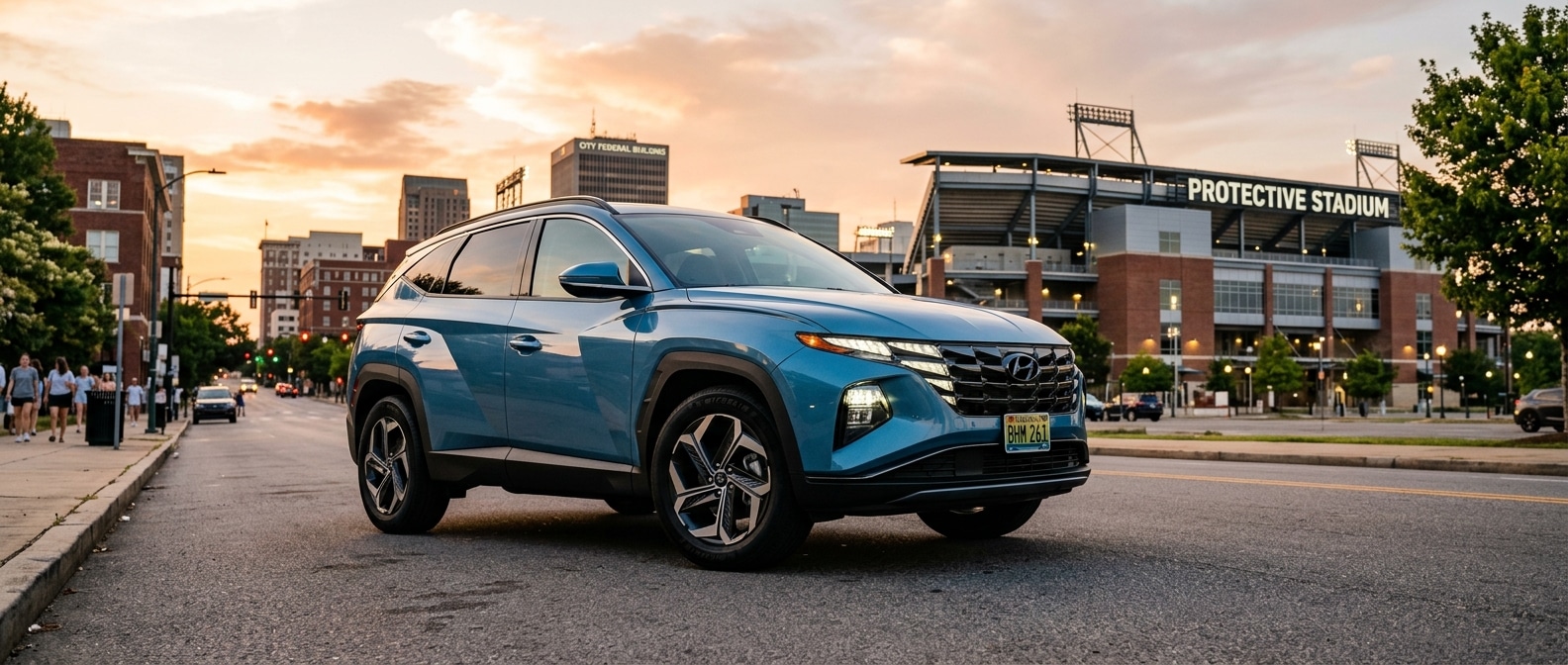
Football season in Birmingham doesn't just fill the seats at Protective Stadium and Legion Field. It fills the roads. When you're driving downtown for a UAB Blazers game or lining up for the Magic City Classic on October 31, you already know what that traffic looks like. Slow-roll on I-65, stoplight-to-stoplight on 22nd Street, then a long idle while the lots fill. That pattern matters for your Hyundai in a specific way, and it's easy to miss until you're overdue on a service you thought was months away.
The variable that decides which services you need before a game-day trip isn't your mileage since the last oil change. What matters more is how those miles happened. Hyundai's factory maintenance schedule splits into two tracks, a normal schedule and a severe schedule. The severe track shortens key intervals by a real margin. Knowing which track you're actually on is the most useful thing you can read before your next home game.
Schedule your pre-season service check online with our team and we'll tell you exactly where you stand.
The short version
- If your Birmingham driving mixes short city trips with game-day congestion, you likely qualify for Hyundai's severe driving schedule, which shortens oil changes from 7,500 miles to 5,000 miles.
- Tire rotation every 7,500 miles is non-negotiable for AWD models; a tread gap over 2/32 inch between axles stresses the coupling.
- The Tucson and Tucson Hybrid both call for 0W-20 full synthetic; the Palisade's 3.8L V6 specifies 5W-30 full synthetic. Wrong viscosity is not a minor issue.
- Brake fluid is due every 30,000 miles or 2 years, whichever comes first. Two-year owners often miss this one.
- Tucson Hybrid and Palisade Hybrid owners have an additional battery cooling system inspection at 30,000 miles.
What Actually Matters When Choosing Which Services to Prioritize?
Your driving pattern matters more than your mileage number, and the gap between Hyundai's two factory tracks isn't a minor tweak, so the checklist that fits you depends on how your Hyundai spends its week rather than the number on the odometer. Under the severe schedule, oil change intervals shorten from 7,500 miles to 5,000 miles. Tire rotation stays at 7,500 but matters more, because the vehicle is working harder in traffic. The table below lays out how the key services compare so you can decide which checklist applies to you.
| Service | Normal Schedule | Severe Schedule | Best For | Key Spec | Tradeoff |
|---|---|---|---|---|---|
| Oil and filter change | Every 7,500 mi or 12 months | Every 5,000 mi or 6 months | Mostly highway or mixed driving | 0W-20 full synthetic (4-cyl/hybrid); 5W-30 full synthetic (Palisade 3.8L V6) | Missing the severe interval shortens engine life over time |
| Tire rotation | Every 7,500 mi | Every 7,500 mi (more urgent) | All models; critical for AWD | Tread depth gap between axles must stay under 2/32 inch | On AWD models, uneven wear stresses the drivetrain coupling |
| Brake fluid flush | Every 30,000 mi or 2 years | Every 30,000 mi or 2 years | Vehicles 2+ years old | Brake fluid absorbs moisture over time, reducing performance | Often skipped by time; mileage-only thinking misses it |
| Multi-point inspection | Every 7,500 mi | Every 7,500 mi | All models | 20+ system check (belts, battery, fluids, brake pads, wiper blades) | No inspection means no early warning on wear items |
| Hybrid battery cooling | N/A (gas models) | N/A (gas models) | Tucson Hybrid, Palisade Hybrid | Inspection every 30,000 mi; inverter coolant at 60,000 mi | Skipping this is the easiest way to void hybrid coverage |
| 30K / 60K / 90K major service | At mileage milestone | At mileage milestone | Vehicles approaching these marks | Full fluid, filter, and drivetrain review | Most wear and repair surprises live in the gaps between these visits |
The Severe-Schedule Trigger Birmingham Drivers Actually Overlook
Stop-and-go traffic is the severe-schedule trigger that catches Birmingham drivers off guard, since Hyundai's factory definition of severe driving takes in frequent short trips under five miles, extended idling, and repeated stop-and-go in heavy congestion. Birmingham game days stack all three inside a single drive. Leave from Homewood or Hoover, sit through the 20th Street interchange on a Saturday afternoon before a UAB home game at Protective Stadium, and your engine is running in conditions that speed up oil oxidation. Heat is the mechanism. Stop-and-go generates more thermal cycling per mile than steady highway cruising, and high temperatures break down oil faster. None of that is opinion. It's chemistry.
The Tucson and Tucson Hybrid both land in the driving pattern we're describing here. Both call for 0W-20 full synthetic, and both sit squarely in severe-use territory for anyone commuting downtown regularly. The Tucson Hybrid adds a layer the gas version doesn't have. Its battery cooling system comes up for inspection at 30,000 miles, and the inverter coolant needs replacement at 60,000 miles. Miss those and you're looking at hybrid-specific wear that the standard oil-change visit won't catch.
If you're driving a Palisade to the Magic City Classic on October 31 with a full carload, the 3.8L V6 takes 5W-30 full synthetic (not 0W-20). The viscosity difference is model-specific, and it matters. Putting the wrong weight in doesn't produce an immediate symptom. It shows up later, in wear patterns and, eventually, in repair costs.
Before game-day trips, check these four things in under five minutes.
- Check oil level cold, before the trip, not after the engine has been running
- Verify tire pressure at the standard PSI listed inside your driver's door jamb, not a generic number
- Top off washer fluid before a long game-day return in the dark
- Look at your tread depth visually on all four corners
Match the Service to How You Actually Drive to the Game
Your baseline driving decides the track, not the odometer reading, because a genuinely mixed life of mostly highway miles with a few stop-and-go game-day runs on top holds up fine on the normal 7,500-mile oil interval, while the severe schedule exists for drivers whose daily baseline is already city-stop driving. If you're commuting downtown, running short errands, and then adding a Legion Field parking-lot wait, you're on the severe track. That combination is what matters.
The Birmingham Bowl at Protective Stadium and the Magic City Classic both throw the kind of sustained, miles-without-moving congestion that counts. Fall in Birmingham means game after game from September through late November, which stacks up as three months of concentrated severe-use conditions for anyone who's in the stands regularly.
The Palisade Hybrid stands out as the practical pick for families making that trip several times. The hybrid powertrain recovers energy during exactly the braking-heavy stop-and-go that defines game day, and the normal 7,500-mile oil interval applies to the hybrid models under moderate use. But the added maintenance items, the battery cooling and inverter coolant, mean the hybrid needs a certified tech who knows those systems. A generic quick-lube isn't the right place for that inspection. We handle it the same visit.
For 2026 Hyundai AWD models, a tread depth difference greater than 2/32 inch between front and rear tires stresses the all-wheel-drive coupling, according to the factory service specification. Tire rotation at every 7,500-mile interval is what keeps that gap in check.
Check the interval math before the weekend gets here. If you're within 1,000 miles of any service interval and game day is coming, come in first. A vehicle that heads into a game-day trip slightly overdue on rotation, or slightly past the two-year brake fluid mark, isn't about to quit on you. But it's running on a smaller margin.
Schedule Your Pre-Game Service Check
Frequently Asked Questions
Does stop-and-go game-day traffic qualify as severe driving for my Hyundai?
Yes. Hyundai's factory definition of severe driving conditions includes repeated stop-and-go in heavy congestion, frequent short trips, and extended idling. A game-day drive that mixes city surface streets with interstate crawl qualifies. Under the severe schedule, the oil change interval shortens to every 5,000 miles or six months, whichever comes first, rather than the standard 7,500-mile interval on the normal track. If your daily commute already runs heavy on city stop-and-go, you're likely on the severe schedule year-round even before you add game days.
Do hybrid Hyundais like the Tucson Hybrid or Palisade Hybrid need different maintenance items beyond a standard oil change?
They do. Beyond the standard oil change, which is 0W-20 full synthetic for the Tucson Hybrid at every 7,500 miles under normal conditions, the Tucson Hybrid and Palisade Hybrid require a battery cooling system inspection every 30,000 miles and an inverter coolant replacement at 60,000 miles. These items don't show up on the standard oil-change reminder, and they need a certified Hyundai technician who knows the hybrid-specific systems. Staying on top of those intervals is how you protect the hybrid powertrain over the long haul.
Categories:
Social


