


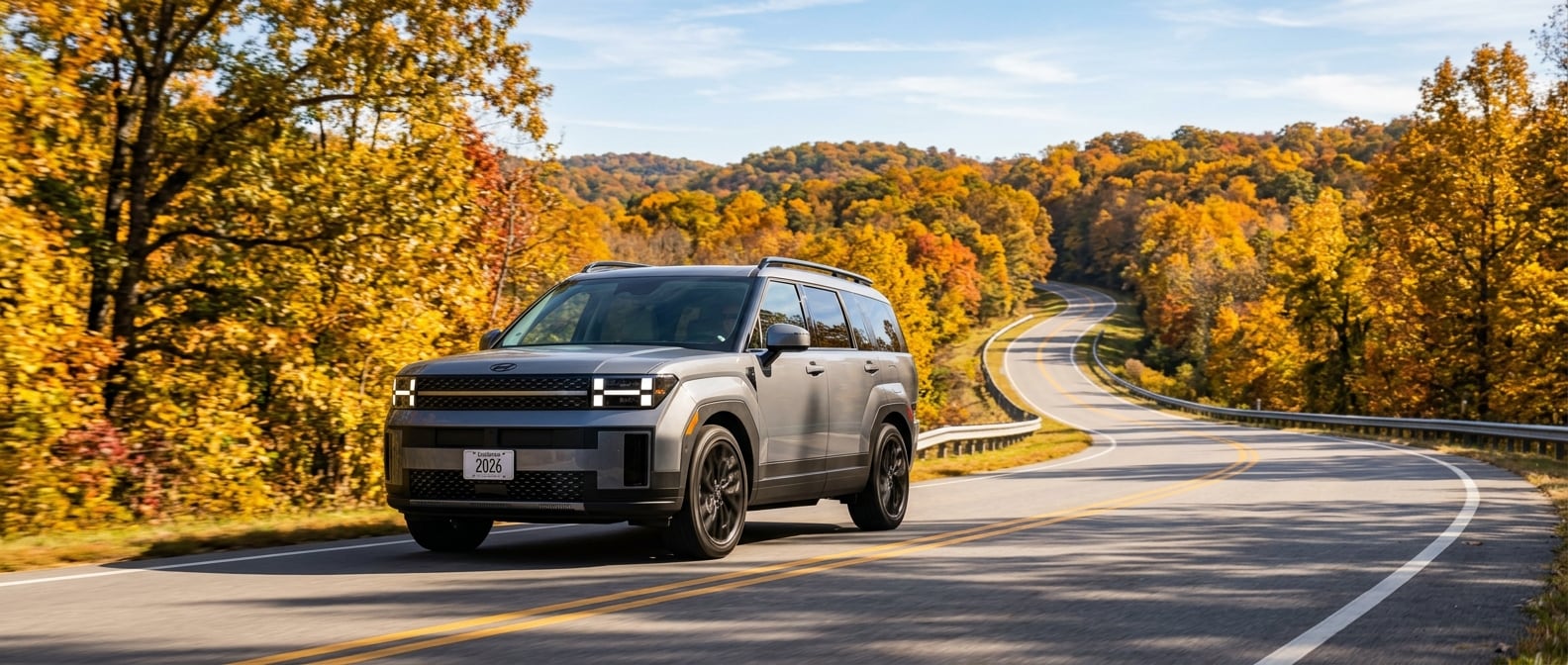
If you're making the US-280 run from Birmingham to Auburn with any regularity, the most practical question you'll face when shopping a 2026 Hyundai Santa Fe isn't "which color." It comes down to which powertrain. Two completely different engines live under the same sheet metal, and they serve genuinely different drivers.
The gas Santa Fe wins when you need towing muscle or serious passing power. The Santa Fe Hybrid wins when you're logging US-280 miles and want the EPA's 34 mpg combined in AWD form, not the gas model's 23. Which one is yours? Your usage decides it.
Browse the 2026 Santa Fe on our lot to see what's in stock right now.
The short version
- The 2026 Santa Fe gas (AWD) is EPA-rated 23 mpg combined; the Santa Fe Hybrid (AWD) is EPA-rated 34 mpg combined (a meaningful gap on a regular Birmingham-Auburn commute)
- Gas XRT trims tow up to 4,500 lbs with a trailer brake package; Hybrid trims are rated to 2,000 lbs max
- Both share the same three-row cabin: up to 79.6 cubic feet of cargo, 7-passenger capacity on most trims
- Pick gas if you tow a boat to Lake Martin or pull a camper; pick hybrid if you're logging Auburn game-day miles repeatedly
- The XRT's standard 8.3 inches of ground clearance is an adventure upgrade; the Hybrid's edge is fuel economy, not off-pavement capability
What's the Difference Between These Two Powertrains?
These two Santa Fes share one body but almost nothing mechanical, so the gas model trades fuel economy for muscle while the Hybrid trades muscle for miles per gallon, and the engine bay is the only place that difference lives. The 2026 Santa Fe gas model runs a 2.5-liter turbocharged four-cylinder making 277 horsepower and 311 lb-ft of torque, paired with a new 8-speed automatic transmission. The Santa Fe Hybrid pairs a 1.6-liter turbocharged four-cylinder with an electric motor for 231 combined horsepower and 271 lb-ft of combined torque, through a 6-speed automatic. That 46-horsepower gap is real, and you'll feel it on a hard merge or a highway pass at speed.
What you won't notice is any meaningful difference in cargo room, seating, or tech. Both are full three-row SUVs. Hyundai carries 14.6 cubic feet of cargo behind the third row, 40.5 cubic feet with the third row folded, and a full 79.6 cubic feet when you fold both rows flat. The third row comes standard on every 2026 trim, XRT included.
| Decision Factor | 2026 Santa Fe (Gas) | 2026 Santa Fe Hybrid |
|---|---|---|
| Horsepower | 277 hp | 231 hp combined |
| Torque | 311 lb-ft | 271 lb-ft combined |
| AWD Fuel Economy (EPA est.) | 20 city / 28 hwy / 23 combined | 35 city / 34 hwy / 34 combined |
| Max Towing (with trailer brakes) | 4,500 lbs (XRT) / 3,500 lbs (other AWD trims) | 2,000 lbs |
| XRT Ground Clearance | 8.3 inches (standard on XRT) | N/A (XRT trim is gas only) |
| Cargo Max (all rows folded) | 79.6 cu ft | 79.6 cu ft |
| Third-Row Seating | Standard all trims | Standard all trims |
| Transmission | 8-speed automatic | 6-speed automatic |
One factor settles it. If you tow anything over 2,000 lbs, you need the gas model. If you don't tow, the Hybrid's EPA-estimated 34 mpg combined in AWD form is hard to argue with on a highway-heavy Alabama drive.
Does the Fuel Economy Gap Actually Matter on US-280?
Yes, the fuel-economy gap matters on this route, and it matters most in the stop-and-go through town while shrinking a little on the wide-open cruising stretches, so the Hybrid's edge depends on how much of your drive is steady highway versus traffic. US-280 between Birmingham and Auburn runs roughly 100 miles of rolling, divided four-lane highway with significant stop-and-go as you push through Sylacauga and drop into Auburn on game weekends. A drive profile like that plays right into the Hybrid's strengths.
See Santa Fe Hybrid inventory and check available trim levels.
The EPA rates the 2026 Santa Fe Hybrid AWD at 35 city / 34 highway / 34 combined mpg. The standard gas AWD model comes in at 20 city / 28 highway / 23 combined. On a typical Birmingham-to-Auburn round trip of about 200 miles, that gap shows up at the pump. Hybrid drivetrains recapture energy under deceleration through regenerative braking, which means the slower stretch through Alexander City (where US-280 tightens and traffic bunches near the Lake Martin turnoff) actually works in the Hybrid's favor rather than against it.
On steady open-highway miles at sustained speed, the Hybrid's advantage narrows against city or mixed driving. The gas model's 28 mpg highway is respectable.
Auburn's round trip is never just highway.
Space, Capability, and the Third-Row Question
Space and seating are where this choice gets easy, since both models hand you the same interior package no matter which engine you pick, and the only real split left is towing capacity and the XRT's off-pavement hardware. Every 2026 Santa Fe trim includes a third row as standard equipment. Hyundai made that change when it redesigned the Santa Fe for the 2024 model year in response to buyer demand, and the SE, SEL, XRT, and Limited trims configure for seven passengers with a second-row bench, while the Calligraphy drops to six with standard captain's chairs.
The XRT is gas-only and carries a few specifics worth knowing. Its ground clearance measures 8.3 inches, a 1.3-inch increase over the standard 7-inch clearance on non-XRT trims. It comes with HTRAC AWD standard, all-terrain tires on 18-inch dark alloy wheels, a 115-volt power outlet in the cargo area, and that higher 4,500-lb towing rating when the trailer brake package is on board. Loading a camper for a fall weekend at Cheaha State Park? The XRT is the trim to weigh. If not, it's capability you won't use.
Our take: The XRT draws people who want the AWD and the rugged look, both completely reasonable wants. The catch worth knowing is that the 4,500-lb tow rating requires the trailer brake package confirmed on the build sheet. Worth verifying before you commit.
So Which Santa Fe Should You Pick?
Which Santa Fe wins for you sorts almost entirely by how much you tow, so haulers and weekend adventurers want the gas model and steady US-280 commuters want the Hybrid, with the profiles below covering the middle ground.
Choose the 2026 Santa Fe gas model if any of these fit.
- You tow a boat, a camper, or any trailer regularly. The Hybrid's 2,000-lb limit rules it out for most trailers
- You want the XRT's standard AWD, all-terrain tires, and extra ground clearance for weekend adventures off the pavement near Cheaha State Park or the Talladega National Forest
- Raw passing power on two-lane stretches of US-280 matters to you; 277 hp vs. 231 hp is a difference you feel when you're loaded and need a confident merge
Choose the 2026 Santa Fe Hybrid if any of these fit.
- You're running Birmingham to Auburn on game days, commuting down US-280, or both. The Hybrid's EPA-estimated 34 mpg combined in AWD form makes that mileage efficient
- Your towing needs are zero or light, staying under 2,000 lbs
- You want the three-row family SUV without giving up fuel economy for the privilege
- You tend to drive mixed city-and-highway, where the hybrid system's regenerative braking delivers its biggest efficiency advantage
The Hybrid asks for one clear concession. You give up towing capacity and the XRT-specific adventure trim, and that's a genuine tradeoff, not a small one. For families who occasionally pull a trailer or want the confidence of a higher-output engine on open roads, the gas model is the better fit. For everyone running the Auburn game-day rotation, the Hybrid is the easier car to own.
Frequently Asked Questions
Does the Santa Fe Hybrid have a real third row?
Yes. Every 2026 Hyundai Santa Fe Hybrid trim includes a third row as standard equipment. Configuration varies by trim, so SE, SEL, Limited, and Calligraphy Hybrid trims all include the third row, with seating for six or seven depending on whether second-row captain's chairs or a bench are installed. Cargo figures stay the same across the lineup at 14.6 cubic feet behind the third row, growing to 40.5 cubic feet with the third row folded and 79.6 cubic feet maximum with both rear rows down.
Is the Santa Fe Hybrid slower than the gas model?
In terms of output, yes. The gas 2.5-liter turbo produces 277 horsepower and 311 lb-ft of torque, while the Hybrid system delivers 231 combined horsepower and 271 lb-ft of combined torque. That gap shows up most during hard acceleration from a stop or when passing at highway speed. For everyday driving on US-280, merges and moderate grades included, the Hybrid's output is plenty. If performance is a primary priority, the gas model is the more assertive choice.
Should I consider a different model altogether?
If the Santa Fe's third row feels snug for your family's tallest passengers, the Palisade offers more third-row legroom while keeping the three-row layout and available hybrid powertrain.
Categories:
Social


