


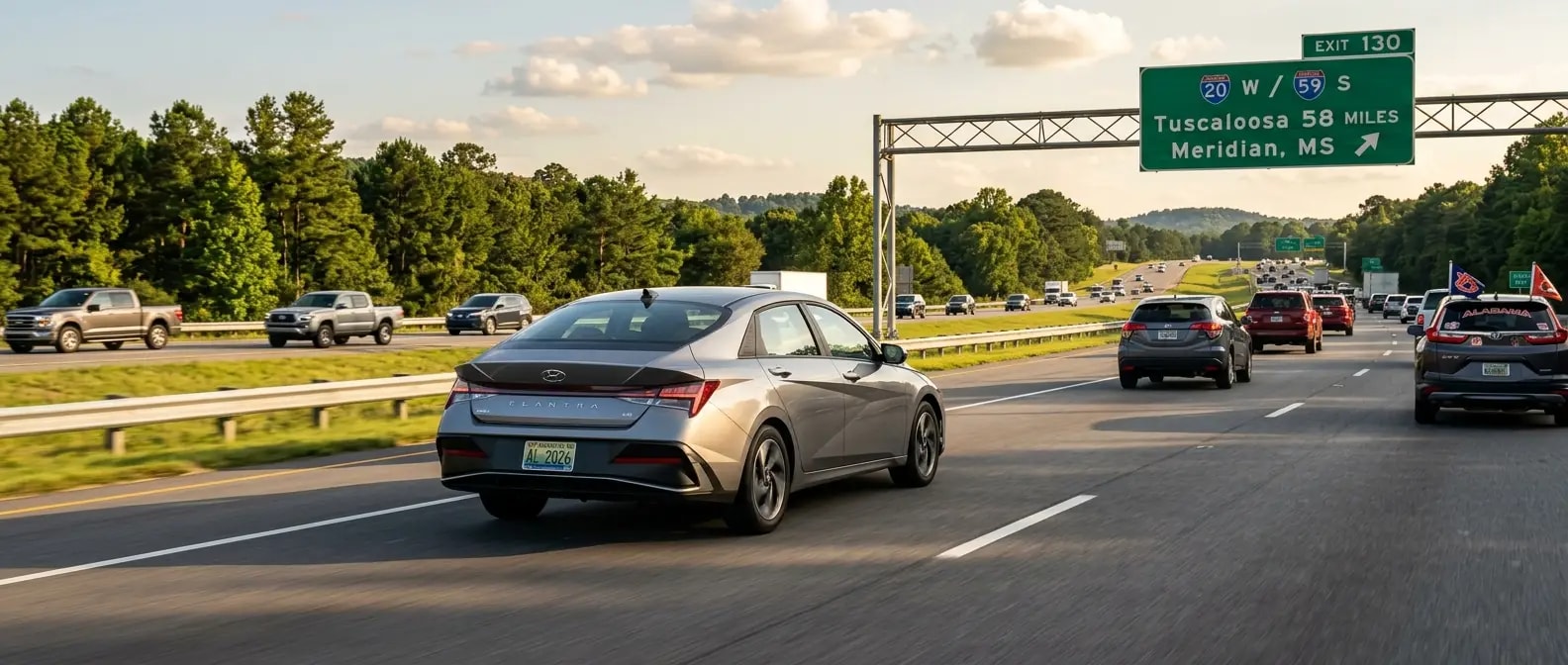
Football season in Birmingham packs I-20 and I-59 tight. If you're driving a 2026 Hyundai Elantra, you picked one of the most fuel-efficient cars for this exact kind of trip, a mix of stop-and-go city streets, compressed game-day interstate traffic, and long open stretches once you clear the metro. You already know the Elantra can handle it. What's worth checking is whether you've set the car up to actually deliver those EPA numbers when you pull out of Birmingham on a Saturday morning.
The EPA rates the 2026 Elantra SE at 40 mpg highway and 35 mpg combined, which translates to roughly 434 miles of highway-weighted range on a 12.4-gallon tank.
That's the baseline. Now let's protect it.
What Goes on the Game-Day MPG Checklist?
Eight items make up this list, and the smart move is to run through them the night before rather than the morning of, since game-day mornings tend to disappear into hunting for your jersey and getting everyone loaded up. Handle it the night before and you'll roll out easy.
- Tire pressure: Check all four cold in the driveway and match the door-jamb spec (usually 33-35 psi for the Elantra). Underinflation raises rolling resistance, one of the most consistent efficiency drains on a highway run.
- Fuel level: Top up the tank the night before. At 12.4 gallons it's genuinely smaller than what you'd find in a mid-size sedan, and you don't want to be hunting a gas station in game-day traffic on I-59 west of Birmingham.
- Engine air filter: If you haven't looked at it lately, a clogged filter makes the 2.0-liter work harder than it should. Two minutes to pull and check.
- Idle Stop & Go: Know it's active. The 2026 Elantra SE comes standard with Idle Stop & Go, which shuts the engine off at longer red lights and restarts it when you lift off the brake. On game-day surface streets in Birmingham it does real work. Don't be startled, let it run.
- A/C setting: Run the A/C on "Auto" and set your temperature instead of maxing the blower. A September afternoon in Alabama demands A/C. Running it flat out continuously pulls more from the engine than a steady set-temperature mode does.
- Trip computer: Reset before you leave. The 2026 Elantra's 10.25-inch digital display shows a real-time efficiency readout. Resetting gives you an accurate picture of this specific drive, not a cumulative average from three weeks of school pickup runs.
- Cruise control: Plan to use it. Once you're clear of Birmingham on I-20 or I-59 and traffic opens up, set cruise. The EPA highway number assumes steady speed. Inconsistent throttle on open interstate miles is where most of the gap between EPA and real-world shows up.
- Cargo: Pull the extra gear out of the trunk if it's been sitting there. The Elantra's trunk is 14.2 cubic feet, plenty of room for stuff that doesn't need to ride along to a football game, and every extra pound you haul costs efficiency at highway speeds.
Why Each Item Actually Matters for I-20 and I-59
Each item on that list connects to how these two corridors actually drive on a Saturday in September, which is why it's worth more than a generic checklist. The reasoning behind every step comes down to the traffic patterns and distances you'll meet between Birmingham and the stadiums.
The Birmingham-to-Tuscaloosa stretch on I-59 runs about 60 miles under normal conditions. On game day, the TideFans community notes that drive time can stretch significantly depending on kickoff and opponent. So you're likely sitting on I-59 in heavy traffic before the road opens up. The Elantra's Idle Stop & Go feature does its quiet, continuous work in exactly that phase.
The Elantra N Line uses a 1.6-liter turbocharged engine rated at 28 city and 35 highway mpg, lower than the base SE's numbers and a trade-off worth knowing if you're cross-shopping trims. If pure efficiency matters more than the sporting feel on this kind of trip, go with the SE or SEL and the naturally aspirated 2.0-liter.
For fans heading east on I-20 toward the Birmingham metro from Anniston or Oxford (about 55 miles out), or coming in from Atlanta (roughly 135 miles on I-20), the math still leans in the Elantra's favor. The EPA rates the 2026 Elantra SE at 40 mpg highway. At that rating, a full 12.4-gallon tank covers approximately 434 miles of predominantly highway driving without a stop. Birmingham to Atlanta round trip runs roughly 270 miles. You'll finish that round trip with fuel to spare, so you're stopping for food and merch and skipping the gas station.
Browse our current Elantra inventory to see which trims are available on the lot right now.
Worth knowing for hybrid shoppers: The 2026 Elantra Hybrid Blue is EPA-estimated at 51 city and 58 highway mpg on an 11.0-gallon tank. That runs smaller than the standard Elantra's 12.4 gallons, though the combined efficiency stretches the range longer. Being a self-charging hybrid (no plugging in), it earns the most during the game-day stop-and-go phase, since it's pulling energy back through regenerative braking.
| Item | Why It Matters on I-20 / I-59 |
|---|---|
| Tire pressure | Low pressure raises rolling resistance; consistent on long open stretches |
| Full tank the night before | Smaller 12.4-gal tank means less margin; don't start partial |
| Air filter check | Restriction makes the 2.0L work harder in sustained highway loads |
| Idle Stop & Go awareness | Handles stop-and-go game-day traffic on Birmingham surface streets |
| A/C on Auto mode | September Alabama heat is real; steady temp setting costs less than max blast |
| Cruise control use | Steady throttle is how 40 mpg hwy becomes a real number, not a brochure figure |
| Trip computer reset | Gives you an accurate read on this drive, not a cumulative average |
| Reduce trunk cargo | Weight costs efficiency; clean it out if the gear isn't needed |
Where the Elantra Is Honest With You
Where the 2026 Elantra asks something of you is the fuel tank, because 12.4 gallons sits on the smaller side for a compact sedan, and that trade-off is worth naming up front so you can plan a long away-game haul around it. Everything else on this car works in your favor.
If you're a fan making a long out-and-back to an away game (think six or seven hours each way), plan to factor in a stop. The car's efficiency means fewer stops overall, though the tank size is what it is, no way around it.
The payoff is an efficiency figure that stays competitive. The EPA's 35 mpg combined and 40 mpg highway for the SE puts it at the top of the compact sedan segment in non-hybrid form. On the kind of trips these corridors involve (Birmingham to Tuscaloosa, Birmingham toward Anniston, or even out I-20 east for an away game in Georgia), the Elantra handles it well and the tank doesn't become a limiting factor.
Explore financing options if you're thinking about making this the car you take to every home game this season.
Your Print-and-Go Recap for Game Day
Night before the game:
- Tires - check pressure, add air if needed
- Fuel - fill to full
- Air filter - quick visual check
- Cargo - clear anything out of the trunk that isn't going to the game
Morning of the game:
- Trip computer - reset before you leave the neighborhood
- Idle Stop & Go - confirm it's active (look for the indicator in the instrument cluster)
- A/C - set your temperature, use Auto mode, don't run max blower all day
- Cruise control - plan to engage it once you're clear of Birmingham traffic on the interstate
So that's it. Eight items and the car is ready to do what the EPA says it can do.
Come see us at Hallmark Hyundai Birmingham at 1424 5th Ave N and we'll walk you through any of these items on the lot.
Frequently Asked Questions
Does running the A/C hurt the Elantra's mpg on a long highway drive?
Yes, but the impact is manageable with the right setting. Running the A/C on its automatic temperature mode (where the system maintains a set cabin temperature) uses less engine load than running the blower at maximum speed continuously. On a September game day in Alabama you're going to run the A/C. Setting it at a steady temperature rather than maxing the fan is the practical way to get the efficiency you need without sweating out the drive.
Is the 2026 Elantra's fuel tank big enough for a Birmingham-to-Tuscaloosa round trip without stopping?
Yes, comfortably. The EPA rates the 2026 Elantra SE at 40 mpg highway on a 12.4-gallon tank. The Birmingham-to-Tuscaloosa corridor on I-59 is approximately 60 miles each way, so a round trip covers roughly 120 miles. That's well within a single tank even accounting for city driving, game-day traffic idling, and the surface streets near Bryant-Denny Stadium. The tank limitation matters more on longer multi-hour away-game trips; for the Tuscaloosa run it's a non-issue.
Categories:
Social


